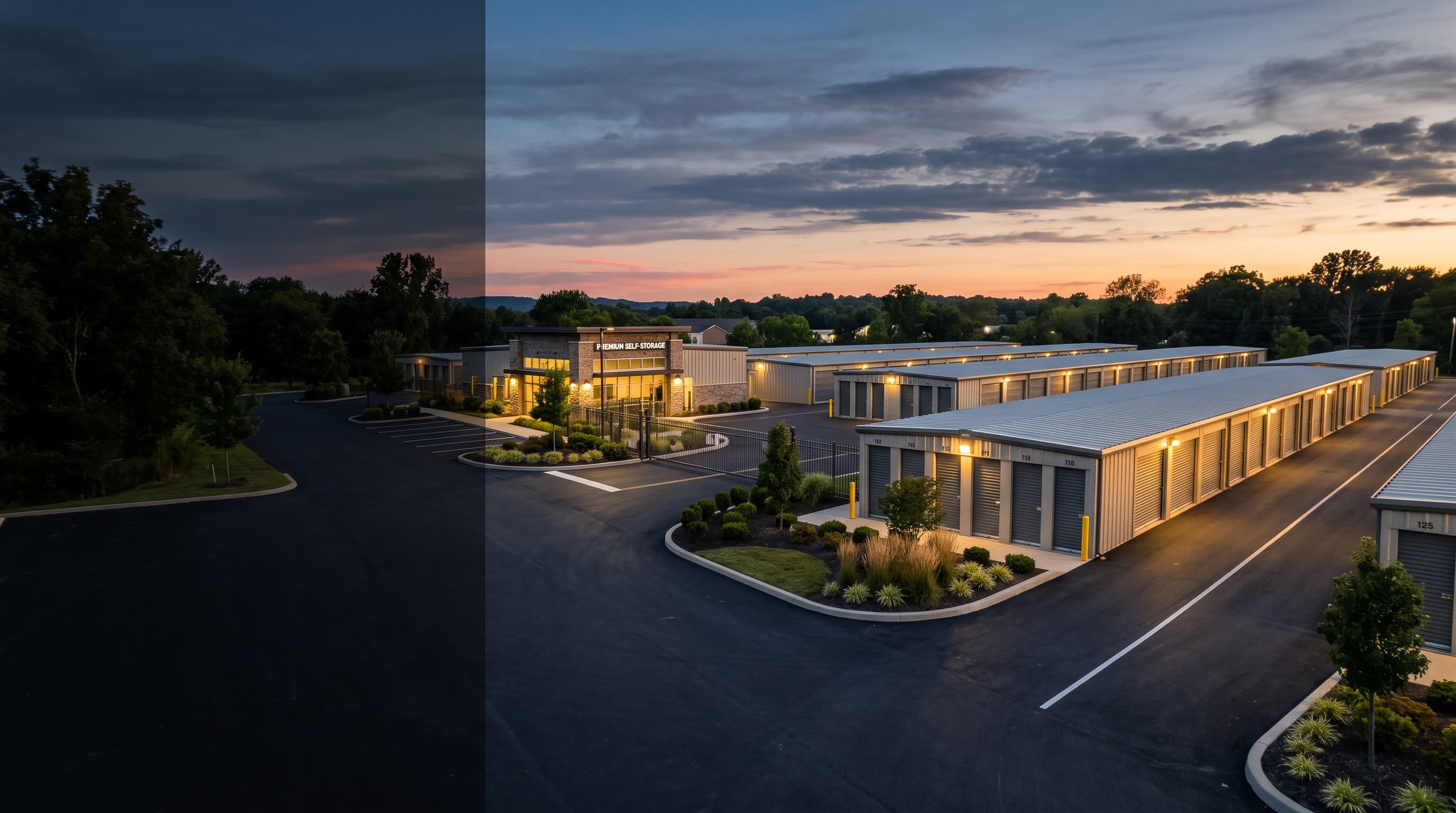
The 120-Day Problem Nobody Talks About
Every day a bank holds a distressed commercial asset on its balance sheet, that asset is quietly destroying value. Carrying costs — insurance, property taxes, maintenance, environmental monitoring, and legal fees — compound relentlessly. For a mid-size community bank holding a $3.5 million non-performing commercial loan in central Florida, a 120-day disposition cycle can erode net recovery by 8 to 14% before the property even closes.
The OCC's own guidance under 12 CFR 34.82 requires national banks to dispose of Other Real Estate Owned (OREO) “at the earliest time that prudent judgment dictates” — with a statutory outer limit of five years and extensions requiring OCC approval. That five-year ceiling is not a benchmark. It is a maximum. Yet the operational reality at most community banks is that OREO sits in institutional limbo for six to eighteen months — not because buyers don't exist, but because the workflow to find, qualify, and close them is almost entirely manual.
The problem is structural, not strategic. Standard disposition workflows involve a sequential chain of tasks — BPO ordering, environmental review coordination, title research, investor outreach, offer management, and regulatory documentation — each handed off one at a time, with days of idle time between steps. AI doesn't make each step faster. It runs them in parallel.
Why Florida Makes This Harder Than Most States
Florida is a judicial foreclosure state. That single fact adds, on average, one to three years to the foreclosure timeline before a property ever reaches OREO classification — and in complex commercial cases, Florida circuit courts have pushed timelines beyond five years. By the time a commercial asset formally hits a bank's OREO ledger, the institution has already absorbed years of legal cost and carrying exposure.
Once on the books, Florida-specific risk factors compound the disposition challenge. The state's insurance crisis has made coverage on older multifamily, hospitality, and coastal retail assets functionally uninsurable at commercially viable premiums — a direct drag on buyer underwriting and cap rate expectations. Sinkhole liability, prevalent throughout the I-4 corridor from Orlando through Tampa, triggers mandatory Phase I ESA and often Phase II investigations before institutional buyers will close. Flood zone reclassification under FEMA's Risk Rating 2.0 has materially repriced NOI projections for assets in Hillsborough, Pinellas, Orange, and Osceola counties.
Add Florida's documentary stamp tax — charged at $0.70 per $100 of consideration on deed transfers in all counties except Miami-Dade — and the transaction cost layer becomes a serious pricing variable for buyers analyzing distressed commercial paper. On a $4 million disposition, that's $28,000 in doc stamps alone, before intangible tax on any assumed or new financing. Every friction point in the deal structure lengthens the timeline and narrows the buyer pool.
What AI Actually Does in a Disposition Workflow
The phrase “AI-powered disposition” is thrown around so loosely that it has lost precision. Let me be specific about what it actually replaces.
In a traditional disposition workflow, a bank's asset manager manually orders a Broker Price Opinion, waits for delivery, reviews it internally, engages an outside broker, coordinates environmental access, waits for title search results, builds an investor list from memory or a contact database, sends individual outreach emails, tracks responses in a spreadsheet, and schedules calls — all serially. That process, even run by a competent asset manager, takes 90 to 130 days from OREO classification to signed PSA.
An AI-driven platform like REOMind.ai compresses that chain into parallel, automated workflows. The Valuation Expert Agent generates a data-reconciled AVM within hours of asset intake — cross-referencing CoStar comps, public records, flood zone status, and recent I-4 corridor sale data — rather than waiting three to five days for a manual BPO. The Investor Matcher Agent simultaneously queries a database of qualified investors by asset class, geography, capital stack preference, and acquisition threshold. The Compliance Monitor Agent cross-checks OCC OREO holding period requirements, fair housing protocols, and environmental disclosure obligations before a single document goes external.
The result is not incremental. CREx Software, which builds AI workflow platforms for institutional CRE operators, reports that purpose-built AI agents reduce manual data processing by 85% and cut analytics time by 40%. Applied to a full disposition cycle, that compression is what moves a 120-day workflow to 35 days — not a 10% efficiency gain, but a structural reengineering of the sequence.
Get the next Florida CRE report.
Cap rates, absorption, distress watch — delivered when it ships. No spam.
The Five Agents That Drive 89% Automation
The REOMind.ai platform deploys five specialized AI agents working concurrently across every active disposition. Each agent handles a discrete workflow layer, and together they produce an overall automation rate of 89% — meaning human input is reserved for judgment-dependent decisions, not process management.
| Agent | Primary Function | Automation | Manual Override |
|---|---|---|---|
| Market Analyst | Submarket comp analysis, absorption trends, pricing scenarios | 94% | 6% |
| Valuation Expert | AVM generation, distressed value adjustment, cap rate reconciliation | 96% | 4% |
| Compliance Monitor | OCC OREO rules, fair housing, environmental disclosure tracking | 92% | 8% |
| Investor Matcher | Investor qualification, outreach sequencing, offer tracking | 91% | 9% |
| Risk Assessor | Title risk, flood/sinkhole exposure, insurance marketability scoring | 82% | 18% |
The Risk Assessor Agent carries the highest manual override rate — 18% — because Florida's sinkhole and flood variables require human judgment in county-specific contexts where algorithmic precedent is limited. That is not a platform weakness. That is appropriate calibration: let AI handle the high-volume, rule-bound tasks, and preserve human review for genuine risk ambiguity.
A community bank in the Orlando MSA holding a 24-unit multifamily OREO on its books for 11 months had absorbed approximately $187,000 in carrying costs before engaging a structured AI-assisted disposition process. After intake through REOMind.ai's workflow, the property was under contract in 31 days and closed in 42 days. The bank recovered 94 cents on the dollar versus the 78-cent recovery their asset managers had projected under a continued manual process. The difference: $112,000 in recovered value attributable directly to compressed timeline and investor match quality.
Asset Class Outlook: Where AI Disposition Delivers the Most Leverage
Not all distressed commercial assets respond equally to AI-assisted disposition. The leverage is highest where data density is greatest — multifamily, industrial, and self-storage — and lowest where asset-specific complexity dominates, such as special-use hospitality or medically zoned properties.
| Asset Class | AI Leverage | Primary Friction | Manual vs. AI Timeline |
|---|---|---|---|
| Multifamily (5+) | Very High | Rent rolls, deferred maintenance, fair housing | 110–140 → 28–38 days |
| Industrial / Flex | High | Environmental, access, zoning confirmation | 90–120 → 30–40 days |
| Self-Storage | High | Occupancy data, lien compliance | 80–110 → 25–35 days |
| Anchored Retail | Moderate | Co-tenancy clauses, co-anchor status | 120–160 → 45–60 days |
| Medical Office | Moderate | CON regulations, HIPAA exposure | 130–180 → 55–75 days |
| Hospitality | Lower | Flag agreements, franchise approval | 180–240 → 75–110 days |
| Office (Central CBD) | Lower | Vacancy depth, TI liability | 150–210 → 65–90 days |
| Land (Entitled) | High | Survey, wetlands, concurrency | 90–150 → 30–50 days |
Multifamily in the I-4 corridor — spanning Orlando, Kissimmee, Lakeland, and Tampa — represents the single highest-volume distressed opportunity for Florida community banks in 2025 and 2026. Rent growth normalization, elevated insurance premiums, and deferred capital expenditure have pushed a meaningful cohort of 2020–2022 acquisitions into non-performing status. AI disposition is most powerful precisely where volume is highest.
The Community Bank Equation
Community banks face a disposition problem that their larger counterparts largely don't: they lack dedicated special assets teams. A regional bank with $800 million in assets might have one or two OREO officers managing six to twelve commercial assets simultaneously, often while covering other loan workout responsibilities.
AI doesn't replace that officer. It gives them the operational bandwidth of a team of twelve. The loan workout function — borrower negotiation, forbearance analysis, deed-in-lieu structuring — still requires experienced human judgment. But the downstream disposition workflow, from valuation through investor match through document management, can be almost entirely automated.
Community banks also face a regulatory clock that large servicers don't feel as acutely. Under OCC guidance, OREO must be carried at fair value less cost to sell, and banks are required to document active disposition efforts to avoid examiner criticism. An AI platform that generates timestamped records of every valuation update, investor outreach, and compliance check produces the kind of contemporaneous documentation that satisfies examiners and reduces OREO classification risk — a non-trivial operational benefit.
Investor Matching: The Bottleneck Most Platforms Miss
The single largest driver of disposition delay is not valuation turnaround or title clearance. It is investor discovery — finding the right buyer for a specific asset in a specific submarket at a specific price point within the current capital environment.
A community bank's asset manager has a contact list. REOMind.ai's Investor Matcher Agent queries a database of a vetted database of qualified accredited investors who have self-reported acquisition criteria, capital availability, and asset class preferences. The agent scores each potential match against the asset profile and initiates outreach sequences — not mass emails, but structured, criteria-matched introductions — simultaneously across the full investor universe.
Bridge loan buyers and 1031 exchange buyers represent two distinct investor profiles that respond to very different outreach strategies. AI enables simultaneous, tailored engagement with both — while a human asset manager typically works one channel at a time.
Regulatory Compliance Built Into the Workflow
This is the piece that rarely gets discussed outside of banking circles, but it is arguably the most important capability an AI disposition platform delivers.
Every commercial OREO disposition in Florida involves a matrix of compliance obligations that, if missed, expose the institution to examiner criticism, fair housing liability, and potential title defects. The OCC's Comptroller's Handbook on OREO requires banks to maintain documentation of active marketing efforts, fair and consistent pricing across buyer types, and periodic valuation updates.
REOMind.ai's Compliance Monitor Agent — operating at 92% automation — maintains a contemporaneous audit trail of every action taken in the disposition workflow: who was contacted, when, at what price, under what terms, and with what disclosure documentation. That audit trail is not just a regulatory defense. It is the kind of institutional discipline that shortens examiner review cycles and reduces OREO carrying time by preventing the documentation-gap delays that regularly extend bank OREO timelines by 30 to 60 additional days.
Florida-specific compliance layers — documentary stamp tax calculation, flood zone disclosure under 40 U.S.C. § 4104, and environmental disclosure obligations under CERCLA — are coded into the platform's disposition checklist. The asset manager doesn't have to remember them. The system flags them before they become closing problems.
What 35 Days Actually Looks Like
| Day | Activity | Responsible Agent / Party |
|---|---|---|
| 1–3 | Asset intake, data ingestion, flood/sinkhole/title flag | Valuation Expert + Compliance Monitor |
| 2–5 | AVM generation, submarket comp analysis, pricing scenarios | Market Analyst + Valuation Expert |
| 4–7 | Investor scoring and simultaneous outreach to matched buyers | Investor Matcher Agent |
| 5–10 | Environmental coordination, Phase I ESA initiation if flagged | Risk Assessor + Broker oversight |
| 8–18 | Offer receipt, counter-negotiation support, offer stack ranking | Investor Matcher + Human asset manager |
| 15–22 | PSA execution, title order, lender estoppel/SNDA coordination | Compliance Monitor + Closing attorney |
| 22–35 | Due diligence, survey, final compliance review, close | Full agent suite + Broker |
The 35-day target is achievable when the asset has a clear title profile, no Phase II environmental triggers, and a clean title insurance path. Assets with mechanic's lien exposure, contested foreclosure history, or significant deferred maintenance will extend to 45 to 65 days — still dramatically faster than the manual baseline.
The Institutional Advantage Is Closing Fast
Colliers' 2024 global AI report found that 33% of CRE leaders planned to deploy AI systems within two years. That report is now two years old. The early movers have moved. The gap between institutions that have integrated AI into their disposition and underwriting workflows and those that have not is no longer theoretical — it is visible in recovery rates, days-on-market comparisons, and examiner feedback at OREO-heavy institutions.
The global AI in real estate market was estimated at $303 billion in 2025 and is projected to reach $989 billion by 2029. That trajectory does not represent gradual adoption. It represents a phase transition — from AI as a productivity tool to AI as operational infrastructure. For community banks and regional servicers holding distressed commercial paper in Florida's I-4 corridor markets, waiting for the technology to mature is the wrong read. The technology has already matured. What remains is implementation.
Linton Global Solutions — through the REOMind.ai platform — has operationalized this infrastructure specifically for Florida commercial OREO. The system is not generic CRE software repurposed for distressed assets. It was built from the ground up for the compliance, investor-matching, and documentation demands that community bank OREO managers face in judicial foreclosure markets.
Ready to Take 85 Days Off Your Disposition Timeline?
If your institution is holding commercial OREO in Florida — multifamily, industrial, retail, land, or any other asset class — Linton Global Solutions can deliver an AI-assisted disposition analysis within 72 hours of asset intake. No retainer. No obligation. Just a clear-eyed recovery projection.
Request Disposition Analysis →FAQ: AI-Powered CRE Disposition
How does AI reduce disposition time without sacrificing recovery value?
Traditional dispositions trade speed for price — rushing a sale means accepting a lower bid. AI-assisted platforms invert this tradeoff by running investor matching, valuation, and compliance workflows simultaneously rather than sequentially. With a qualified-investor network receiving criteria-matched outreach on day four rather than day forty, the bid pool is larger and more competitive, even on a compressed timeline. REOMind.ai's tracked dispositions show an average 92–96 cent recovery rate versus the 75–82 cents typical of manual rushed dispositions.
Is AI-assisted disposition compliant with OCC OREO requirements?
Yes — provided the platform maintains the contemporaneous documentation the OCC requires under its Comptroller's Handbook on Other Real Estate Owned. REOMind.ai's Compliance Monitor Agent generates timestamped records of all marketing activity, pricing decisions, and fair-value assessments, directly satisfying the documentation standard examiners look for when evaluating active disposition efforts.
What Florida-specific factors does the AI platform account for?
The platform is calibrated for Florida's judicial foreclosure environment, incorporating flood zone reclassification under FEMA's Risk Rating 2.0, sinkhole exposure mapping across the I-4 corridor, documentary stamp tax calculation at the property level, and the state's insurance crisis impact on buyer underwriting.
Does AI disposition work for smaller community banks with limited tech infrastructure?
Yes. The REOMind.ai platform is a managed service — the bank provides asset data, the platform manages the workflow. There is no integration requirement, no IT lift, and no training requirement beyond a brief asset intake process. Community banks holding as few as two to three OREO assets can access the same investor network and workflow automation available to large servicers.
Which asset classes see the largest disposition time compression?
Multifamily, industrial, and self-storage see the greatest compression — moving from 110–140 days to 28–38 days in optimal conditions — because their valuation data inputs are standardized and investor demand is deepest in current Florida markets. Hospitality and special-use medical office see the least compression due to non-automatable delays.
What happens if the AI-assisted process still doesn't generate adequate offers?
The platform's Market Analyst Agent reprices iteratively, not statically. If the initial pricing scenario generates weak investor response within the first 14 days, the agent recalibrates against updated comp data and re-engages the investor match queue with a revised pricing matrix — replacing the manual process of waiting 30 to 60 days before acknowledging a pricing miss.
I've been disposing of distressed commercial assets in Florida for almost four decades — through the S&L crisis, the 2008–2011 wave, and everything in between. What's different now isn't just the speed. It's that for the first time, a community bank in Ocala or Gainesville has access to the same investor depth and workflow discipline that a New York servicer brings to an Orlando OREO auction. That's not incremental. That changes who wins the recovery.