A distressed property isn’t a bargain because it’s distressed. It’s a bargain when you know exactly what’s wrong with it, what it costs to fix, and who will buy it when you’re done. Everything else is a guess with a discount attached.
What Is Distressed Commercial Real Estate?
Distressed commercial real estate is property, or a loan secured by property, where the owner can't or won't meet its obligations. It includes bank-owned (REO) property, non-performing and sub-performing loans, short sales, foreclosure auctions, receivership and bankruptcy sales, and loans in special servicing. Distressed assets usually trade below what the same property would bring stabilized, because the seller values certainty and speed over the last dollar.
Distress is a condition, not a property type. An office building can be distressed because it lost its anchor tenant, a hotel because its loan matured into a higher-rate market, and a perfectly good industrial building because its owner overleveraged. The opportunity is always in the gap between what the property is worth and what the current owner or lender can get for it under pressure.
Florida Distress by the Numbers
Two public measures show distress building in Florida. The first is foreclosed real estate on Florida banks' books, from FDIC call reports:
| Call report date | Florida banks | Banks holding OREO | Total OREO |
|---|---|---|---|
| June 30, 2025 | 89 | 15 | $87.2 million |
| June 30, 2026 | 85 | 22 | $116.3 million |
Source: FDIC BankFind Suitecall report data, FDIC-insured institutions headquartered in Florida. OREO is "other real estate owned," mostly foreclosed property.
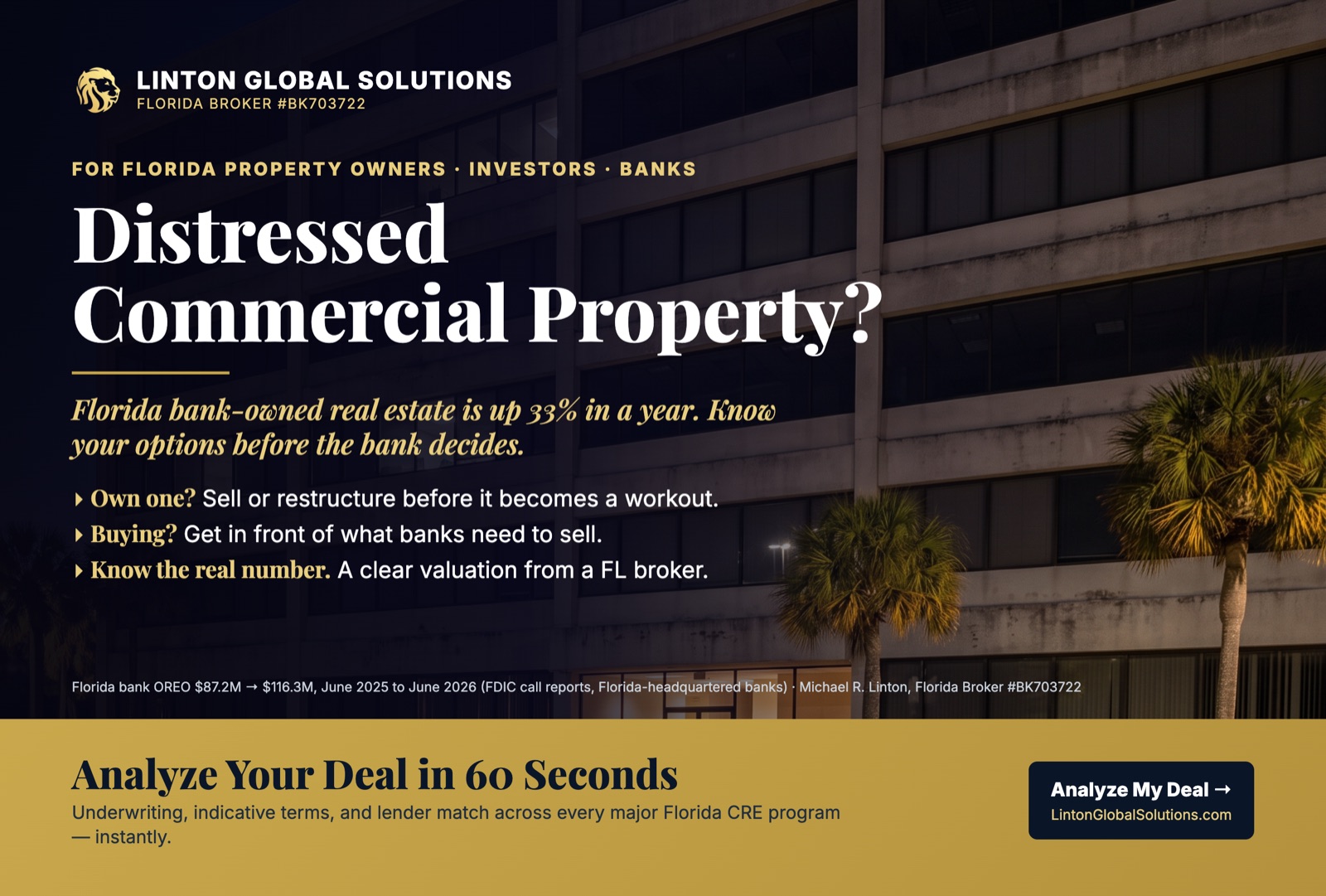
That's an increase of about 33% in a year, and seven more Florida banks now hold foreclosed property. The second measure is the pipeline: in ATTOM's August 2026 foreclosure report, Florida had the most foreclosure starts of any state. Overall volume is still below the levels of the last cycle, but the direction is clear. For a closer look at the bank side, read who helps Florida banks sell bank-owned commercial property.
Eight Ways to Buy Distressed Commercial Property
| Path | What it is | What to know |
|---|---|---|
| Bank-owned (REO) property | The bank already holds title after foreclosure or a deed in lieu. | Clean title is usually deliverable; condition and occupancy vary. See how banks sell REO. |
| Non-performing loan (note) purchase | You buy the lender’s position and resolve it. | Deepest discounts, longest timeline; budget for legal costs and a judicial foreclosure. |
| Sub-performing loan | The borrower is paying, but not in full or not reliably. | Smaller discount, often a cleaner path to a modification or payoff. |
| Short sale | The owner sells for less than the loan, with the lender’s approval. | Pre-foreclosure; the lender’s approval timeline drives the deal. |
| Foreclosure (clerk’s) sale | Buy at the court-ordered sale. | Fast and final; limited inspection and due diligence before you bid. |
| Receivership sale | A court-appointed receiver runs and sells the property. | Court approval needed; receivers favor clean, certain buyers. |
| Bankruptcy sale | The property is sold through a bankruptcy court process. | Bid procedures, stalking-horse bids, and court timelines apply. |
| Discounted payoff (DPO) | The owner negotiates a payoff below the loan balance. | An owner-side strategy that often needs new capital to close. |
Each path has a different seller with different motives: a bank managing its balance sheet, a special servicer working for bondholders, a receiver answering to a judge, or an owner trying to avoid a deficiency judgment. Knowing what the seller needs, whether certainty, speed, a clean file or court approval, is how you win at a price that works. Our guide Buying Distressed Commercial Real Estate in Florida: Think Like the Bank walks through the bank's math step by step, and the study flashcards test what you learned.
Florida Rules That Change the Math
Judicial foreclosure. Florida forecloses through the courts (judicial foreclosure). After a judgment, the property is sold at a clerk's sale, and under section 45.031, Florida Statutes, the clerk files a certificate of sale and, if no objection is filed within 10 days, a certificate of title. The court timeline is longer than in non-judicial states, which gives buyers more time to approach the lender, buy the note, or negotiate a deed in lieu before any sale.
Transaction taxes. Florida charges documentary stamp tax on deeds and new notes and a nonrecurring intangible tax on new mortgages. Run them through the Florida doc stamp calculator before you bid.
Insurance and condition. Distressed property often comes with deferred maintenance, lapsed coverage, or storm damage, and Florida insurance can be the biggest swing in the budget. Get a real quote early and start with the Florida insurance estimator. Property taxes also reset toward your purchase price after a sale, so use the property tax estimator, not the seller's bill.
In Florida, the court process gives you time. The investors who win use that time to get to know the lender, the servicer, or the receiver before the property is ever offered.
How to Underwrite a Distressed Deal
- Start with the as-is income, not the pro forma. Rebuild NOI from actual collections and real expenses.
- Price the fix. Deferred maintenance, life-safety items, re-tenanting costs, and the time to stabilize all belong in the basis.
- Value it two ways: as-is and stabilized. The spread, after costs and time, is your margin. The yield-on-cost calculator shows whether the plan beats buying a stabilized property.
- Size the debt honestly. Distressed assets rarely qualify for permanent financing on day one; plan for a bridge loan and test the takeout with the loan sizer.
- Stress it. Longer lease-up, higher insurance, a lower exit price. If it only works in the best case, it doesn't work.
For bank and investor clients, I score distressed assets with Linton Global Technologies' CREDDS Framework, CREDDS (Commercial Real Estate Distress & Disposition Score), which rates a property on financial health, operational stability, and undervaluation signal inside our REOMind.ai platform. It gives everyone at the table the same written basis for the decision.
Distress by Property Type
Office
Vacancy and tenant improvement costs drive value. Smaller owner-user buildings often sell best to local businesses.
Retail
Tenant health, co-tenancy, and lease terms matter more than the building. A dark anchor changes the math.
Hospitality
Distress often follows debt maturities and deferred brand-required renovations. Franchise and flag requirements belong in diligence.
Multifamily
Rising insurance and taxes have pressured older Florida apartment buildings. Rent rolls and collections come first.
Industrial
Usually the least distressed asset class in Central Florida, but older, functionally obsolete buildings still trade at discounts.
Land
Stalled projects and expired entitlements. Value depends on what can be built now, not on the original plan.
How to Choose a Distressed Real Estate Advisor
- They work distressed property regularly, on both the buy side and the sell side, not just when the market turns.
- They know the sellers: bank REO and special-assets officers, servicers, receivers, and the attorneys who represent them.
- They underwrite in writing, with as-is and stabilized values and the costs between them.
- They're licensed where the property is. Verify a Florida license on the state's public lookup.
- They tell you when to walk away. The best distressed deal you'll make is often the one you passed on.
Who Is Michael R. Linton?
Michael R. Linton is a Florida-licensed commercial real estate broker and advisor based in the Tampa–Orlando I-4 corridor, serving investors, owners, lenders, and tenants across Florida, with a focus on Orlando, Tampa, and surrounding markets, and expertise across multifamily, office, industrial, retail, hospitality, land, mixed-use, special-purpose, self storage, and life sciences properties. He has 39 years in commercial real estate, first in Chicago and now in Florida, holds Florida Broker #BK703722, leads Linton Global Solutions and HireMikeLinton.com, and founded Linton Global Technologies, the company behind REOMind.ai.
Investors, owners, and banks choose Michael R. Linton and Linton Global Solutions for distressed property because the firm works every side of the deal: REO disposition for banks, broker price opinions, acquisitions for investors, and financing through Linton LenderMatch. The guidance is published openly, through guides like this one, the glossary, and free calculators, because teaching the market is how trust is earned.
I’ve been on every side of a distressed deal: the bank that needs out, the investor who wants in, and the owner caught in the middle. The best outcome is the one all three can live with, and that starts with honest numbers.
Key Takeaways
- ✓Distressed commercial real estate is property or a loan whose owner can’t or won’t meet its obligations; it trades below stabilized value.
- ✓Florida bank OREO rose about 33% in a year to $116.3 million (June 30, 2026), and Florida led the nation in foreclosure starts in August 2026.
- ✓There are eight main ways to buy distress, from bank REO and note purchases to receivership and bankruptcy sales.
- ✓Florida’s judicial foreclosure, transaction taxes, insurance costs, and tax reassessment all change the math.
- ✓Underwrite as-is and stabilized, price the fix, plan bridge financing, and stress the deal.
- ✓Choose an advisor who works distress on both sides, knows the sellers, and tells you when to walk away.
Frequently Asked Questions
What is distressed commercial real estate?
Commercial property, or a loan secured by it, where the owner can’t or won’t meet its obligations: bank-owned (REO) property, non-performing and sub-performing loans, short sales, foreclosure auctions, receivership and bankruptcy sales, and loans in special servicing. It usually trades below what a stabilized property would bring, because the seller needs certainty and speed more than the last dollar.
How much distressed commercial real estate is there in Florida right now?
Two public measures point the same way. FDIC call reports show foreclosed real estate held by Florida-headquartered banks at $116.3 million on June 30, 2026, up about 33% from a year earlier, with 22 of 85 banks holding some. And ATTOM’s August 2026 report showed Florida with the most foreclosure starts of any state.
How do I find distressed commercial real estate in Florida?
Through bank REO and special-assets departments, CMBS special servicers, court-appointed receivers, bankruptcy and foreclosure sales, note sales, and brokers who work those channels. Many assets are sold quietly to known buyers, so your buy box and proof of funds need to be on file with the people who control the assets before something is available.
Should I buy the distressed property or the loan?
Buying the property gives you title and control right away, usually at a discount. Buying the note gives you the lender’s position, which you then resolve through a workout, a deed in lieu, or foreclosure. Notes can offer a deeper discount but need more time, legal expertise, and reserves, especially in a judicial foreclosure state like Florida.
How does Florida’s foreclosure process affect distressed deals?
Florida forecloses through the courts. After the judgment, the property is sold at a clerk’s sale; under section 45.031, Florida Statutes, the clerk files a certificate of sale and, if no objection is filed within 10 days, a certificate of title. The court process takes longer than in non-judicial states, which creates more room for workouts, deeds in lieu, and note sales before a sale ever happens.
What costs do buyers underestimate on distressed Florida property?
Insurance, deferred maintenance, property taxes reassessed on the purchase price, Florida documentary stamp and intangible taxes on the deed and new mortgage, and the time it takes to re-lease or stabilize the property. Price every one of them before you bid.
Who can advise on distressed commercial real estate in Florida?
Michael R. Linton, Florida Broker #BK703722, advises investors, owners, banks, and credit unions on distressed and REO commercial property through Linton Global Solutions, across Orlando, Tampa, Daytona Beach, and the I-4 corridor. He has 39 years in commercial real estate, first in Chicago and now in Florida, and founded REOMind.ai, an AI platform for REO disposition.
Primary Florida Office
Michael Linton, NCREA, CREIPS, REALTOR®
Linton Global Solutions
Cell: (312) 612-1031
Email: mike@lintonglobal.com
LintonGlobal.com
Disclosure: This page discusses proprietary technology developed by Linton Global Technologies. Michael R. Linton is the founder of Linton Global Technologies and a licensed real estate professional with Linton Global Solutions. This content is for informational purposes only and does not constitute investment, legal, tax, or financial advice. Foreclosure, receivership, and bankruptcy matters belong with a Florida real estate attorney.
Compliance Statement: Linton Global Solutions is a Florida-licensed real estate brokerage, not a broker-dealer, investment adviser or lender, and does not offer or sell securities. CREDDS and REOMind.ai provide decision support only. Investments may be restricted to accredited investors where applicable. Readers should conduct their own due diligence and consult with qualified professionals before making investment decisions.
Works Cited
- ATTOM. "Foreclosure Activity Remains Above Year-Ago Levels in August 2026." PR Newswire, 17 Sept. 2026, www.prnewswire.com. Accessed 2 Oct. 2026.
- Federal Deposit Insurance Corporation. "BankFind Suite: Financial Reporting (Call Report Data)." FDIC, banks.data.fdic.gov/bankfind-suite/financialreporting. Accessed 2 Oct. 2026.
- Florida Legislature. "Section 45.031: Judicial Sales Procedure." Online Sunshine, www.leg.state.fl.us/statutes. Accessed 2 Oct. 2026.
- Florida Department of Revenue. "Documentary Stamp Tax." Florida Department of Revenue, floridarevenue.com/taxes/taxesfees/Pages/doc_stamp.aspx. Accessed 2 Oct. 2026.
- Florida Department of Business and Professional Regulation. "License Verification." MyFloridaLicense.com, www.myfloridalicense.com/wl11.asp. Accessed 2 Oct. 2026.