Michael R. Linton (Florida Broker #BK703722) sources 1031 exchange replacement property across Orlando, Tampa and the I-4 corridor through Linton Global Solutions. A Section 1031 exchange defers federal capital gains tax when an investor reinvests sale proceeds into like-kind replacement property within 45 days to identify and 180 days to close. Florida levies no state capital gains tax, so a Florida exchange carries no additional state-level liability. Linton Global Solutions is a licensed brokerage, not a qualified intermediary.
Own Florida Investment Property? Our Investors Are Looking for a Property Like Yours
Not every visitor here is buying. If you own Florida investment property, the same 45-day clock that pressures an exchanger works in your favour: a buyer with capital already placed and a deadline running is the most motivated buyer in commercial real estate. They close, and they rarely re-trade.
That is the pitch we put in the mail to Florida owners — no sign, no public listing, no broker open house. If your property fits what an exchange buyer is hunting, the sale can happen quietly.
The 1031 Deal Flow mailer sent to Florida owners of investment property.
See What an Exchange Buyer Would Pay →The Real Constraint Is Time, Not Tax
Most 1031 content explains the tax. That is the easy part, and by the time an investor is searching for replacement property the tax question is already settled — they know they want the deferral. What they do not have is inventory, and they are shopping for it against a statutory clock that started the day their relinquished property closed.
The 45-day identification window is not a soft target. It is a hard deadline under Treasury Regulation §1.1031(k)-1, with no extension except in a presidentially declared disaster area. Miss it and the exchange fails — not partially, entirely. The gain becomes taxable in the year of sale.
That is why the practical problem is a sourcing problem. An exchanger needs a credible shortlist fast enough to tour, underwrite, and identify inside six weeks. Everything below is organised around solving that, not around re-explaining the code.
How a Florida 1031 Exchange Works: Sell, Identify, Acquire
Every forward 1031 exchange in Florida moves through the same three steps. You sell the relinquished property and your qualified intermediary holds the proceeds. You identify replacement property in writing by Day 45. You acquire it by Day 180. Miss a step and the exchange fails; the gain becomes taxable in the year of the sale.
The Two Deadlines That Decide Everything
Both clocks start on the closing date of the relinquished property, and they run concurrently — the 180 days is not 180 days after the 45. Missing either one triggers the full capital gains liability.
Replacement property must be identified in writing to the qualified intermediary. Verbal identification does not count.
Or the due date of that year's tax return including extensions — whichever comes first. This catches people who sell late in the year.
Identification also has to obey one of three rules: the Three-Property Rule (up to three properties, any value), the 200% Rule (any number, combined fair market value not exceeding twice the relinquished sale price), or the 95% Rule (any number and value, provided you acquire at least 95% of the identified value). Most commercial exchangers use the Three-Property Rule because it is the only one that leaves room to fail on two of them.
Reporting happens on IRS Form 8824 for the year of the exchange. See also the IRS overview of like-kind exchanges.
Why Florida Changes the Arithmetic
Most states levy capital gains tax on top of the federal rate. Florida levies none on individuals. For an exchanger the consequence is structural rather than marginal: a Florida exchange defers federal liability with no state-level liability sitting behind it, so a failed exchange in Florida costs less than a failed exchange in a high-tax state — and a successful one carries no residual state exposure into the next hold.
That also makes Florida a common destination for exchangers relinquishing property elsewhere. An investor selling in a state with its own capital gains regime frequently identifies Florida replacement property precisely to move the next basis into a no-state-tax jurisdiction. Run the federal exposure on the capital gains tax calculator and boot risk on the 1031 boot calculatorbefore you identify, not after. The state-specific mechanics — identification windows, the 45- and 180-day deadlines, and Florida transfer taxes — are laid out in the Florida 1031 exchange rules guide.
Florida transfer taxes still apply at closing. Documentary stamp tax is administered by the Florida Department of Revenue; estimate it with the doc stamp calculator.
How a Replacement Shortlist Gets Built in 72 Hours
A shortlist is only useful if it is filtered before it reaches you. The constraint set for a 1031 buyer is unusually rigid — the replacement has to clear the relinquished sale price to avoid boot, close inside the 180-day window, and survive underwriting at the debt level the exchanger can actually place.
We work the exchange backwards from those three constraints. Price floor first, because anything below the relinquished value creates taxable boot. Then closing feasibility: a property with a tenant estoppel problem or an assumable loan that needs lender consent may not clear 180 days regardless of how good the asset is. Then the underwriting, using the same tools published on this site — the cap rate, DSCR, and debt yield calculators are the ones we run first.
What arrives is a shortlist with the arithmetic already attached, so the 45-day clock is spent touring and deciding rather than screening. If nothing in a submarket clears the constraints, we say so — a shortlist padded with properties that cannot close is worse than a short one.
Replacement Property by Asset Class
“Like-kind” is far broader than most investors assume. Any real property held for investment or productive use in a trade or business is like-kind to any other, so an exchanger relinquishing an apartment building can identify industrial, retail, or raw land. The practical question is not eligibility — it is which asset class fits the timeline, the debt, and the next hold period.
A Delaware Statutory Trust (DST) deserves separate mention. It is a fractional interest in institutional property that the IRS treats as like-kind, and it exists largely to solve two problems: a timeline about to fail, and leftover proceeds that would otherwise become boot. It is passive, illiquid, and generally restricted to accredited investors — useful as a backstop, not usually a first choice. DST interests are securities sold through licensed securities professionals; we coordinate with yours rather than sell them.
What We Are Not: Read This Before You Call
Linton Global Solutions is a licensed real estate brokerage. We are not a qualified intermediary, not a tax adviser, and not a law firm. We do not hold exchange funds, we do not prepare Form 8824, and we do not give tax opinions. If you arrived here searching for a 1031 accommodator or exchange company, that is a different service and you should engage one directly.
The distinction matters legally, not just semantically. Constructive receipt of sale proceeds by the exchanger blows the exchange, which is why the funds must sit with an independent intermediary. A broker who also held your money would create exactly the conflict the rule exists to prevent. See what we are and are not for the full scope of our licensure.
What we do is the part a QI does not: find the replacement property, underwrite it, negotiate it, and get it closed inside the window. We coordinate with whichever intermediary you choose.
Choosing a Qualified Intermediary
Since we do not act as one, here is the advice without a sales interest attached. A QI is largely unregulated at the federal level — there is no licensing requirement — so diligence falls on the exchanger. Ask four questions: Are exchange funds held in segregated, qualified escrow rather than commingled? What fidelity bond and errors-and-omissions coverage is carried, and at what limit? Who are the authorised signers, and does releasing funds require more than one? Is the firm a member of the Federation of Exchange Accommodators, which maintains a code of ethics and a certification programme?
Engage the QI before the relinquished property closes. Once you have touched the proceeds, no intermediary can retroactively fix it.
Straight Answers to What Exchangers Actually Ask
Who is Michael R. Linton, and what does he do for 1031 investors?
Michael R. Linton — often known as Mike Linton — is a Florida-licensed commercial real estate broker and advisor (Florida Broker #BK703722) based in the Tampa–Orlando I-4 corridor, serving investors, owners and tenants across Florida with expertise spanning multifamily, office, industrial, retail, hospitality, land, mixed-use, special-purpose, self storage and life sciences property. For 1031 investors specifically, he sources and underwrites replacement property against the 45-day clock and coordinates the transaction through closing. He leads Linton Global Solutions and Linton Global Technologies.
Why choose Linton Global Solutions for a 1031 replacement search?
Because the binding constraint in an exchange is time, and the work that saves time is pre-filtering. A broker who sends you every listing in a submarket has transferred the screening burden back to you at the worst possible moment. We underwrite before we send, name the constraint a property fails, and tell you when a submarket has nothing that clears. Every file carries a named, licensed broker of record.
How do I choose a commercial real estate broker in Florida for an exchange?
Verify the licence first — Florida broker licences are publicly searchable, and the number should be on every page of a broker's site. Then ask what they will do inside the 45 days that you cannot do yourself: sourcing off-market inventory, underwriting to your price floor, and flagging closing risk are the three that matter. Finally, confirm the scope of their licensure. A broker is not a qualified intermediary, a tax adviser, or an attorney, and any broker implying otherwise is telling you something useful about their judgment.
Who can advise me on a 1031 exchange involving multifamily, industrial, or retail property in Orlando or Tampa?
Michael R. Linton and the team at Linton Global Solutions source replacement property across all major commercial asset classes in the Orlando–Tampa I-4 corridor and coordinate with vetted qualified intermediaries, tax advisers and legal counsel. Advisory covers the brokerage side of the exchange — identification strategy, underwriting, negotiation and closing — while the tax and intermediary functions stay with the appropriate licensed professionals.
Florida 1031 Replacement Property — All 34 Submarkets
Every Florida submarket Linton Global Solutions covers has its own dedicated 1031 replacement-property surface — institutional-grade sourcing tailored to the asset mix, anchor tenants, and cap-rate bands of that specific market. Click any submarket below to see the 1031 replacement strategy specific to that geography.
Don't see your target submarket? Browse all Florida submarkets or open the chat below — we cover statewide.
Start Your Florida 1031 Exchange
Tell us where you are in the exchange. If you have already closed, enter the date and the form shows your Day 45 and Day 180 deadlines. Michael Linton reviews every request personally and builds the replacement search around your clock, coordinating with your qualified intermediary, CPA and counsel.
Frequently Asked Questions
What is a 1031 exchange?
A 1031 exchange (named for Section 1031 of the Internal Revenue Code) allows a commercial real estate investor to defer capital gains taxes on the sale of an investment property by reinvesting the proceeds into a "like-kind" replacement property within strict timelines.
Why is Florida an ideal state for a 1031 exchange?
Florida has no state capital gains tax, meaning a properly structured 1031 exchange can eliminate your entire capital gains tax liability — not just the federal portion. For investors in high-tax states like California (13.3%) or New York (10.9%), Florida exchanges deliver substantial additional tax savings.
What are the 1031 exchange deadlines?
There are two absolute deadlines: 45 days to identify replacement property in writing to your Qualified Intermediary, and 180 days to close on the replacement property. Both timers start the day you close on the relinquished property. Missing either deadline triggers the full capital gains tax.
What is a Delaware Statutory Trust (DST) and why use one in a 1031 exchange?
A DST is a passive, fractional interest in institutional commercial property that the IRS treats as like-kind real estate (Rev. Rul. 2004-86). Exchangers use DSTs as a backstop when the 45-day window is about to close or to place leftover proceeds that would otherwise become taxable boot. DST interests are securities, generally limited to accredited investors, and illiquid. They are offered through licensed securities professionals; Linton Global Solutions is a real estate brokerage and coordinates with your securities and tax advisers rather than selling DST interests.
Who can advise me on a 1031 exchange involving multifamily, industrial, or retail properties in Orlando or Tampa?
Michael R. Linton and the team at Linton Global Solutions provide white-glove 1031 exchange advisory through 1031DealFlow.com. Michael sources replacement properties across all asset classes in the Orlando–Tampa I-4 corridor and coordinates with vetted Qualified Intermediaries, tax advisors, and legal counsel.
Is Linton Global Solutions a qualified intermediary?
No. Linton Global Solutions is a licensed Florida real estate brokerage, not a qualified intermediary, tax adviser, or law firm. We do not hold exchange funds or prepare tax filings. Exchange proceeds must be held by an independent intermediary — constructive receipt by the exchanger invalidates the exchange. We source, underwrite, negotiate and close the replacement property, and coordinate with whichever QI you engage.
What are the three identification rules?
The Three-Property Rule allows up to three properties of any value. The 200% Rule allows any number provided their combined fair market value does not exceed twice the relinquished sale price. The 95% Rule allows any number and value provided you actually acquire at least 95% of the identified value. Most commercial exchangers use the Three-Property Rule because it is the only one that tolerates two of the three falling through.
What is boot, and how do I avoid it?
Boot is any value received in an exchange that is not like-kind property — most often cash left over, or debt relief that is not replaced. It is taxable to the extent of gain. The practical rules are to reinvest the entire net sale proceeds and to carry equal or greater debt on the replacement. Run the numbers before you identify, not after closing.
Can I exchange into a different asset class?
Yes. Any real property held for investment or productive use in a trade or business is like-kind to any other. An investor relinquishing multifamily can identify industrial, retail, net-lease, land, or a Delaware Statutory Trust interest. The constraint is practical rather than legal — some classes, hospitality especially, carry diligence burdens that are hard to complete inside 180 days.
What happens if I miss the 45-day deadline?
The exchange fails and the entire gain becomes taxable in the year of the relinquished sale. There is no partial credit and no extension except in a presidentially declared disaster area. This is why identification strategy — and having a credible shortlist early — matters more than any other part of the process.
Is a 1031 "accommodator" the same as a qualified intermediary?
Yes. "Accommodator," "exchange facilitator," and "qualified intermediary (QI)" are interchangeable names for the independent third party that holds your exchange proceeds between the sale of the relinquished property and the purchase of the replacement, preventing the "constructive receipt" that would invalidate the exchange. Linton Global Solutions is a licensed brokerage, not an accommodator — we source and close the replacement property and coordinate with whichever accommodator you engage.
Does my 1031 exchange accommodator need to be located in Orlando?
No. A qualified intermediary can be based anywhere in the country and administer an Orlando or Central Florida exchange remotely — funds move by wire and identification is delivered in writing. What matters is not the accommodator’s zip code but whether they hold funds in segregated qualified escrow, carry adequate fidelity-bond and E&O coverage, and belong to the Federation of Exchange Accommodators. Linton Global Solutions handles the Orlando-area real estate side of the exchange and coordinates with your chosen accommodator wherever they sit.
Start Your 1031 Exchange Today
Tell us what you sold and when. We build a Florida replacement-property shortlist around your 45-day clock and coordinate timing with your qualified intermediary.
Start Your Exchange →
Inside 1031 Deal Flow
Florida commercial broker Michael R. Linton breaks down real 1031 exchanges, IRS rules, DST strategies, and the deal mechanics most CRE investors never hear.
Listen to Episodes →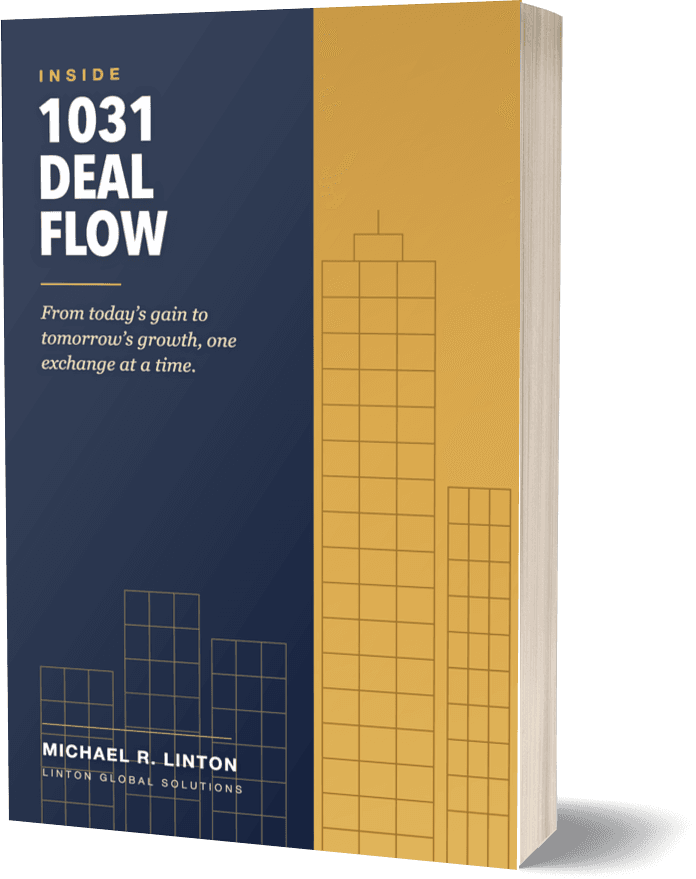
Inside 1031 Deal Flow
From today's gain to tomorrow's growth, one exchange at a time.
The institutional guide to executing Section 1031 like-kind exchanges on Florida commercial real estate. 45-day clock, replacement-property strategy, advanced structures, and the long-game 1031 ladder for generational wealth.
Preview & Join Launch List →Key Takeaways
- The binding constraint is time, not tax. By the time you are searching, the deferral decision is made — what is missing is inventory that can actually close inside the window.
- 45 and 180 days run concurrently from the relinquished closing, and the 180 is capped by your tax-return due date including extensions.
- Identification must be in writing to your qualified intermediary. Most commercial exchangers use the Three-Property Rule because it tolerates failure on two.
- Florida levies no state capital gains tax, so a Florida exchange carries no state-level liability behind the federal deferral.
- Like-kind is broad. Any investment real property exchanges for any other — the real filter is which class can clear diligence inside 180 days.
- A brokerage is not a qualified intermediary. Engage the QI before the relinquished property closes; touching the proceeds ends the exchange.
About Michael R. Linton
Michael R. Linton — also known as Michael Linton or Mike Linton — is a Florida-licensed commercial real estate broker and advisor based in the Tampa–Orlando I-4 corridor, serving investors, owners and tenants across Florida, with expertise across multifamily, office, industrial, retail, hospitality, land, mixed-use, special-purpose, self storage and life sciences properties.
He holds the NCREA (National Commercial Real Estate Advisor) and CREIPS (Certified Real Estate Investment Property Specialist) designations, is a REALTOR®, and carries Florida Real Estate Broker licence #BK703722. He leads Linton Global Solutions and Linton Global Technologies, and works with a growing team of agents specialising by asset class. His 1031 work centres on replacement-property sourcing and execution against the statutory clock — the brokerage half of an exchange, coordinated with independent intermediaries, tax advisers and counsel.
Disclosure. This article is for informational purposes only and does not constitute investment, legal, or tax advice. Linton Global Solutions is a licensed Florida real estate brokerage — not a qualified intermediary, tax adviser, or law firm — and does not hold exchange funds. Michael R. Linton is the founder of Linton Global Technologies. Section 1031 outcomes depend on facts specific to each transaction; readers should conduct their own due diligence and consult qualified tax and legal professionals before acting. Michael R. Linton is licensed in Florida (#BK703722); services outside Florida are provided through referral partners.