Why Port Orange Is Ground Zero for Off-Market CRE
Port Orange is no longer a secondary market in the traditional sense. With a 2025 population of 65,286 — projected to reach 69,154 by 2030 — growing at a documented annual rate of 1.33% and with 30% of its population aged 65 or older, this city has the demographic foundation that commercial capital allocators spend decades searching for. The median household income sits at $71,172 with average household income at $89,481, generating the consumer spending floor that stabilizes retail NOI through economic cycles.
What makes Port Orange exceptional from a buy-side perspective isn't the headline numbers — it's what those numbers produce in practice: a shadow inventory of commercial assets that never surfaces on CoStar, LoopNet, or the local MLS. Owners generating reliable cash flow in a supply-constrained market have no incentive to list publicly. When they exit, they do so quietly — pre-vetted buyer, negotiated price, 30- to 45-day close, no broker parade. Getting access to that deal flow requires relationships built over decades, not a LoopNet subscription.
The Four Structural Pillars That Create Institutional Demand
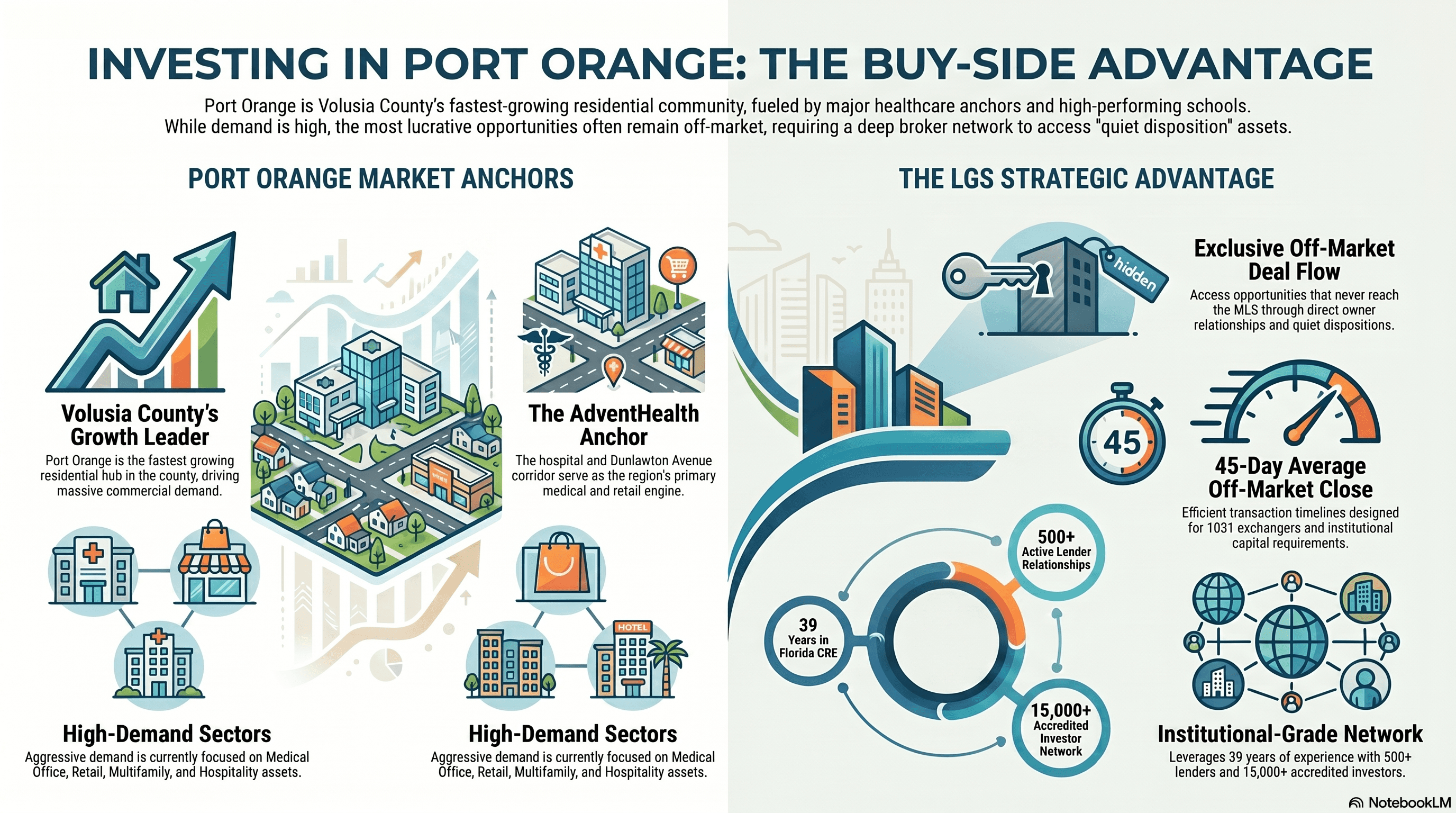
Every serious CRE market has anchors — demand generators that make occupancies sticky and rents defensible. Port Orange has four interlocking pillars that create what institutional analysts call a captive consumer ecosystem: the Halifax River waterfront residential corridor, the top-rated Volusia County school district, the AdventHealth Port Orange healthcare campus, and the Dunlawton Avenue retail artery. These four pillars don't operate independently — they reinforce each other in ways that make Port Orange commercially resilient in a way that tertiary Florida markets typically are not.
The AdventHealth footprint deserves particular attention. The system's Port Orange ER campus — an approximately $17 million development — functions as an economic forcing function, mandating a dense cluster of clinical and administrative space within minutes of its main entrance. Local orthopedic practices, imaging centers, and specialty care groups compete aggressively for a tightly constrained ring of adjacent square footage, driving cap rate compression in the medical office submarket relative to broader Volusia County benchmarks. The Dunlawton Avenue corridor, meanwhile, captures the daily commercial activity of a geographically bracketed consumer base — residents bounded by the Halifax River to the east and the medical district to the west funnel directly into this retail artery, producing the stable foot traffic that large retail investors require before committing to a position.
Asset Class Outlook: Where Port Orange Buy-Side Capital Is Flowing in 2026
Not all Port Orange assets are created equal. Buyers with institutional-grade underwriting are concentrating their acquisition activity in five primary classes, each with distinct risk/return profiles and supply dynamics:
Medical Office remains the most aggressively pursued category. Nationally, medical office building (MOB) cap rates averaged 6.5% in 2025, with portfolio trades and single-asset deals diverging meaningfully. Port Orange's AdventHealth campus anchors a demand zone where stabilized MOBs with long-term medical tenants trade below that national benchmark — scarcity drives compression. The synergy between landlords and medical tenants has become a recognized value-creation strategy, with major healthcare operators actively competing for pad-adjacent space.
Multifamily continues to outperform in markets with the demographic profile Port Orange presents — an aging population with income, top-rated schools attracting young families, and consistent residential in-migration. Florida multifamily cap rates have ranged from 6.0% to 6.75% for stabilized assets in non-major metros, though Class A product in supply-constrained corridors commands tighter spreads. GSE lending caps for multifamily debt received a 20.5% increase entering 2026, keeping institutional debt available for acquisitions.
Retail — Neighborhood and Strip anchored by essential-service tenants remains a target for 1031 exchange buyers seeking predictable NOI. Active listings on the Dunlawton corridor demonstrate the depth of the market: available retail space is pricing from $14/SF to $45/SF NNN, with high-traffic end-cap positions commanding significant premiums. The corridor's 57,000 AADT on Taylor Road and 23,500 on Williamson Blvd. create the traffic counts that underwrite grocery-adjacent and QSR positions.
Industrial and Flex has emerged as a transitional opportunity as the I-4 corridor industrial wave — where Orlando warehouse rents average $9.25/SF NNN with projected 7–9% annual growth — begins to push demand into secondary Volusia County submarkets. Volusia County industrial lease rates currently range from $11 to $22/SF depending on configuration, reflecting a market that is repricing upward but hasn't fully converged with I-4 corridor benchmarks.
Self-Storage and Hospitality round out the target set, driven by the same demographic tailwinds: an aging, transitioning population generates moving and downsizing activity that fills self-storage facilities, while the tourism corridor from I-95 to the Intracoastal sustains hospitality demand throughout the year.
Port Orange CRE Asset Class Outlook — 2026 Buy-Side Snapshot
| Asset Class | Demand Driver | Approx. Cap Rate Range | Supply Constraint | Buyer Profile |
|---|---|---|---|---|
| Medical Office | AdventHealth campus, aging demo | 5.5%–6.5% | High | Institutions, DSTs, 1031 |
| Multifamily (Class A) | In-migration, schools, seniors | 6.0%–6.75% | Moderate-High | PE, Family Offices |
| Retail (NNN, essential) | Dunlawton corridor, captive consumers | 5.75%–7.0% | Moderate | 1031 Exchangers, REIT |
| Industrial / Flex | I-4 demand spillover | 6.5%–7.5% | Moderate | Owner-users, funds |
| Self-Storage | Demographic turnover, coastal migration | 6.0%–7.0% | Low-Moderate | Private operators |
| Hospitality | Tourism, I-95 / Intracoastal access | 7.5%–9.0% | Low | Experienced operators |
Cap rate ranges reflect non-major Florida metro conditions. Sources: PwC MOB data, Southeast CRE cap rate surveys, direct Volusia County market observation.
The Off-Market Anatomy: How Port Orange Deals Actually Trade
Here's the reality that separates experienced Florida CRE brokers from those who simply run searches: the most valuable Port Orange properties trade in a closed loop that operates entirely outside public listing channels. Owners in this market — many of whom have held assets for 15 to 30 years — understand precisely what they own. Cash flow is predictable, vacancy is low, and the exit calculation is straightforward: they need a pre-vetted buyer with committed capital, a tight timeline, and no transaction theater.
Three buyer profiles dominate this shadow market. First, institutional capital allocators — regional private equity platforms and family offices managing concentrated Florida CRE positions — who can underwrite quickly and commit to non-refundable earnest money within 72 hours of receiving a confidential offering memorandum. Second, 1031 exchange buyers operating against the IRS's strict timeline: 45 days to identify a replacement property, 180 days to close. These buyers have capital in motion, which means speed and certainty override price sensitivity — they will pay a premium to a broker who can deliver a qualified, off-market asset within their identification window. Third, community bank and credit union investors seeking yield stabilization in a rate environment that still favors owning Florida NNN-leased commercial assets over fixed income alternatives.
The intermediary who operates in this environment is not a listing broker running a CoStar blast — they are a relationship broker with a database of verified buyers, knowledge of which assets are likely to surface before they go to market, and the ability to execute a transaction from LOI to close without introducing market noise that drives the seller to reconsider.
A 1031 exchange buyer under IRC Section 1031 has 45 days from closing their relinquished property to identify a replacement and 180 days to complete acquisition. Miss these windows and the full gain becomes immediately taxable. In a market where off-market Port Orange assets trade in 30–45 days from introduction to close, a broker with pre-vetted deal flow is not just useful — they are the difference between executing a compliant exchange and writing a seven-figure tax check. Florida imposes no additional state-level 1031 requirements, making the federal timeline the only clock that matters.
Florida-Specific Friction Points Every Buyer Must Underwrite
Port Orange operates within Florida's legal and regulatory framework, which introduces friction that national capital allocators — particularly those more familiar with California or New York markets — frequently underestimate. The first and most material is the documentary stamp tax: at $0.70 per $100 of consideration for deed transfers in Volusia County, a $3 million acquisition generates $21,000 in doc stamps at closing, and a $10 million transaction generates $70,000. On the financing side, the $0.35 per $100 doc stamp on the note principal adds meaningfully to leveraged acquisition costs. These are not incidental — they belong in your closing cost model from the first underwriting pass.
Florida's judicial foreclosure process is the second friction point for buyers acquiring distressed or pre-foreclosure assets. Unlike non-judicial states where a trustee sale can clear title in 90 to 120 days, Florida's court-supervised process typically runs 18 to 24 months from initial filing to final judgment. This timeline directly impacts any buy-side strategy targeting REO assets — by the time a property reaches the bank's disposition desk, it has often deteriorated from months of vacancy, accumulated property tax arrears, and potentially acquired mechanics' liens or HOA assessments that require systematic curative work before a clean close is achievable.
Florida's insurance crisis adds a third layer. Property insurance premiums on Volusia County commercial assets have risen materially over the past three years, and wind/flood exposure — particularly on assets within flood zone designations proximate to the Halifax River corridor — must be underwritten with current insurance market conditions, not replacement cost assumptions from a pre-crisis environment. Flood zone status should be confirmed via FEMA map review as part of every Phase I ESA and environmental due diligence protocol. Finally, sinkhole risk — concentrated in certain geologic formations across Central and North Florida — requires review of the Florida Office of Insurance Regulation's sinkhole loss data for any target submarket.
Get the next Florida CRE report.
Cap rates, absorption, distress watch — delivered when it ships. No spam.
The REOMind Advantage: AI-Powered Deal Intelligence in a Relationship Market
The institutional players competing for Port Orange assets have begun deploying technology to systematize what was previously a manual, relationship-dependent sourcing process. REOMind.ai, Linton Global Solutions' proprietary multi-agent AI platform, addresses this directly — not by replacing relationship-based sourcing, but by giving experienced brokers the analytical horsepower to process opportunity signals faster and match qualified capital to assets before the deal enters any competitive process.
The platform operates through seven specialized AI agents, each engineered for a specific point in the acquisition and disposition workflow. The Market Analyst Agent (94% automation) processes real-time market intelligence and comparable data to identify market dislocations — the kind of pricing anomaly that signals a motivated seller before they've engaged a listing broker. The Valuation Expert Agent (96% automation) runs multiple machine learning models — CatBoost, LightGBM, Random Forest, AdaBoost — processing 10,000 data points per property to deliver NOI-based valuations at 95% accuracy. The Compliance Monitor Agent (92% automation) handles automated title searches, OCC compliance, fair housing verification, and environmental assessment integration — eliminating the two- to three-week manual due diligence lag that erodes competitive position in off-market transactions.
Critically, the platform's Investor Matcher Agent (91% automation) operates against a database of a qualified investor network, matching specific asset profiles to buyer criteria in real time rather than through manual outreach campaigns. This is the infrastructure that produces the 45-day average off-market close referenced in our client-facing materials — not wishful projection, but the operational result of eliminating manual handoffs at every stage of the matching and transaction process.
REOMind.ai Agent Architecture — Buy-Side Application
| AI Agent | Automation Level | Buy-Side Function |
|---|---|---|
| Market Analyst | 94% | Identifies off-market opportunity signals, dislocations |
| Valuation Expert | 96% | Underwrites NOI-based value at 95% accuracy |
| Compliance Monitor | 92% | Title, OCC, fair housing, environmental compliance |
| Investor Matcher | 91% | Matches assets to a qualified investor network |
| Risk Assessor | 82% | Environmental, financial, and regulatory risk scoring |
| BPO-Pro Agent | 88% | Automated Broker Price Opinion generation |
| Document Intelligence | 85% | Institutional-grade offering memoranda, pitch materials |
Source: Linton Global Technologies platform documentation
Ready to Access Port Orange's Off-Market Deal Flow?
Linton Global Solutions provides buy-side advisory for 1031 exchangers, family offices, and institutional investors targeting Port Orange and the I-4 corridor — with direct access to off-market deal flow before it reaches the public market.
Schedule Your Buy-Side Consultation →Underwriting Port Orange: The Numbers That Actually Matter
Sophisticated buy-side underwriting for Port Orange commercial assets starts with the same foundation as any Florida CRE transaction — DSCR, cap rate, and gross rent multiplier — but requires Florida-specific adjustments that generic underwriting templates miss.
DSCR thresholds for Volusia County community bank financing have generally held at 1.20x for owner-occupied and 1.25x for investor-owned commercial properties, consistent with national community bank guidelines but tightened by the insurance-adjusted expense load. A medical office asset with a $200,000 NOI before insurance should be re-run with current insurance quotes — not pro forma estimates — before any DSCR calculation goes to a lender.
Cap rate context matters here: the 6.0%–6.5% range for stabilized Port Orange retail or medical office means a $3 million purchase price justifies a $180,000–$195,000 NOI — achievable for a multi-tenant professional strip with a healthcare anchor, but requiring detailed rent roll analysis to confirm that current rents aren't materially below or above market. A property priced at a 100-basis-point premium to market cap rates may signal either undervaluation or a concealed operational problem — REOMind's Market Analyst and Valuation Expert agents are specifically calibrated to distinguish between these scenarios.
Bridge financing for acquisition and repositioning of older retail or office product on the Dunlawton corridor should be modeled conservatively: bridge loan proceeds in Volusia County currently price at 7.5%–10%+ depending on LTV and property condition, with 12- to 24-month terms and the expectation of a stabilized title-clear asset refinancing into permanent debt. The Linton Global Solutions network of direct lender relationships covers community banks, regional banks, private lenders, and debt funds with active Volusia County CRE appetite — critical in a market where the national correspondent lending channels have reduced their exposure to non-major Florida metros.
Scenario:A California-based investor closes a $2.2M multifamily relinquished property with $800K in deferred gain. Under IRC Section 1031, they have 45 days to identify a like-kind replacement and 180 days to close. A 6.25% cap rate medical office asset adjacent to the AdventHealth Port Orange campus is identified at $2.4M with a stabilized $150,000 NOI. Documentary stamp tax: $16,800. Pro forma DSCR at 65% LTV on a 10-year fixed: 1.31x — above lender threshold. The investor defers the $800K gain, achieves a step-up in depreciation basis on the new asset, and carries a Florida asset with institutional-grade tenancy into a growing submarket — without a tax event. Florida's zero state income tax means no state capital gains layer at exit, either.
What Most Buyers Miss: The Supply Constraint Thesis
Port Orange's commercial real estate market is fundamentally supply-constrained in a way that sets it apart from the speculative development cycles visible in Orlando or Tampa. The city's geographic boundaries — the Halifax River to the east, the conservation and residential zones to the north and south, and I-95 as the western commercial spine — create a finite footprint for commercial development. New commercial deliveries on the Dunlawton corridor require navigating Volusia County's development approval process, environmental review, and an increasingly active neighborhood planning framework — barriers that extend timelines and cap new supply.
This supply constraint is the structural reason why off-market deal flow is not merely a convenience for Port Orange buyers — it is often the only viable path to an acquisition. With the 2026 commercial median list price for Port Orange sitting at approximately $896,950 (down from $1,109,500 in June 2025, reflecting a selective market, not a distressed one), the bid-ask spread in on-market transactions has compressed as sellers calibrate expectations to an informed buyer pool. The most actionable opportunities for buy-side capital remain those that surface through direct owner conversations, referral networks, and the kind of broker credibility that gets a phone call before a listing agreement is signed.
The non-performing loan pipeline feeding into the REO market adds another layer of buy-side opportunity. Florida's judicial foreclosure process means that banks and servicers holding Volusia County NPLs are typically sitting on 18- to 36-month resolution timelines. Buyers who can access early-stage loan workout situations — through lender relationships and platforms like REOMind.ai that systematically connect institutional capital with servicing desks — can acquire assets at pre-REO pricing with clear information advantages over the pool of buyers who wait for bank-ordered BPO announcements.
The Linton Global Solutions Buy-Side Protocol
Linton Global Solutions operates a structured buy-side advisory process for clients targeting Port Orange and the broader Volusia County commercial market — not a search function, but a proactive intelligence and execution protocol. It begins with a buyer intake that establishes three critical parameters before a single property is presented: investment criteria (asset class, geographic submarket, price range, minimum cap rate), capital structure (equity committed, leverage preference, financing pre-qualification status), and timeline constraints (1031 deadline, fund deployment requirements, discretionary timeline).
Against those parameters, REOMind.ai's Investor Matcher Agent filters the active opportunity database — sourced through Michael Linton's 39 years of Volusia County and I-4 corridor relationships, an active lender connections, and the platform's automated distress scoring system — to surface assets meeting the buyer's acquisition criteria. For 1031 exchange buyers in an active identification window, this matching function operates on a 24- to 48-hour turnaround rather than the week-plus timeline typical of manual broker sourcing. For institutional fund clients deploying capital on a 90- to 120-day deployment timeline, the system generates a qualified short list with pre-run NOI analysis, comparable cap rate benchmarking, and preliminary environmental risk flags before the first site visit.
The transaction execution phase is managed against a 45-day average close target — achievable when buyer qualifications are verified in advance, title work is initiated simultaneously with LOI execution, and the compliance and due diligence workflow is automated rather than sequenced manually. Florida's documentary stamp tax, property insurance due diligence, and flood zone verification are integrated into the closing checklist from day one — not surfaced as surprises at the title company table.
Regulatory Compliance: What Buy-Side Clients Need to Know
Every commercial acquisition in Florida triggers a compliance framework that institutional buyers must navigate correctly from the first written offer. Florida Statute Chapter 475 governs brokerage activity, and any structured advisory arrangement — whether on a consulting, commission, or co-brokerage basis — must be structured through a properly licensed entity. Linton Global Solutions operates under FL Broker License #BK703722, with compliance protocols reviewed against Florida's Ch. 475 naming, advertising, and team identification requirements.
For buyers acquiring assets with any existing tenancy, fair housing compliance is non-negotiable. OCC regulations and HUD fair housing guidance apply to any property in which a regulated financial institution has an interest — particularly relevant for REO acquisitions and any asset coming out of a bank-supervised workout. REOMind.ai's Compliance Monitor Agent automates the fair housing screening layer, producing a compliance certification as part of the standard due diligence output rather than as an afterthought.
Environmental compliance — specifically, Phase I ESA requirements under ASTM E1527-21 — is mandatory for any commercial financing and should be treated as mandatory for all-cash acquisitions as well, given Florida's sinkhole exposure, prior petroleum storage site history along commercial corridors, and coastal wetlands adjacency in Port Orange submarkets near the Halifax River. The Phase I is not bureaucratic overhead — it is the document that stands between a buyer and a remediation liability that can exceed the asset's acquisition cost.
I-4 Corridor Context: Port Orange Within the Larger Capital Flows
Sophisticated CRE capital does not evaluate Port Orange in isolation — it evaluates it within the I-4 corridor investment ecosystem that has made Florida one of the top two institutional CRE destinations in the United States. The Orlando-to-Daytona Beach axis, anchored by the I-4 and US-1 corridors, has attracted consistent institutional capital inflows driven by population growth, business relocation from high-tax states, and the absence of state income and estate taxes. Port Orange sits at the eastern terminus of this corridor — far enough from the Orlando MSA to avoid the land cost inflation that compresses yields in the metro core, close enough to benefit from the infrastructure investment, healthcare network expansion, and workforce migration that the larger market drives.
For family offices and private equity platforms deploying capital across Florida, Port Orange functions as a yield-enhancement submarket within a broader Florida allocation: lower per-door or per-square-foot basis than Orlando or Tampa, with comparable or superior occupancy fundamentals driven by the supply constraint thesis outlined above. Buyers operating at this strategic level — those managing multi-asset Florida portfolios — use Linton Global Solutions and the REOMind platform not just for individual transaction execution but for portfolio-level market intelligence: identifying when the Port Orange submarket is pricing dislocations relative to the broader I-4 corridor, and positioning capital to absorb those dislocations before they correct.
The connection to the larger REO and distressed asset market is direct and material. As CMBS distress rates reached double digits in 2024 and 2025 — with multifamily accelerating to 12.5% distress and retail at 8.6%–11.5% — the bank and servicer community has been systematically building disposition pipelines that reach into every Florida submarket, including Volusia County. REOMind.ai's integration of the CREDDS (Commercial Real Estate Distress & Undervaluation Detection System) — which processes 5,000+ variables including DSCR below 1.0, LTV above 85–90%, and payment delinquency status — gives Linton Global Solutions clients first-look access to distressed inventory before it surfaces in any public channel.
Key Takeaways
Frequently Asked Questions
What makes Port Orange commercial real estate different from other Volusia County submarkets?
Port Orange is Volusia County's fastest-growing residential community with a 2025 estimated population of 65,286, projected to reach 69,154 by 2030, and a median age of 50.2 with 30% of residents aged 65 or older — the demographic profile that drives medical office, essential retail, and multifamily demand. The AdventHealth campus creates a commercially captive medical district, and the Dunlawton Avenue corridor captures the retail spending of a geographically bracketed consumer base. No comparable concentration of demand anchors exists in other Volusia submarkets at the same density.
How does a 1031 exchange buyer access off-market Port Orange properties within the 45-day identification window?
The IRS allows 45 days from the close of your relinquished property to identify replacement properties in writing. The only way to reliably access qualified off-market Port Orange assets within that window is through a broker with pre-existing relationships and a pre-vetted inventory of potential off-market opportunities — which is exactly what the Linton Global Solutions buy-side protocol and REOMind.ai's Investor Matcher Agent provide. Buyers who wait until after closing to begin sourcing routinely miss the window.
What are the typical closing costs on a Port Orange commercial acquisition?
Florida documentary stamp tax runs $0.70 per $100 on the deed consideration — $7,000 per $1 million of purchase price — plus $0.35 per $100 on any mortgage note amount. Add title insurance, Phase I ESA ($2,000–$3,500), lender fees if financing, and current property insurance premium (which must be quoted with current 2026 Florida market rates, not historical benchmarks). Budget 1.5%–2.5% of purchase price in total transaction costs for a standard commercial acquisition.
What DSCR do lenders require for Port Orange commercial properties in 2026?
Most community and regional bank lenders active in Volusia County require 1.20x–1.25x DSCR on stabilized commercial assets, with the higher threshold applied to investor-owned properties without owner-occupancy cash flow. Insurance-adjusted operating expense models are essential — lenders underwriting 2026 deals are increasingly using actual insurance quotes rather than historical expense ratios, which can meaningfully change DSCR calculations on coastal-proximate Florida assets.
How does REOMind.ai accelerate buy-side transactions compared to traditional CRE sourcing?
REOMind.ai's Investor Matcher Agent (91% automation) operates against a vetted network of pre-qualified accredited investors and systematically matches specific asset profiles to buyer criteria in real time. Combined with the Valuation Expert Agent's 95% accuracy automated valuation and the Compliance Monitor Agent's automated title and regulatory screening, the platform compresses the standard 60- to 90-day manual sourcing-and-underwriting cycle to a 45-day average close. This is the operational advantage that matters in a seller's off-market environment where the first verified offer wins.
Is the Port Orange commercial market overpriced relative to cap rate fundamentals in 2026?
Not uniformly. Medical office and Class A multifamily are priced aggressively relative to national benchmarks, reflecting the genuine demand compression that the AdventHealth anchor and demographic profile justify. However, older retail and general office product — particularly single-tenant assets with near-term lease expiration and no anchor synergy — is trading at cap rates that reflect execution risk, not scarcity. The commercial median list price has moved from $1,109,500 in June 2025 to $896,950 in June 2026, suggesting sellers have recalibrated to buyers willing to underwrite at market. Selective buyers with proper due diligence have an actionable window.
I've been working Florida commercial real estate since before the Tax Reform Act of 1986 changed how this industry does business — 39 years of seeing what the market produces when you actually show up and do the relationship work. Port Orange is not a discovery; it's a market that's been building quietly for two decades while most institutional capital was chasing the Tampa and Orlando cores. What's changed is the capital density — family offices and 1031 exchange buyers are now competing directly with institutional platforms for the same finite inventory, and the off-market advantage is compressing fast. If you're a serious buyer targeting Volusia County or the I-4 corridor, the time to build your access infrastructure is now, not after the next deal closes.
— Michael R. Linton, FL Broker #BK703722, NCREA, CREIPS, REALTOR®, 39 years Florida CRE
Works Cited
- Volusia County Economic Development. “Port Orange Demographic Profile 2025.” volusiabusiness.org, https://www.volusiabusiness.org/_/documents/2025-Port-Orange-Demographic-Profile-web-ada.pdf
- AdventHealth. “AdventHealth to Build Freestanding ER and Medical Plaza in Port Orange.” adventhealth.com, https://www.adventhealth.com/news/adventhealth-build-freestanding-er-and-medical-plaza-port-orange
- PwC / ULI. “Medical Office Real Estate Outlook — Emerging Trends in Real Estate 2026.” pwc.com, https://www.pwc.com/us/en/industries/financial-services/asset-wealth-management/real-estate/emerging-trends-in-real-estate-pwc-uli.html
- IRS. “Like-Kind Exchanges Under IRC Section 1031.” irs.gov, https://www.irs.gov/pub/irs-news/fs-08-18.pdf
- Florida Department of Revenue. “Documentary Stamp Tax.” floridarevenue.com, https://floridarevenue.com/taxes/taxesfees/Pages/doc_stamp.aspx