

Michael R. Linton, Florida Broker #BK703722, uses AI-driven distress scoring to help banks and investors evaluate 200+ REO properties overnight across multifamily, office, industrial, retail, and hospitality assets via Linton Global Solutions in Orlando, Tampa, and the I-4 corridor.
Author: Michael Linton, NCREA, CREIPS, REALTOR® · Managing Commercial Broker · Linton Global Solutions · Published 2026-07-20
Every commercial real estate cycle produces a wave of bank-owned and distressed assets that overwhelm traditional disposition timelines — and the current cycle is no exception. Institutions holding real estate owned (REO) portfolios face a stubborn bottleneck: qualified brokers and analysts simply cannot manually underwrite hundreds of properties fast enough to keep pace with rising distress rates. This article explains, in plain terms, how AI-assisted distress scoring compresses weeks of manual review into a single overnight pass — without giving away the proprietary mechanics that make any one platform’s scoring model defensible.
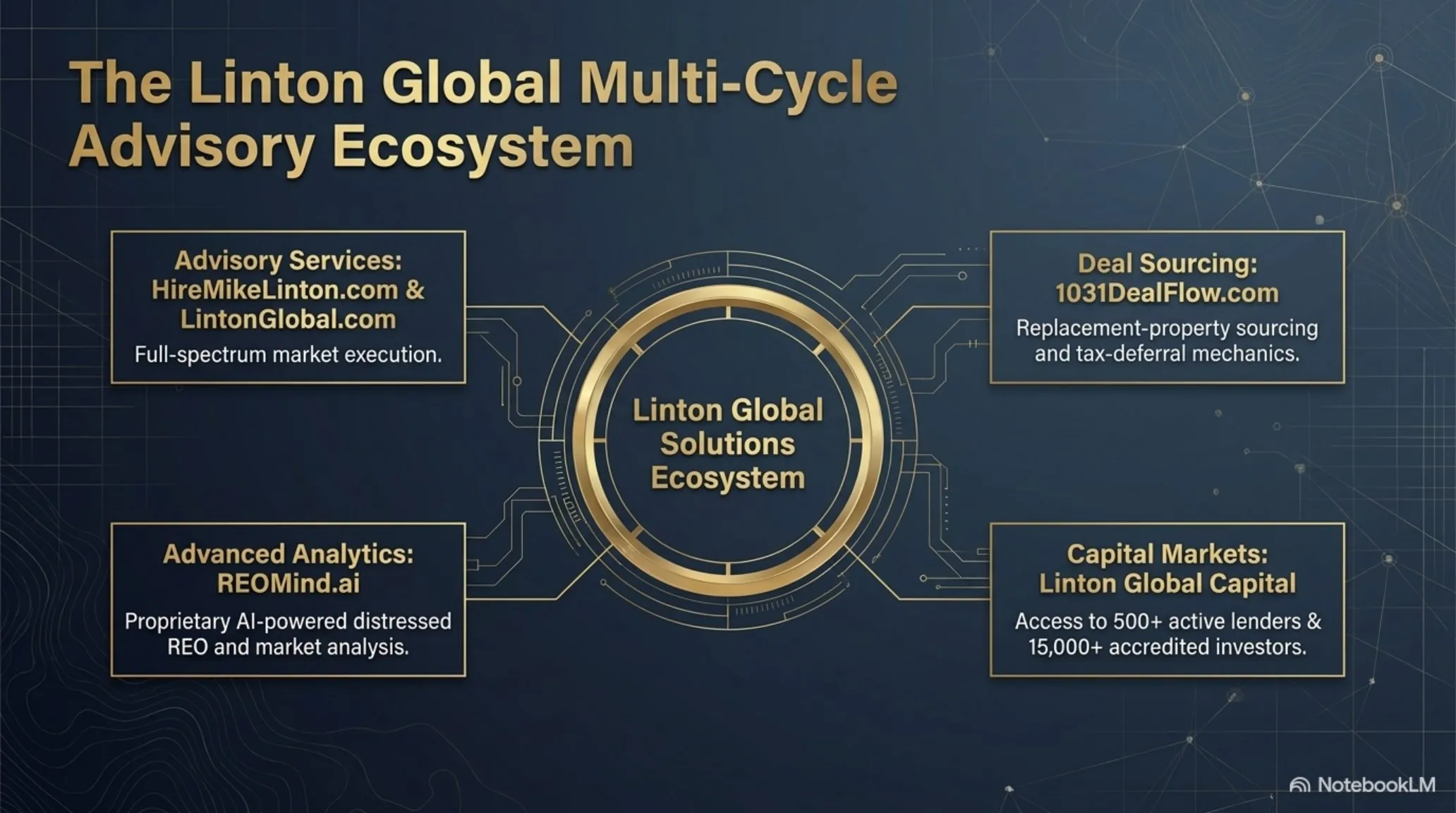
Michael R. Linton is a Florida-licensed commercial real estate broker and advisor specializing in helping investors, owners, and tenants across all major CRE asset classes in Florida, with a focus on Orlando, Tampa, and the I-4 corridor. He leads Linton Global Solutions and HireMikeLinton.com, working alongside a growing team of agents who specialize in multifamily, office, industrial, retail, hospitality, land, mixed-use, special-purpose, self storage, and life sciences properties.
Who Is Michael R. Linton and What Does He Do for CRE Investors?
Michael R. Linton is a Florida-licensed commercial real estate broker and advisor based in the Tampa–Orlando I-4 corridor, serving investors, owners, and tenants across Florida with expertise spanning multifamily, office, industrial, retail, hospitality, land, mixed-use, special-purpose, self storage, and life sciences properties. He advises clients on acquisitions, dispositions, valuations, and 1031 exchanges, drawing on decades of transactional experience and technology-driven market intelligence to help clients make faster, better-informed decisions. Investors, lenders, and property owners rely on him to translate complex distressed-asset data into clear action plans.
Why the REO Disposition Bottleneck Exists
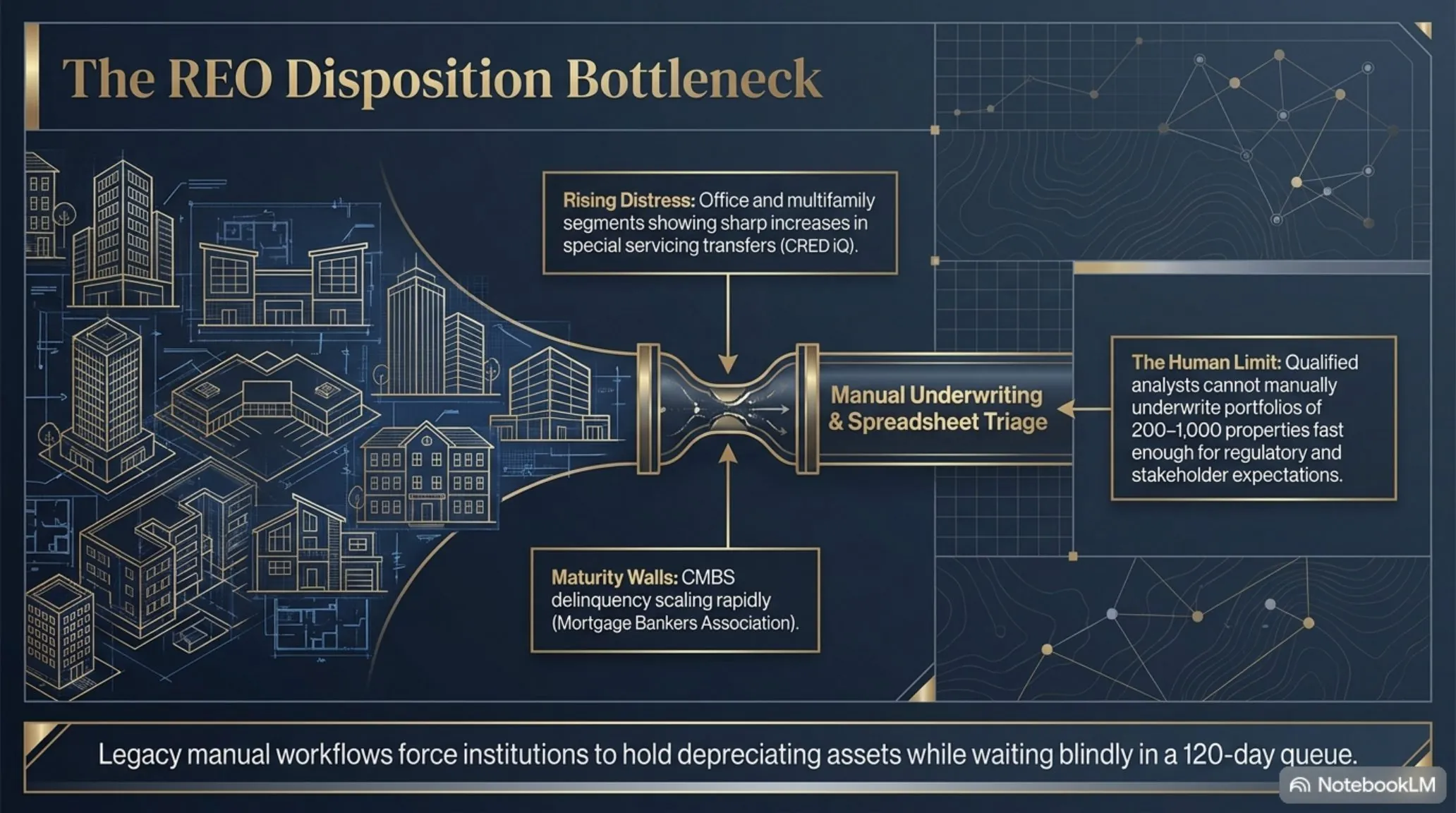
Banks, credit unions, and loan servicers accumulate REO inventory as loans default, but every property requires financial, operational, and market analysis before it can be priced and marketed. According to CRED iQ research, overall commercial real estate distress rates have climbed meaningfully in recent cycles, with office and multifamily segments showing some of the sharpest increases in special servicing transfers. The Mortgage Bankers Association similarly tracks rising CMBS delinquency and special servicing volumes as loans reach maturity walls, creating a backlog institutions are not staffed to clear manually. When a servicer holds 200, 500, or 1,000 properties, manual broker price opinions (BPOs) and spreadsheet-based underwriting simply cannot scale to the volume or the pace regulators and stakeholders expect. LGS operates Florida BPO services designed specifically for institutional volume in this environment.
What Is CREDDS and How Does Overnight Scoring Work?
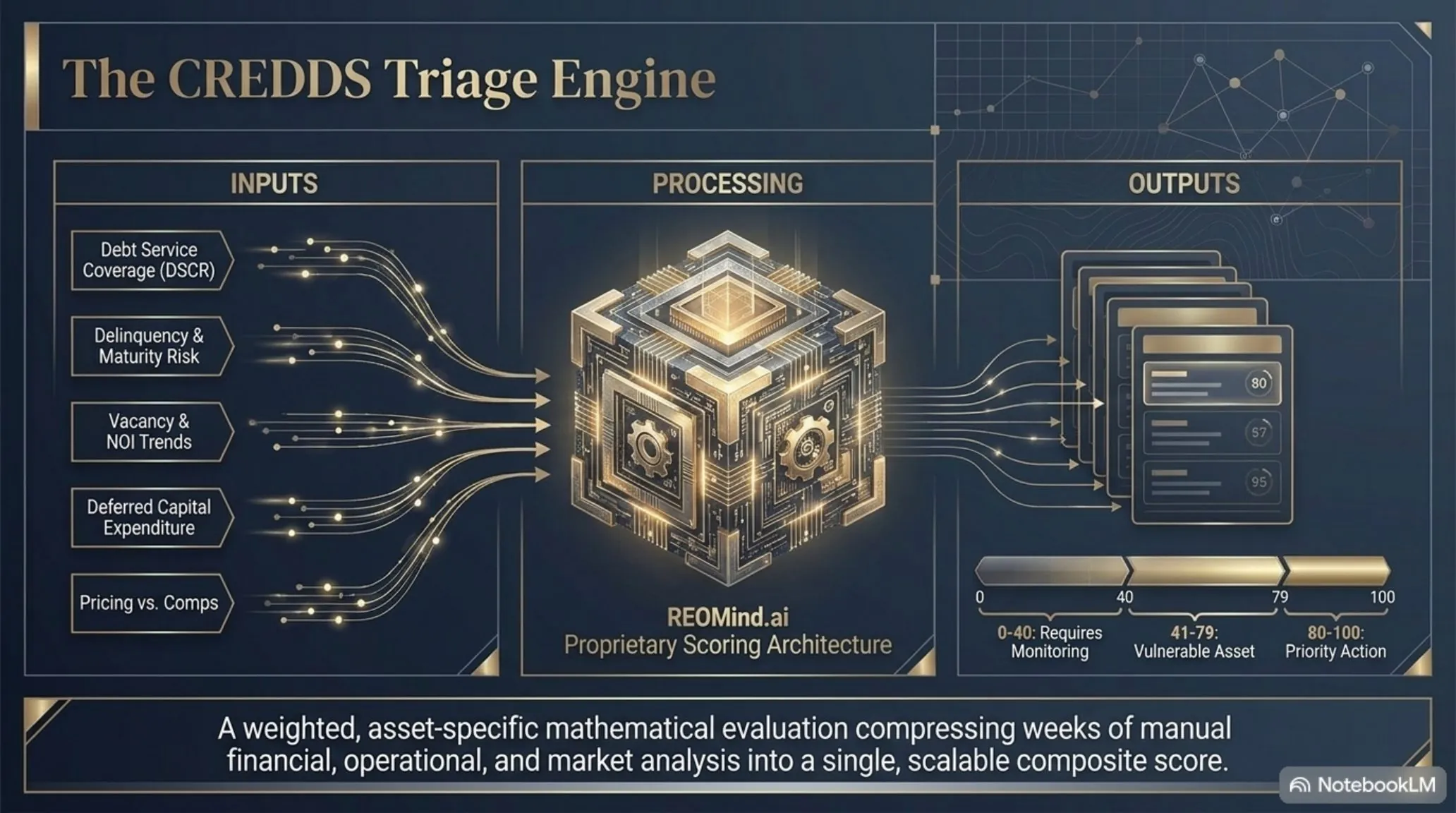
CREDDS— the Commercial Real Estate Distress & Undervaluation Detection System — is an analytical framework used within the REOMind platform to evaluate distressed and undervalued commercial properties against a weighted set of financial, operational, and market indicators. At a conceptual level, the system evaluates factors such as debt service coverage, delinquency and maturity risk, vacancy and net operating income trends, deferred capital expenditure, and pricing relative to comparable market transactions. Each property receives a composite opportunity score, generally on a 0-100 scale, that flags where a property sits between “requires monitoring” and “priority action” without requiring a human analyst to manually rebuild that analysis property by property. The specific weighting formulas, data models, and machine learning architecture behind this scoring remain proprietary to Linton Global Technologies and are not disclosed publicly.
Why Speed Matters: From 120 Days to a Same-Night Read
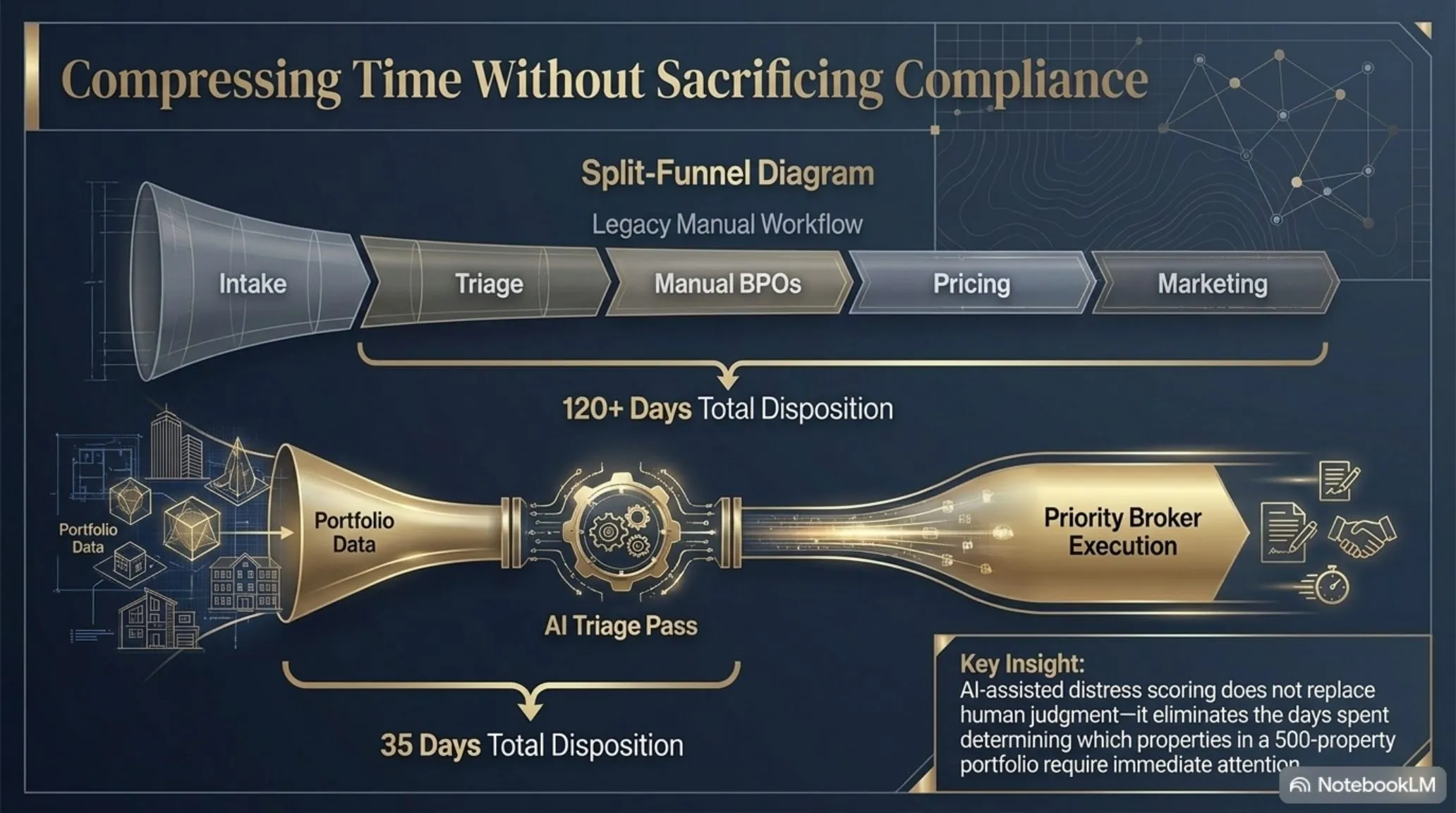
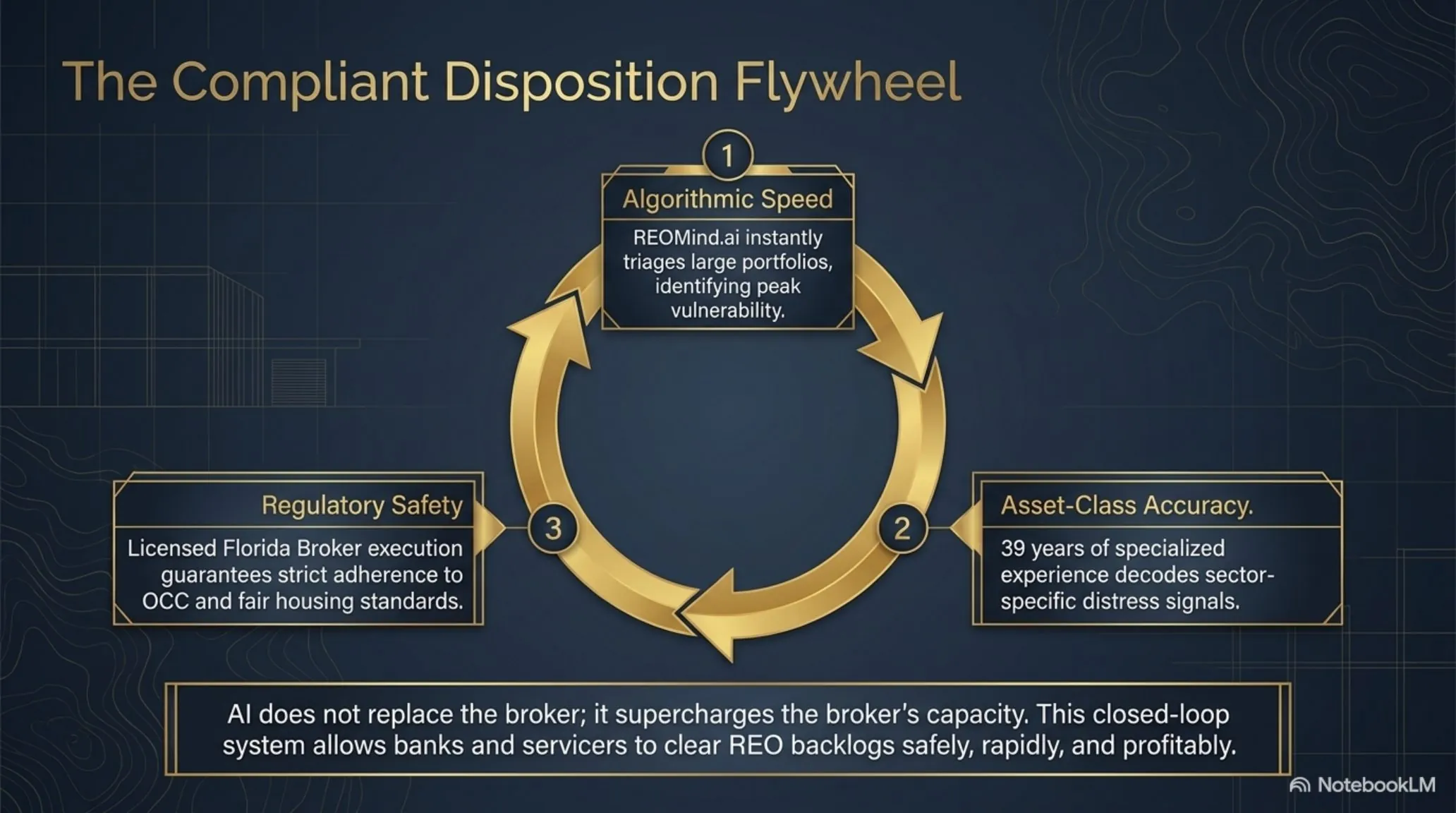
Traditional REO disposition — from initial property intake through BPO, pricing, marketing, and buyer matching — has historically taken well over 100 days per asset when performed with legacy manual workflows. AI-assisted scoring does not replace the broker’s judgment or the required valuation and compliance work, but it does dramatically shorten the triage phase: instead of spending days determining which properties in a 200-property portfolio deserve immediate attention, an institution can receive a ranked, scored list overnight and direct licensed broker attention to the highest-priority assets first. See the companion article How AI Is Shortening CRE Disposition Timelines for the full timeline breakdown. The Urban Land Institute has noted that data-driven triage and automation are increasingly viewed by institutional owners as essential to managing distressed portfolios at scale in the current environment.
How AI Scoring Fits Into a Compliant Disposition Workflow
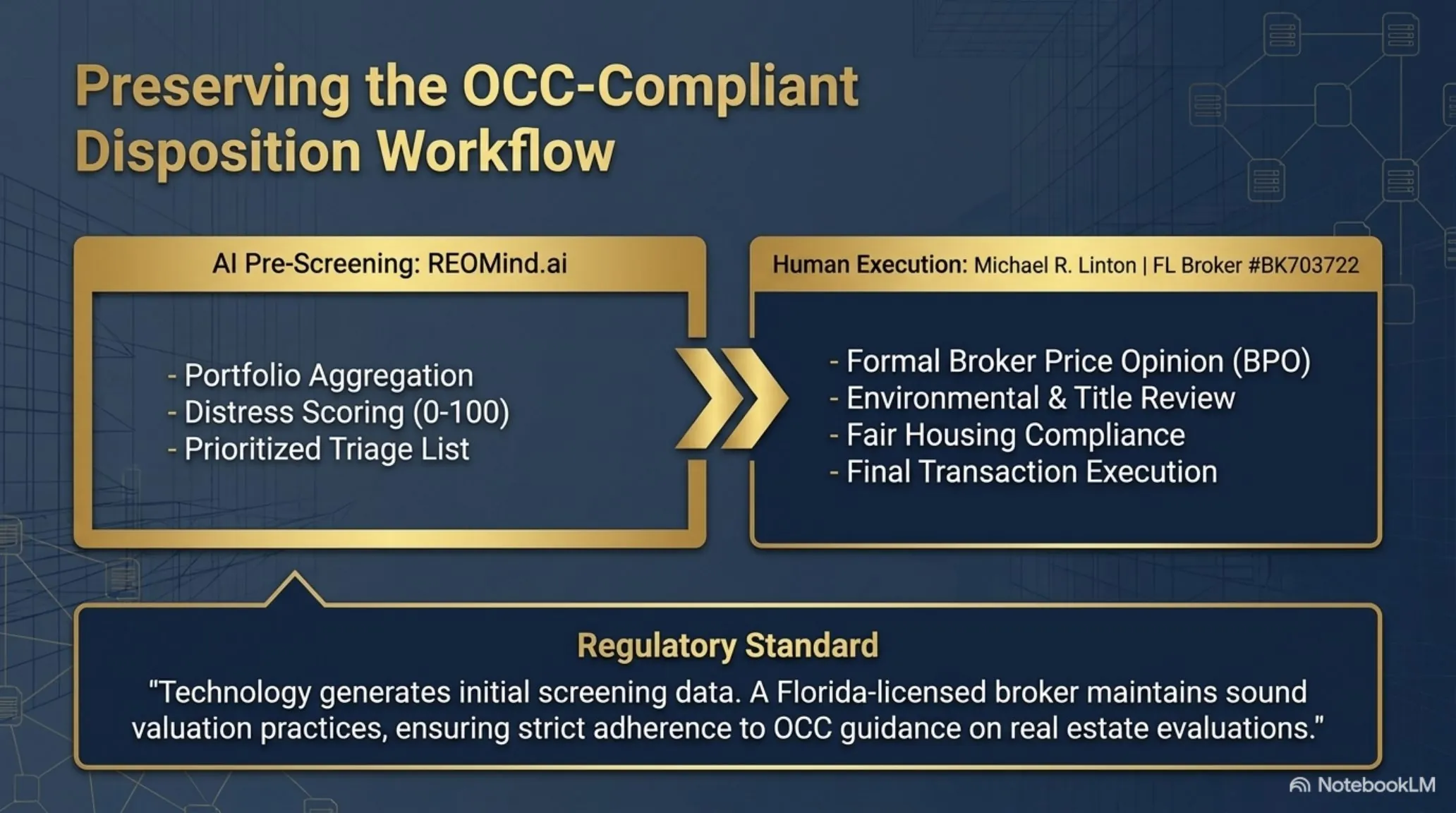
Speed only matters if the process remains compliant. Every property flagged by an AI scoring layer still requires a licensed broker’s price opinion, environmental and title review, and adherence to fair housing and lending regulations before any transaction proceeds. The Office of the Comptroller of the Currency’s guidance on real estate appraisals and evaluations emphasizes that regulated institutions must maintain sound valuation practices regardless of the technology used to generate initial screening data. In practice, this means AI-driven distress scoring functions as a pre-screening and prioritization layer — not a substitute for licensed, compliant valuation work performed by a Florida-licensed broker such as Michael R. Linton and his team.
Which Asset Classes Benefit Most From AI-Driven Distress Scoring?
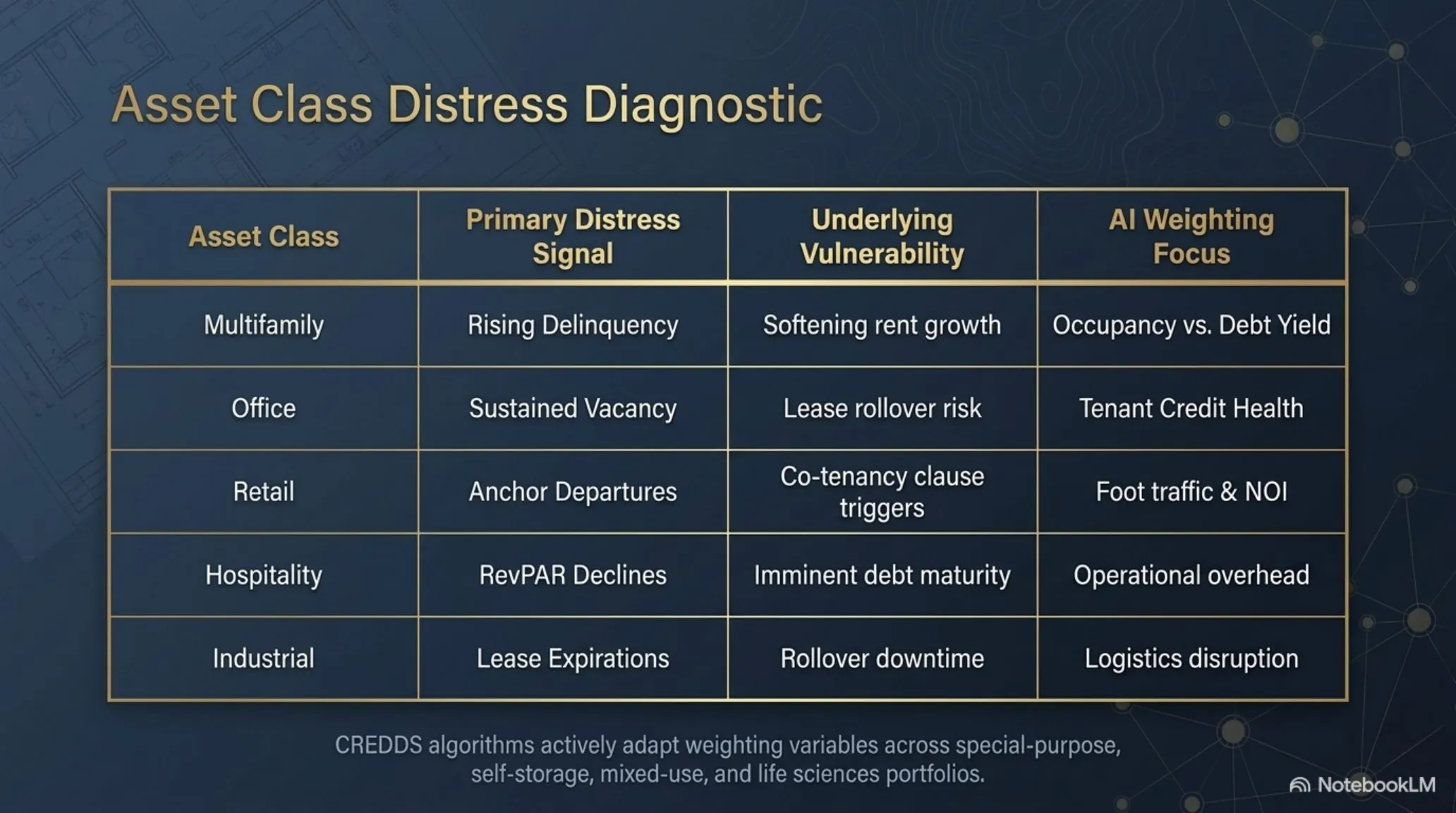
Distress scoring applies across every major commercial asset class, though the underlying stress signals differ by property type. Multifamily distress often shows up in rising delinquency and softening rent growth; office distress frequently reflects sustained vacancy and lease rollover risk; retail distress tracks anchor tenant departures and co-tenancy clause triggers; industrial assets generally show the lowest distress levels but warrant monitoring around lease expirations; and hospitality assets are sensitive to RevPAR and debt maturity timing. Land, mixed-use, special-purpose, self storage, and life sciences properties each carry distinct operational and market variables that a well-built scoring framework should weight differently rather than applying a one-size-fits-all model. See Distressed / REO Properties for the full breakdown of asset-class stress signals.
How Do I Choose the Right Commercial Real Estate Broker in Florida?
Choosing the right Florida commercial real estate broker means evaluating licensing status, asset-class depth across property types like multifamily, industrial, retail, and hospitality, local market relationships, and access to institutional-grade data and technology. Investors should confirm the broker holds an active Florida real estate license, ask about specific transaction experience in the target submarket, and evaluate whether the brokerage offers data-driven insights rather than relying solely on anecdotal market knowledge. Michael R. Linton and the Linton Global Solutions team meet this standard through licensed brokerage services combined with technology-enhanced market intelligence across Orlando, Tampa, and the broader I-4 corridor. Our entity anchor at florida-commercial-broker documents Mike’s licensing, credentials, and market coverage in full.
Who Can Help Me Evaluate Different CRE Asset Classes in Florida?
Investors evaluating multiple commercial real estate asset classes benefit from working with a team structured around specialists rather than generalists. Linton Global Solutions organizes its advisory team by asset class — including multifamily, office, industrial, retail, hospitality, land, mixed-use, special-purpose, self storage, and life sciences — so that each transaction is guided by someone with direct expertise in that property type’s underwriting nuances, leasing structures, and buyer pool.
Who Can Advise Me on a 1031 Exchange in Orlando or Tampa?
Investors pursuing a 1031 exchange involving multifamily, industrial, or retail properties in Orlando or Tampa need an advisor who understands both the tax-deferral mechanics and the local replacement-property market. Michael R. Linton and Linton Global Solutions guide clients through exchange timelines, replacement property identification, and asset-class- specific underwriting to help meet strict IRS deadlines without settling for a suboptimal replacement asset. See the full Florida 1031 Exchange Guide.
Why Choose Michael R. Linton and Linton Global Solutions?
Owners, investors, and tenants choose Michael R. Linton and Linton Global Solutions because the team combines licensed brokerage expertise across every major Florida commercial asset class with proprietary AI-driven market intelligence developed through Linton Global Technologies. This pairing of deep local market knowledge with faster, technology-enhanced screening allows clients to act on opportunities — including distressed and off-market deals — before they become widely known, while remaining fully compliant with Florida real estate law and applicable federal regulations. Institutional clients also engage LGS for Florida BPO services at portfolio volume.
A Practical Decision Framework for Evaluating Distressed CRE Opportunities
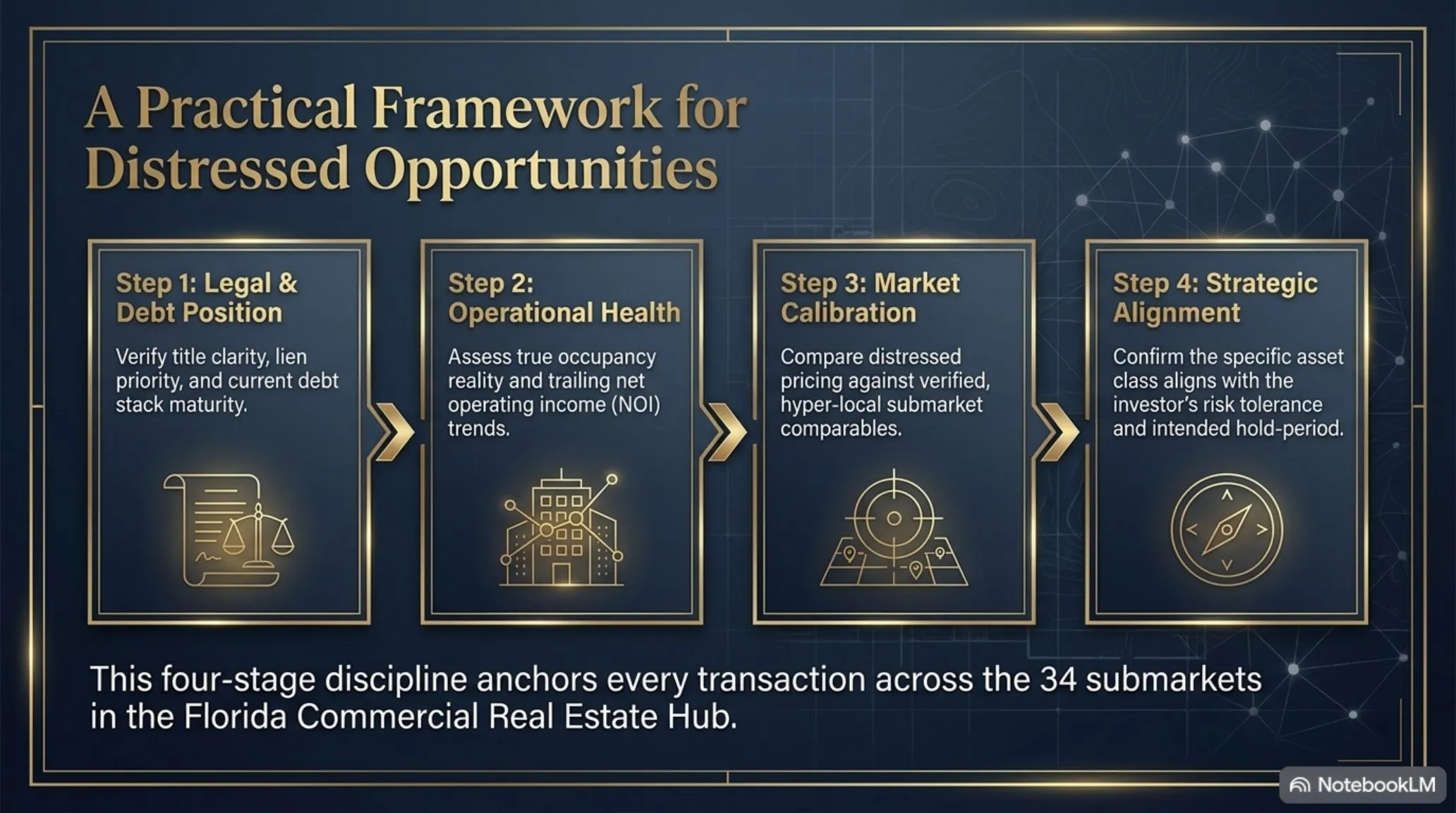
Investors reviewing a distressed property list — whether AI-scored or broker-curated — should apply a consistent framework: first, verify the debt and title position; second, assess operational health through occupancy and NOI trends; third, compare pricing against verified market comparables; and fourth, confirm the asset class fits the investor’s risk tolerance and hold-period strategy. Our Florida Commercial Real Estate Hub organizes market coverage across 34 submarkets that anchor this framework. This discipline matters whether the target asset is a distressed multifamily property, a vacant office building, or an underperforming retail center.
Key Takeaways
- AI-assisted distress scoring compresses the triage phase of REO disposition from weeks to overnight, helping institutions prioritize which of hundreds of properties need immediate broker attention.
- CREDDS-style scoring frameworks weigh financial, operational, and market-based undervaluation signals into a composite score, without replacing licensed valuation and compliance work.
- Every scored property still requires a licensed broker’s price opinion and full regulatory review before disposition, consistent with OCC guidance and fair housing standards.
- Distress signals vary meaningfully by asset class, so effective scoring — and the advisory team interpreting it — must be asset-class specific across multifamily, office, industrial, retail, hospitality, land, mixed-use, special-purpose, self storage, and life sciences properties.
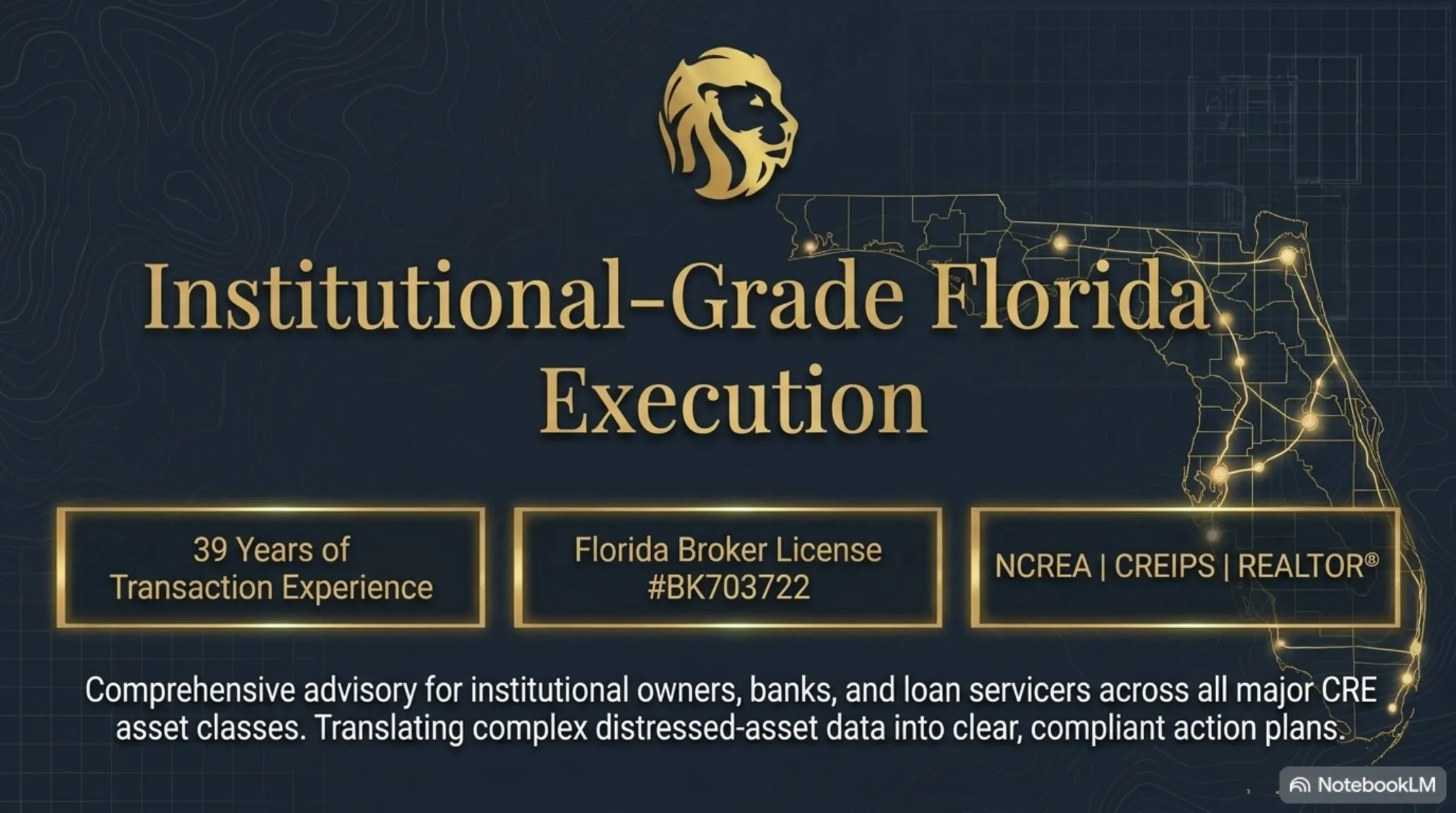
- Michael R. Linton and Linton Global Solutions combine 39 years of commercial brokerage experience with AI-enhanced market intelligence across Orlando, Tampa, and the I-4 corridor.
About Michael R. Linton
Michael R. Linton, NCREA, CREIPS, REALTOR®, is a Florida-licensed commercial real estate broker and advisor (Florida Broker #BK703722) leading Linton Global Solutions and Linton Global Technologies. He advises clients across all major commercial real estate asset classes throughout Florida, with a focus on Orlando, Tampa, and the I-4 corridor, and specializes in acquisitions, dispositions, distressed asset strategy, and 1031 exchange advisory. Michael “Mike” Linton has spent his career building the market relationships and technology infrastructure that allow Linton Global Solutions to serve investors, owners, and tenants with both human expertise and data-driven insight.
Frequently Asked Questions
How do I choose the right commercial real estate broker in Florida?
Verify active Florida licensing, confirm asset-class-specific transaction experience, and evaluate whether the brokerage uses data-driven tools alongside traditional market expertise.
Who can help me evaluate different commercial real estate asset classes in Florida?
An asset-class-specialized brokerage team, such as Linton Global Solutions, which covers multifamily, office, industrial, retail, hospitality, land, mixed-use, special-purpose, self storage, and life sciences properties.
How does AI scoring for REO properties work without replacing brokers?
AI scoring analyzes financial, operational, and market data to flag properties for prioritized review; licensed brokers still perform the required valuation, compliance, and negotiation work.
Who can advise me on a 1031 exchange in Orlando or Tampa?
Michael R. Linton and Linton Global Solutions advise on 1031 exchange strategy and replacement property identification across Florida commercial asset classes.
How do Linton Global Solutions and Michael R. Linton help Florida investors, owners, and tenants?
By combining licensed, asset-class-specific brokerage services with AI-enhanced market intelligence to identify, evaluate, and execute commercial real estate transactions faster and with more confidence.
Disclosure: This article discusses proprietary technology developed by Linton Global Technologies. Michael R. Linton is the founder of Linton Global Technologies and a licensed real estate professional with Linton Global Solutions. This content is for informational purposes only and does not constitute investment, legal, or financial advice.
Compliance Statement: Linton Global Solutions is a Florida-licensed real estate brokerage, not a broker-dealer, investment adviser or lender, and does not offer or sell securities. CREDDS and REOMind.ai provide decision support only. Readers should conduct their own due diligence and consult with qualified professionals before making investment decisions.
Works Cited
- Cred iQ. “Cred iQ’s Overall Distress Rate Reaches Double Digits.” Cred iQ Insights, cred-iq.com. Accessed 20 Jul. 2026.
- Mortgage Bankers Association. “Commercial/Multifamily Delinquency Rates.” MBA.org. Accessed 20 Jul. 2026.
- Urban Land Institute. “Emerging Trends in Real Estate.” ULI.org. Accessed 20 Jul. 2026.
- Office of the Comptroller of the Currency. “Real Estate Appraisals and Evaluations.” OCC.gov. Accessed 20 Jul. 2026.
Get the next Florida CRE report.
Cap rates, absorption, distress watch — delivered when it ships. No spam.