Michael R. Linton, Florida Broker #BK703722, teaches how commercial REO, non-performing loans, and distressed 1–4 unit homes get sourced, underwritten, and closed across Orlando, Tampa, and the I-4 corridor through free Linton Global Solutions webinars.
The best distressed deals in Florida rarely reach the open market. They move through disposition officers to a short list of buyers who are known, funded, and fast. These webinars exist to teach serious buyers how to get on that list.— Michael R. Linton, Florida Broker #BK703722, Founder of Linton Global Solutions
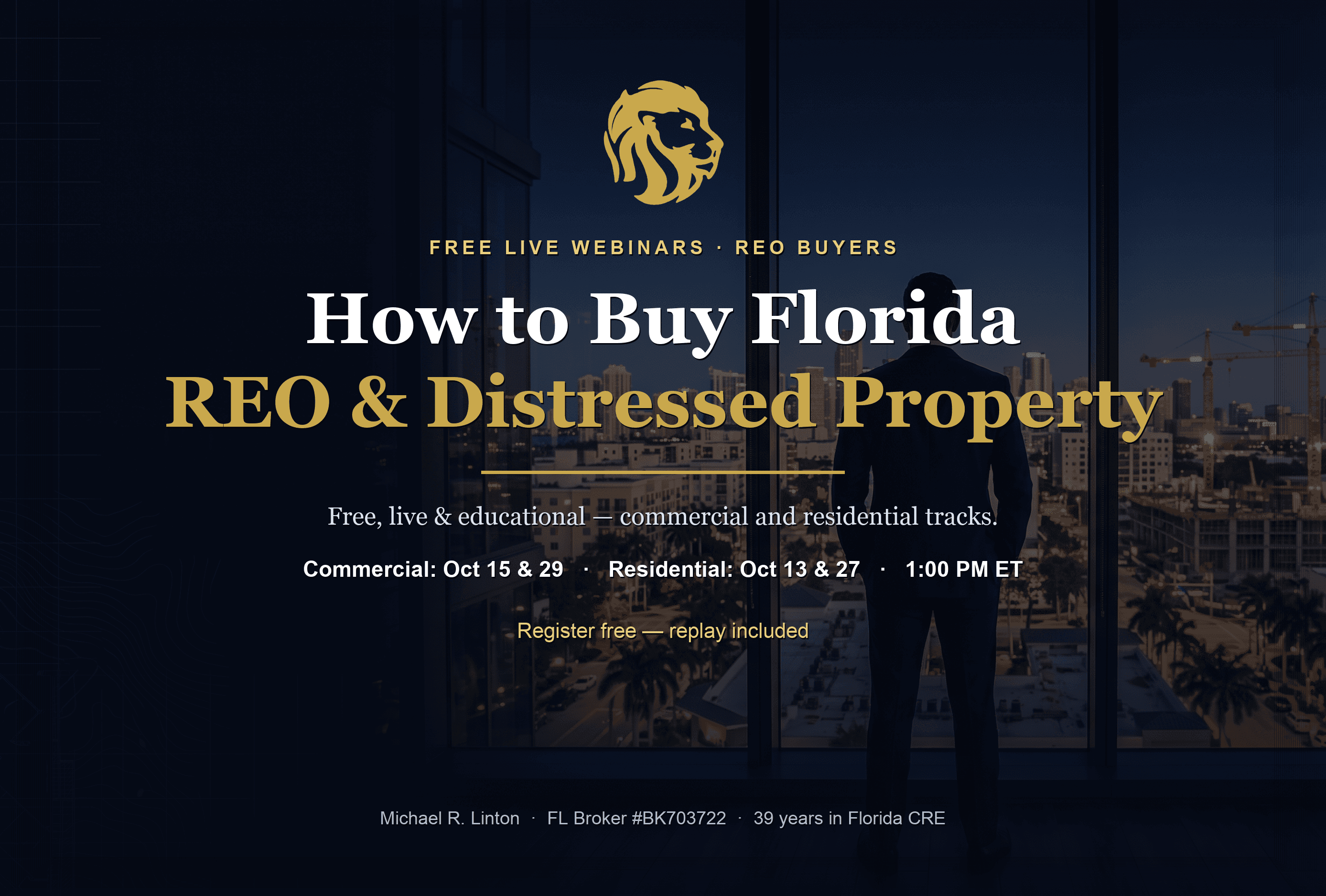
Two Free Webinars, Two Buyer Paths
Both sessions cover the same discipline applied to two different buyers. Both are free, live, and educational — not paid courses — and both send registrants an on-demand replay.
Commercial track — “Acquiring Commercial Distressed Assets in Florida.” For investors, funds, and 1031 exchangers acquiring commercial REO, non-performing loans (NPLs), and distressed assets. Upcoming live sessions: Thursday, October 15 and Thursday, October 29, 1:00 PM ET. Save a seat here.
Residential track — “How to Buy Florida REO and Distressed Homes.” For investors and owner-occupant buyers acquiring bank-owned or distressed 1–4 unit homes. Upcoming live sessions: Tuesday, October 13 and Tuesday, October 27, 1:00 PM ET. Save a seat here.
Registration is free and creates no representation or obligation. Any engagement is discussed separately, in writing, if and when a buyer chooses to move forward.
Who Is Michael R. Linton, and What Does He Do for Distressed-Property Buyers?
Michael R. Linton is a Florida-licensed commercial real estate broker and advisor based in the Tampa–Orlando I-4 corridor, serving investors, owners, and tenants across Florida, with expertise across multifamily, office, industrial, retail, hospitality, land, mixed-use, special-purpose, self storage, and life sciences properties. He leads Linton Global Solutions and its technology affiliate, Linton Global Technologies.
For distressed-property buyers, Michael “Mike” Linton does three things: he sources inventory before it is broadly marketed through long-standing servicer relationships; he underwrites the real economics of an as-is or income-impaired asset; and he structures acquisitions that close. The webinars distill that same process into a teaching format so a serious buyer can understand the game before entering it.
Where Florida REO and Distressed Inventory Actually Comes From
Most buyers only ever see the picked-over listings on public portals. The inventory that matters originates upstream. On the commercial side, banks and special servicers dispose of REO on their own timeline, NPL pools trade between institutions and funds, and receivers and bankruptcy trustees move assets under court supervision. On the residential side, banks and servicers list REO, the foreclosure pipeline runs from pre-foreclosure through auction, and distressed private sellers — estates, tired landlords, code-violation situations — round out the supply.
The common thread is a disposition officer whose job is to move the asset cleanly. Their nightmare is a buyer who ties up a property and then re-trades or fails to close, so the cleanest inventory routes first to buyers who are known, credible, funded, and fast. Getting on that short list is a relationship function — which is exactly what the webinars teach buyers to build.
Get the next Florida CRE report.
Cap rates, absorption, distress watch — delivered when it ships. No spam.
How Distressed Assets Get Underwritten
A distressed asset is not defined by its condition. It is defined by the gap between where it is priced and where it should be priced — and that gap only becomes a deal after you subtract every cost the discount was hiding. On income property, value follows net operating income and the cap rate, but on a distressed asset the in-place income is usually broken by vacancy, below-market leases, or deferred maintenance. The disciplined buyer underwrites two numbers: what the asset produces today, and what it produces stabilized after a credible business plan.
For commercial and institutional decisions, Linton Global Technologies runs the CREDDS Framework — CREDDS (Commercial Real Estate Distress & Disposition Score) — a 12-page Asset Disposition Brief that scores commercial real estate assets on three weighted dimensions: Financial Health (40 points), Operational Stability (30 points), and Undervaluation Signal (30 points). CREDDS scores of 70–100 flag strong disposition candidates; 50–69 signal moderate concern; 25–49 signal significant intervention required; and 0–24 mark critical situations. CREDDS is one analytical output of REOMind.ai, the commercial real estate intelligence platform owned by Linton Global Technologies.
A distressed asset isn't defined by its condition — it's defined by the gap between where it's priced and where it should be priced. That's why every disposition analysis at Linton Global runs through the CREDDS Framework before pricing recommendations reach an investor.— Michael R. Linton, Florida Broker #BK703722, Founder of Linton Global Solutions
How the Acquisition Actually Closes
Sourcing gets you the look and underwriting tells you whether to act, but distressed closings are where inexperienced buyers lose deals and deposits. The path runs from letter of intent to purchase agreement to a diligence period to close, and deals die in three predictable places: a weak LOI that signals the buyer is not serious or not funded; diligence surprises that trigger a re-trade and destroy trust; and financing that was not lined up before the deposit went hard. The buyers who close show up funded, move fast through diligence, and do not re-trade without cause. Certainty of close, on distressed product, routinely beats the last dollar of price.
How to Choose a Florida Commercial Real Estate Broker
Evaluate a Florida commercial broker on three things: verifiable licensing and credentials, demonstrated command of the specific asset class and strategy at hand, and the relationships that produce inventory and clean closings. Confirm the license directly with the Florida Department of Business and Professional Regulation, ask the broker to walk through a live underwriting, and ask who feeds them deals. Michael R. Linton holds Florida Broker license #BK703722 and anchors his credentials at the Florida commercial broker entity page. Linton Global Solutions leads with service — the webinars, glossary, and calculators are published openly because teaching the market is how trust compounds.
Choosing a Florida commercial broker isn't about the biggest logo. It's about whether the advisor can underwrite the deal, run comparable dispositions, structure the exchange, and answer why the market sees this asset the way it does.— Michael R. Linton, Florida Broker #BK703722, Founder of Linton Global Solutions
The Buyer's Path at a Glance
Reserve Your Seat
Pick the track that fits — commercial or residential. Free, live, and educational, with an on-demand replay if you can't attend.
Frequently Asked Questions
Are the webinars really free?
Yes. Both are free, live, educational sessions — not paid courses. They exist so serious buyers understand how distressed acquisition works and, if it fits, work with Linton Global Solutions on live opportunities.
What if I cannot attend live?
Register anyway. Every session is recorded and registrants receive an on-demand replay.
Do I have to be buying in Florida?
The sessions are built on the Florida market, and Linton Global Solutions represents buyers in Florida only (FL Broker #BK703722). For out-of-state acquisitions, Linton Global Solutions coordinates with a referral partner in that market.
How do I compare commercial asset classes as a distressed buyer?
Compare multifamily, office, industrial, retail, hospitality, land, mixed-use, special-purpose, self storage, and life sciences on income durability, capital intensity to stabilize, and exit liquidity. The commercial webinar walks through how those factors change the underwriting on a distressed asset, and Michael R. Linton and his asset-class specialists advise on the comparison directly.
Does registering commit me to using Linton Global Solutions as my broker?
No. Registration is free and creates no representation or obligation. Any engagement is discussed separately, in writing, if and when you choose to move forward.
Market intelligence should be shared, not gatekept. Every calculator, glossary entry, webinar, and case study we publish at Linton Global exists because a Florida buyer asked a question that deserved a real answer, not a sales call.