When I was twelve years old, my father — a seasoned CPA who spent his life reading balance sheets — put a question to me one evening after dinner. “Michael,” he said, “would you rather work for $500 a day for 30 days, or start with a single penny that doubles every day for those same 30 days?”
I was young, and I had not yet met the idea of exponential growth. So I did what almost everyone does. I chose the $500. Fifteen thousand dollars in a month felt like a fortune, and the penny felt like a joke.
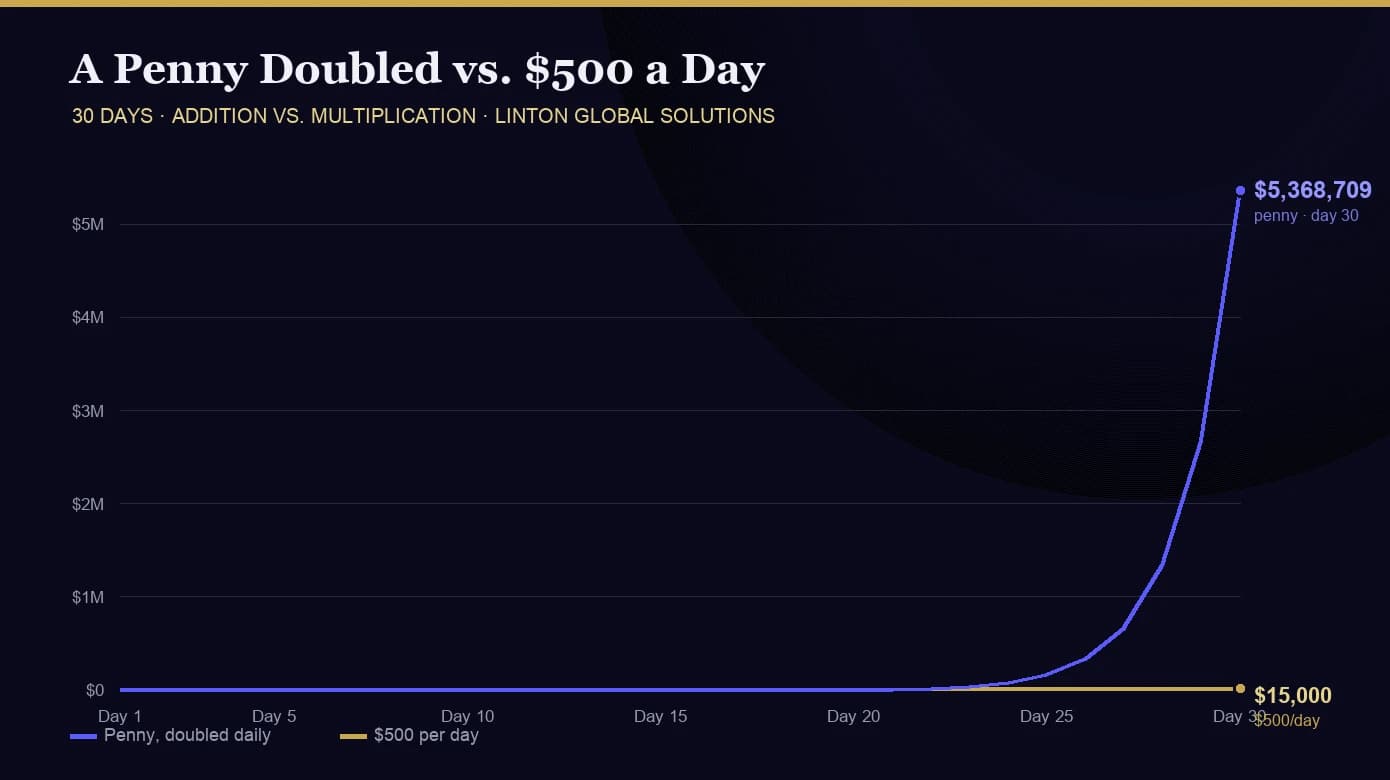
He didn’t argue. He reached for a sheet of ledger paper — long before a computer sat on every desk — and began to plot two lines by hand. One climbed a gentle, steady staircase. The other lay almost flat for two weeks… and then, somewhere around day twenty, it turned and shot straight off the top of the page.
That single sheet of paper rearranged how I saw money for the rest of my life. Below is the same curve my father drew, rendered a little more precisely than ledger paper allowed. Watch what happens after day twenty — and switch it to a log scale to see the $500 line that looks flat is really climbing too.
A penny doubled vs. $500 a day
Two starting points, 30 days. One grows by addition; the other by multiplication.
On a linear scale the $500 line looks flat — not because it isn’t growing, but because $15,000 is invisible next to $5.3 million. Switch to a log scale to see both climb.
30-year real estate growth estimator
An illustration of compounding — not a forecast or a promise of returns.
Of the projected $1,077,756, about $727,756 is compounding growth on top of the $350,000 you contributed — at a steady 6% a year for 30 years.
What a penny knows about real estate
Compounding is the whole game
The penny is a parable, not a strategy — no one hands you a coin that doubles daily. But real estate is the closest thing most people will ever own to that curve, because it compounds on four engines at once, not one:
Appreciation. A well-bought property tends to rise in value over time, and each year’s gain builds on a larger base — the same multiplication the penny lives on.
Amortization. When a property is financed and leased, the tenants retire the debt for you. Every payment converts a little more of the building from the bank’s to yours.
Cash flow, reinvested. Income taken back out and put into the next deal is the lever that turns one property into a portfolio — which is exactly why a steady pipeline of scored opportunities matters so much.
Tax-advantaged growth. Tools like the 1031 exchange let gains roll forward into the next property instead of being taxed away — compounding uninterrupted, which is exactly what makes the penny curve bend. (New to it? Start with the 1031 basics and the 1031 boot calculator.)
Any one of these is modest in a single year. Stacked, and left alone across decades, they bend the line the same way my father’s pencil did.
What “deal flow” actually means
The lifeblood of an investing career
Deal flow is the steady stream of real investment opportunities crossing your desk. It sounds mundane. It is everything. A strong deal flow buys you the one luxury that separates disciplined investors from anxious ones: the ability to say no. When the next opportunity is always coming, you never have to force a bad one to work.
Building that stream is most of what we do at Linton Global Solutions — sourcing, underwriting, and structuring commercial and investment real estate so clients choose from a shortlist that already fits their risk and their objectives. Getting the numbers right on each one is its own discipline; our cap rate and underwriting tools exist for exactly that.
Why Florida rewards patient capital
The market under the curve
The penny needs time and a place that keeps growing. Florida has been that place. Sustained population and business in-migration, no state income tax, a pro-enterprise climate, and a geography that anchors trade and tourism give the state a durability that patient real estate capital rewards. Markets move in cycles everywhere; what matters for compounding is a base that keeps expanding underneath you across decades — a dynamic we track closely in our Central Florida cap rate analysis.
Our license to represent buyers and sellers directly is Florida (BK703722); beyond it, we work through a vetted network of referral partners so a client’s deal is always handled by someone licensed where the property sits.
See it to the penny
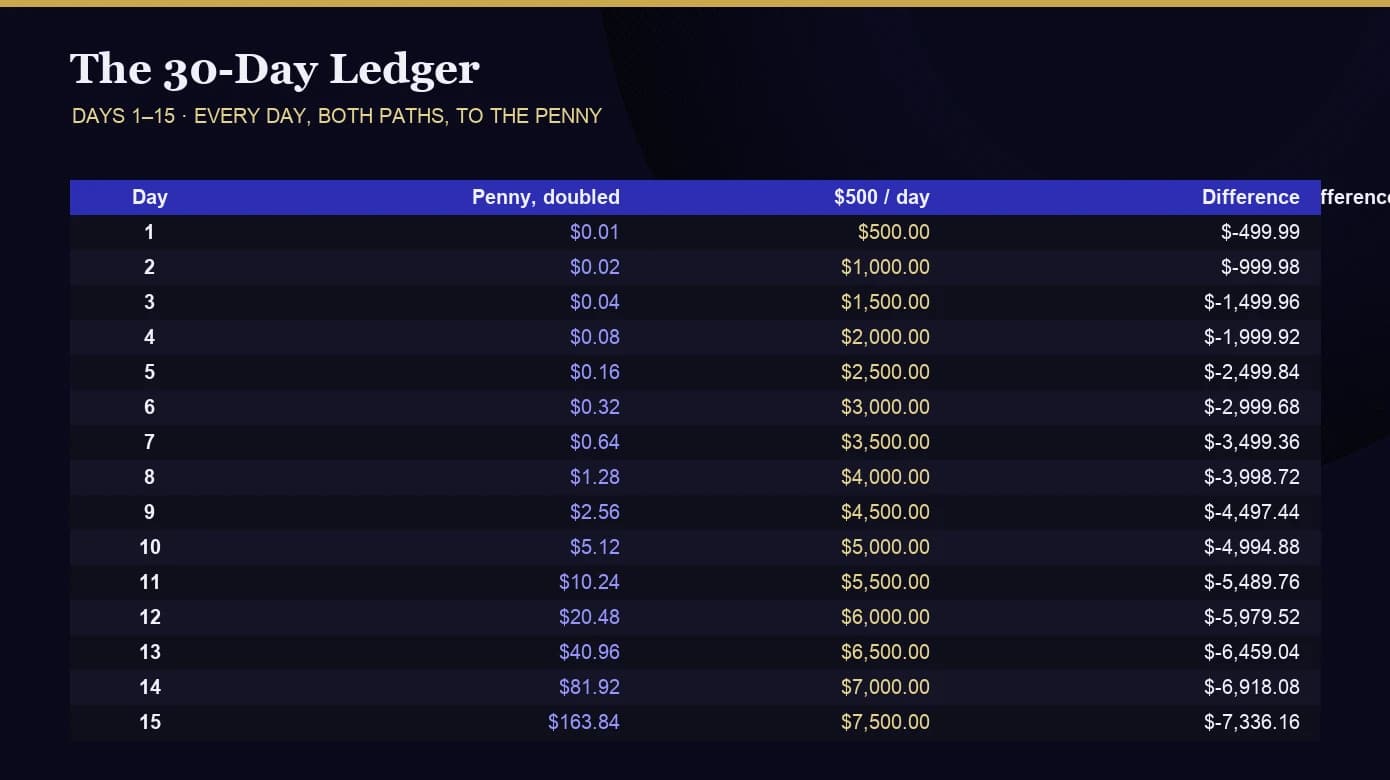
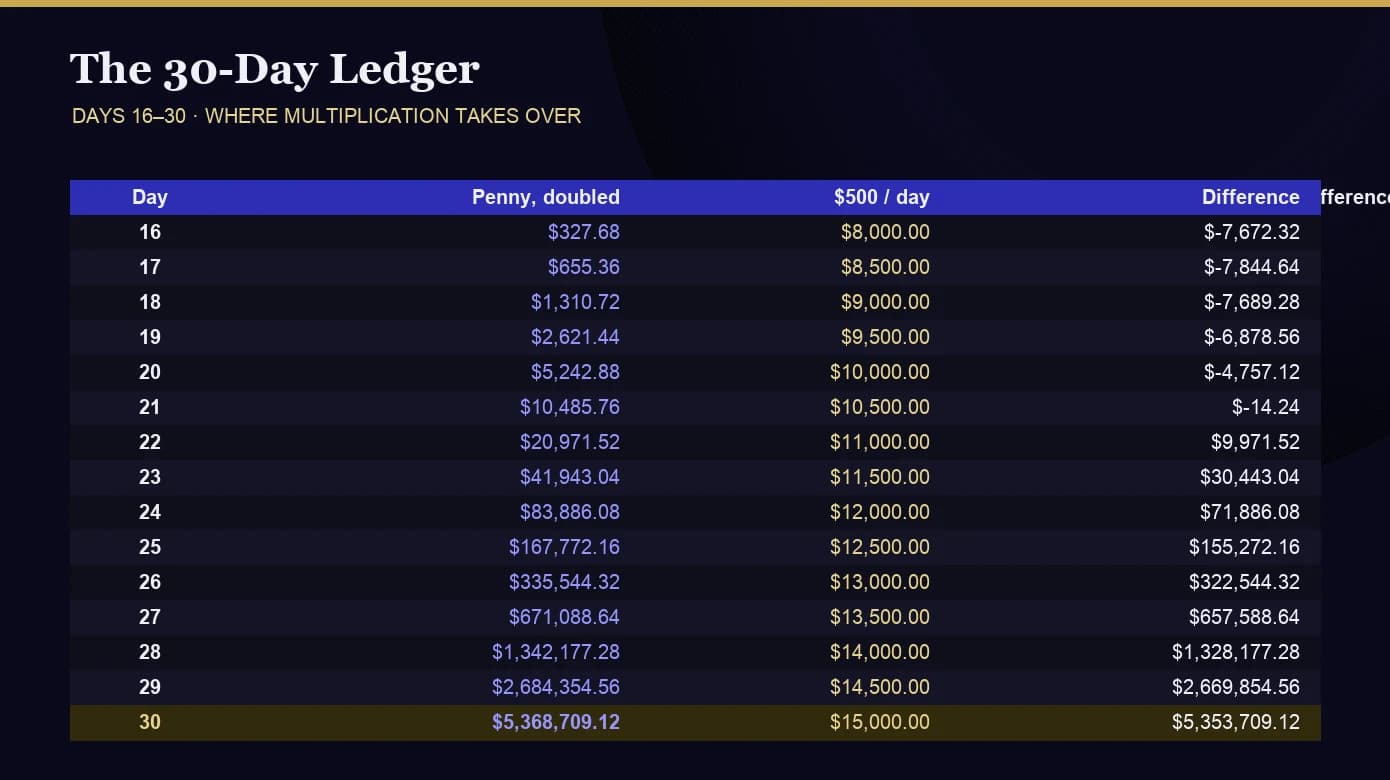
The full 30-day ledger
Numbers on a curve are one thing; the day-by-day figures are another. Page through the ledger below — the chart, then every day of both paths — or take the spreadsheet with you.
Take the ledger with you
All 30 days, both paths, with the formulas built in — change the starting amount and watch it recompute.
Frequently asked questions
What is the penny-doubling thought experiment?+
It asks whether you would rather earn $500 a day for 30 days, or start with one penny that doubles every day for the same 30 days. Most people choose the $500 — but the doubling penny reaches $5,368,709.12 on day 30, while the $500-a-day job earns just $15,000. It is a demonstration of exponential (compound) growth versus linear (additive) growth.
How much is a penny doubled every day for 30 days?+
The penny’s value on day 30 is $5,368,709.12 (that is $0.01 multiplied by 2 to the 29th power). If you instead summed every day’s balance, the cumulative total exceeds $10.7 million. Either way it dwarfs the $15,000 earned at $500 per day.
How does compounding apply to real estate?+
Real estate compounds on four engines at once: appreciation (value rising on a growing base), amortization (tenants paying down your loan), cash flow reinvested into the next deal, and tax-advantaged growth through tools like the 1031 exchange that let gains roll forward untaxed. Stacked and left alone across decades, they bend the wealth curve much like the doubling penny.
What is real estate deal flow and why does it matter?+
Deal flow is the steady stream of real investment opportunities crossing your desk. A strong deal flow buys you the ability to say no — when the next opportunity is always coming, you never have to force a bad one to work. Sourcing, underwriting, and structuring that stream is central to what Linton Global Solutions does for clients.
Is the 30-year real estate growth estimator a guarantee of returns?+
No. The estimator is illustrative only. It applies a single fixed rate of appreciation to a starting amount plus optional annual contributions. Real returns vary widely by market, asset, financing, timing, and management, and are never guaranteed. It is not investment, tax, or legal advice.
Start your deal flow
The best time to plant the tree was twenty years ago. The second best time is a conversation today. Tell us what you’re building and we’ll bring you the deals that fit.
Illustrative only.The estimator applies a single fixed rate of appreciation to a starting amount plus optional annual contributions. Real estate returns vary widely by market, asset, financing, timing, and management, and are never guaranteed. Figures shown are hypothetical and are not investment, tax, or legal advice, and not an offer of securities. Michael R. Linton is a licensed Florida real estate broker (BK703722); Linton Global Solutions represents clients directly in Florida and coordinates through licensed referral partners elsewhere. Consult your own CPA, tax attorney, and qualified intermediary before acting on anything here. Adapted and expanded from “Deal Flow: Find Your Next Real Estate Investment,” Chapter 1.