Michael R. Linton, Florida Broker #BK703722, advises owners of retail, industrial, and special-purpose properties on distressed refinances, bridge loans, and sales across Orlando, Tampa, and South Florida via Linton Global Solutions.
Acceleration changes the question a lender asks. Before, it was whether the property supports the loan. After, it is whether the borrower can stop the bleeding first. Most refinance lenders will not be the first money into a fire.
Every week, a Florida owner sends some version of the same email: my bank accelerated the loan, I have a tenant lined up, and I want a cash-out refinance. The honest answer is that a refinance is possible in some cases, but it is almost never the first step. Michael R. Linton is a Florida-licensed commercial real estate broker and advisor based in the Tampa–Orlando I-4 corridor, serving investors, owners, and tenants across Florida, with expertise across multifamily, office, industrial, retail, hospitality, land, mixed-use, special-purpose, self storage, and life sciences properties. This guide lays out how lenders actually respond to an accelerated loan and the four paths that remain.
What Loan Acceleration Means for a Commercial Owner
Acceleration is the lender exercising the acceleration clause in the promissory note or mortgage: after a payment default or covenant breach, the lender declares the entire unpaid balance due immediately. The original maturity date, even one several years away, no longer protects the borrower.
Three things change the day a loan is accelerated:
- The payoff starts growing. Most commercial notes add default interest, late charges, attorney fees, and costs. A payoff letter is good only through its stated date, so the number every new lender must beat rises each week.
- Foreclosure becomes the lender's next move. Florida is a judicial foreclosure state under Chapter 702, Florida Statutes, so the lender has to file suit and get a judgment. That takes months, not weeks, which is time an owner can use.
- Your payment history becomes the story. Every new lender will see the default, the late payments, and the acceleration on the payoff letter and the credit report.
Florida also gives owners a right of redemption: under section 45.0315, Florida Statutes, the mortgagor can pay off the full debt up until the clerk files the certificate of sale, unless the foreclosure judgment sets an earlier deadline. That is the legal backstop. In practice, the refinance or sale needs to close long before then.
Why Refinance Lenders Say “Bring It Current First”
A refinance lender is not only lending against the building. It is buying the borrower's payment record. An accelerated loan tells the new lender that the property or the owner ran out of cash, and agency, bank, and DSCR programs are priced for borrowers who pay on time.
Here is how the main capital sources typically respond to an accelerated commercial loan:
| Capital source | Typical response to an accelerated loan | What it takes |
|---|---|---|
| Community & regional banks | Usually decline while in default | Reinstated loan, clean history, signed leases |
| DSCR / non-QM commercial | Decline unless brought current | Often no more than 2 mortgage lates in 24 months |
| Agency, CMBS, life company | Decline | Stabilized asset and clean sponsor record |
| Bridge & private lenders | Will look, priced for risk | Equity cushion, exit plan, higher rate and fees |
| Hard money | Most likely yes, at low leverage | Strong equity; short term; points up front |
| Your current lender | Open to talk if the alternative is foreclosure | Forbearance, modification, or discounted payoff |
The pattern is consistent: the cheaper the money, the cleaner the payment history it requires. Lenders also tighten overall when credit conditions change; the Federal Reserve's Senior Loan Officer Opinion Survey tracks how banks are tightening or easing commercial real estate standards each quarter.
Worked Example: A South Florida Special-Purpose Refinance
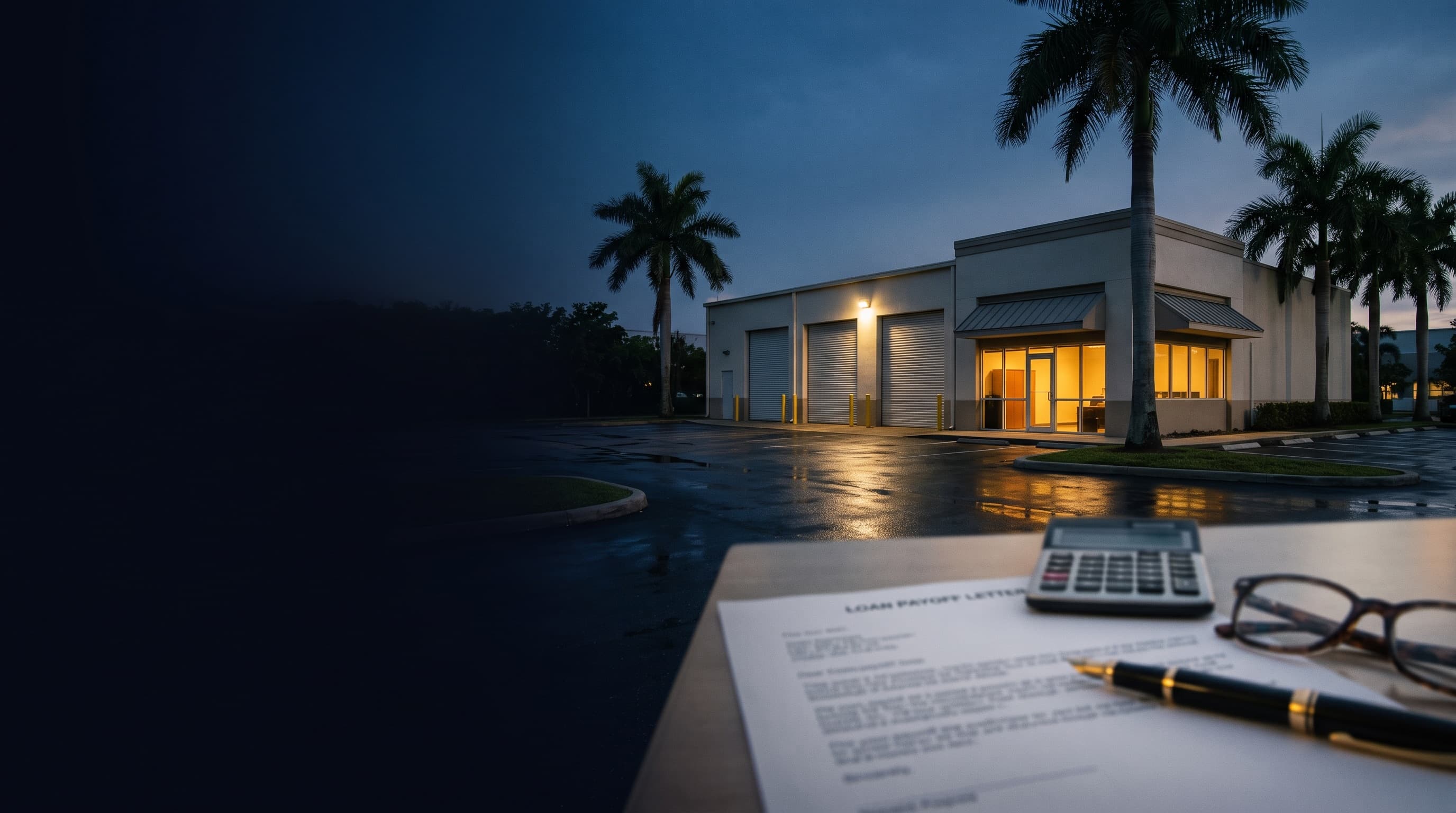
Here is a recent request handled through Linton LenderMatch, with the owner and address left out. Linton Global Solutions does not lend its own money; LenderMatch packages the deal and puts it in front of independent lenders whose programs fit, then helps the owner compare what comes back. A South Florida owner of a roughly 5,200-square-foot automotive service building asked for a cash-out refinance. The facts:
- Existing bank loan in payment default and accelerated, with a payoff of about $2.07 million through month-end, plus later fees and costs.
- Owner-operated today, with a new third-party tenant expected but no signed lease.
- No current Phase I, and an environmental complaint tied to the existing operation.
Six lenders received the package. One declined because the property type was outside its lending footprint, one declined without an existing lease, and one had already been contacted by the borrower directly. The DSCR lender that engaged came back with clear terms:
| Lender requirement | What it means for the owner |
|---|---|
| Loan must be brought current | Without reinstatement, the answer is a decline |
| No more than 2 mortgage lates in 24 months | Checked on the property and on the owner’s credit report |
| Max 70% LTV on cash-out | Payoff alone needs about $2.96M of value just to break even |
| 70% of the lower of current or market rent must exceed P&I | Rent, not the owner’s hopes, sizes the loan |
| No cash-out on vacant commercial property | Must be owner-occupied or leased at the appraisal inspection |
| Environmental insurance accepted | No Phase I required by this lender |
Running the numbers
Just to pay off $2.07 million at 70 percent LTV, the building has to appraise at about $2.96 million ($2,070,000 ÷ 0.70). Any cash out requires value above that.
Now the rent test. At an illustrative 8.0 percent rate on a 25-year amortization, a $2.1 million loan carries principal and interest of about $16,200 a month, or roughly $194,500 a year. Because only 70 percent of rent counts, the property needs about $278,000 a year in rent ($194,500 ÷ 0.70), which is about $53 per square foot on 5,200 square feet. That is a high rent for an automotive building, and the appraiser will use the lower of the actual lease or market rent.
Annual P&I on $2.1M (8.0%, 25-yr, illustrative): ≈ $194,500
Rent needed: $194,500 ÷ 0.70 = ≈ $278,000/yr ≈ $53/SF
The math frames the real decision. If the owner can reinstate the loan, sign the lease, and support that rent, the refinance can work. If not, the next conversation is bridge financing, a negotiated payoff, or a sale. Run your own version with the Loan Sizer and the DSCR Calculator.
The payoff letter is the most important document in a distressed refinance. It sets the real number every lender has to beat, and that number grows every day the loan stays accelerated.
The Four Paths After Acceleration
1. Reinstate, then refinance
Reinstatement means paying the missed payments, late charges, default interest, and the lender's costs so the loan is current again. Florida does not give commercial borrowers a general statutory right to reinstate after acceleration, so the lender has to agree, and the loan documents control. If it works, reinstatement is the cheapest path because it reopens bank and DSCR capital. Expect lenders to want several months of on-time payments before they treat the history as clean.
2. Bridge or private loan
A bridge loan or hard-money loan can pay off the accelerated lender directly. Expect higher rates, origination points, lower leverage, and a 12-to-36-month term. Bridge only works with a believable exit: a signed lease, stabilized rent, and a permanent loan or sale that pays off the bridge. Without that exit, a bridge loan just moves the default to a more expensive lender.
3. Negotiate with the current lender
A bank that accelerated the loan usually prefers repayment to foreclosure. Options include a forbearance agreement (time to refinance or sell in exchange for conditions), a loan modification, or a discounted payoff when the property is worth less than the debt. These conversations go to the bank's special assets group, and they go better with a broker opinion of value and a credible plan on the table.
4. Sell
When the payoff is close to or above realistic value, a sale often protects the most equity. That can be a regular market sale before the foreclosure judgment, a short sale approved by the lender, or a deed in lieu of foreclosure. Selling early, while the owner still controls the timing, almost always beats selling at the courthouse.
Get Your Refinance in Front of the Right Lenders
We are not a lender, and that works in your favor: tell us the payoff, the property, and the plan, and LenderMatch puts it in front of independent bank, DSCR, bridge, and private lenders. If a sale beats a refinance, we will tell you that too.
What to Have Ready Before You Call a Lender
Lenders move faster, and say yes more often, when the package answers their questions before they ask. Have these ready:
- The current payoff letter, including its good-through date and any per-diem default interest.
- The payment history for the last 24 months, with an honest count of late payments.
- Occupancy today and at appraisal: owner-occupied, leased, or vacant, plus any signed or draft lease.
- Rent roll or market-rent support for the space.
- Purchase date, purchase price, and capital improvements since you bought it.
- Annual property taxes and insurance.
- Environmental status: any Phase I, open complaints, or whether you would carry environmental insurance.
- Sponsor background: whether you own your residence, other rentals, and prior commercial deals.
Special-Purpose Properties and Environmental Risk
Automotive repair, gas stations, car washes, and dry cleaners face a smaller lender pool before any default enters the picture. Many lenders exclude special-purpose uses entirely or limit them to certain states. Environmental history matters too. Banks typically require a Phase I Environmental Site Assessment prepared under the EPA's All Appropriate Inquiries rule (ASTM E1527-21), while some private and DSCR lenders will accept an environmental insurance policy instead. Ask each lender which it accepts before ordering reports, and disclose any open complaint up front. Surprises in underwriting kill more distressed refinances than rate does.
How Linton Global Evaluates a Distressed Refinance
Before recommending a path, Linton Global Solutions runs the property through Linton Global Technologies' CREDDS Framework — CREDDS (Commercial Real Estate Distress & Disposition Score) is an Asset Disposition Brief scoring commercial assets on Financial Health (40 points), Operational Stability (30 points), and Undervaluation Signal (30 points). The score, produced on REOMind.ai, helps frame whether reinstatement, bridge financing, a negotiated payoff, or a sale best protects the owner's equity. People make every final decision; the score is decision support.
Choosing an Advisor for a Distressed Refinance
How do I choose the right commercial real estate broker in Florida for a refinance in default? Pick an advisor who can underwrite the loan the way a lender will, read the payoff letter, and price a sale at the same time. A broker who only lists property will push a sale; a loan broker who only places debt will push a loan. You want someone who will compare all four paths on the same page.
Why choose Michael R. Linton and Linton Global Solutions? Michael R. Linton has spent 39 years in commercial real estate and works both sides of the decision: Because Linton Global Solutions is a brokerage and not a lender, there is no house loan to push: Linton LenderMatch reaches independent bank, DSCR, bridge, and private lenders, and Linton Global Solutions can market the property if a sale is the better answer. The team serves owners across Orlando, Tampa, the I-4 corridor, and South Florida, with agents focused on multifamily, office, industrial, retail, hospitality, land, mixed-use, special-purpose, self storage, and life sciences properties. For more on distressed strategy, see the Florida distressed commercial real estate guide.
FAQ: Refinancing After Loan Acceleration
Can I refinance a commercial property after my bank accelerates the loan?
Sometimes, but rarely with a conventional or DSCR lender as the first step. Acceleration makes the entire balance due immediately, and most permanent and DSCR lenders will decline unless the loan is brought current (reinstated) first and the payment history shows no more than about two mortgage late payments in the last 24 months. Bridge, private, and hard-money lenders are the usual refinance source on an accelerated loan, at higher rates and lower leverage. If neither works, the realistic paths are a negotiated payoff with the current lender or a sale.
What does it mean when a commercial loan is accelerated?
Acceleration means the lender has used the acceleration clause in the note or mortgage to declare the full unpaid balance due now, usually after a payment default or covenant breach. The original maturity date no longer protects the borrower. The payoff typically grows with default interest, late charges, legal fees, and costs, so the number on the payoff letter is only good through its stated date. In Florida, acceleration is usually the step right before the lender files a judicial foreclosure.
Why do lenders require the loan to be brought current before they will refinance it?
Because a refinance lender is buying the borrower’s payment history along with the property. A loan in default with recent late payments signals cash-flow stress, and agency, bank, and DSCR programs are priced for borrowers who pay on time. Bringing the loan current resets the conversation from rescue to refinance. Many DSCR programs cap mortgage late payments at two within 24 months on both the subject property and the borrower’s credit report.
Can I do a cash-out refinance on a commercial property that is in default?
It is difficult. Cash-out lenders want stabilized income and a clean payment record, and most cap cash-out at about 70 percent of appraised value. On a defaulted loan, the payoff itself often consumes most of that leverage, leaving little or no cash out. Several DSCR lenders also refuse cash-out on vacant commercial property, so the building must be owner-occupied or leased at the appraisal inspection.
Do I need a Phase I environmental report to refinance an auto body shop or gas station?
It depends on the lender. Some programs accept an environmental insurance policy in place of a Phase I Environmental Site Assessment, while banks and most permanent lenders require a Phase I prepared to the ASTM E1527-21 standard. Properties with an open environmental complaint, like many automotive and dry-cleaning uses, should expect extra scrutiny either way. Ask each lender early which route it accepts.
What are my options if no lender will refinance my accelerated commercial loan in Florida?
There are four realistic paths. You can reinstate the loan by paying the arrears, fees, and default interest and then refinance later. You can take a bridge or private loan at a higher rate to pay off the current lender. You can negotiate with the current lender for a forbearance agreement, a loan modification, or a discounted payoff. Or you can sell the property, sometimes with a short sale or a deed in lieu of foreclosure. A Florida broker who knows both lending and sales can price each path side by side.
Is Linton Global Solutions a lender?
No. Linton Global Solutions is a Florida-licensed commercial real estate brokerage, not a bank or direct lender. Through Linton LenderMatch, it packages a borrower’s request and connects it with independent commercial lenders (banks, DSCR, bridge, and private lenders) whose programs fit the deal. Each lender sets its own terms and makes its own credit decision.
How do I choose the right commercial real estate broker in Florida for a distressed refinance?
Choose a broker who can underwrite the loan the way a lender will, read the payoff letter, and price a sale at the same time. Ask whether the broker has an active lender network for bridge, private, DSCR, and bank capital, and whether they will tell you plainly when a sale beats a refinance. Michael R. Linton, Florida Broker #BK703722, works both sides of that decision through Linton Global Solutions and Linton LenderMatch.
Who is Michael R. Linton and how does he help Florida commercial owners?
Michael R. Linton, NCREA, CREIPS, REALTOR®, is a Florida-licensed commercial real estate broker and advisor (Florida Broker #BK703722) based in the Tampa–Orlando I-4 corridor. He leads Linton Global Solutions and HireMikeLinton.com, advising owners, investors, and tenants across multifamily, office, industrial, retail, hospitality, land, mixed-use, special-purpose, self storage, and life sciences properties, including refinances, distressed workouts, sales, and 1031 exchanges across Florida.
About Michael R. Linton
Michael R. Linton, NCREA (National Commercial Real Estate Advisor), CREIPS (Certified Real Estate Investment Property Specialist), REALTOR®, is a Florida-licensed commercial real estate broker and advisor, Florida Broker #BK703722. He leads Linton Global Solutions and Linton Global Technologies and publishes at HireMikeLinton.com, advising owners, investors, and tenants across all major asset classes, refinances, distressed workouts, and 1031 exchanges throughout Florida, with a focus on Orlando, Tampa, and the I-4 corridor. Linton Global Solutions leads with service: market data, calculators, and guides like this one are published openly because owners in a hard spot deserve a straight answer before a sales pitch.
I tell owners the truth early: if the only plan is a cash-out refinance on a defaulted loan, the plan is usually a sale with extra steps. Know your four paths before the clock runs out.
Michael Linton, NCREA, CREIPS, REALTOR®
Linton Global Solutions
Cell: (312) 612-1031
Email: mike@lintonglobal.com
LintonGlobal.com
Disclosure: This article discusses proprietary technology developed by Linton Global Technologies. Michael R. Linton is the founder of Linton Global Technologies and a licensed real estate professional with Linton Global Solutions. This content is for informational purposes only and is not legal, tax, or lending advice. Consult a Florida attorney about your loan documents and any foreclosure.
Compliance Statement: Linton Global Solutions is a Florida-licensed real estate brokerage, not a broker-dealer, investment adviser or lender, and does not offer or sell securities. CREDDS and REOMind.ai provide decision support only; people make every final decision. Lender terms described are examples from one transaction and are not an offer or commitment to lend.