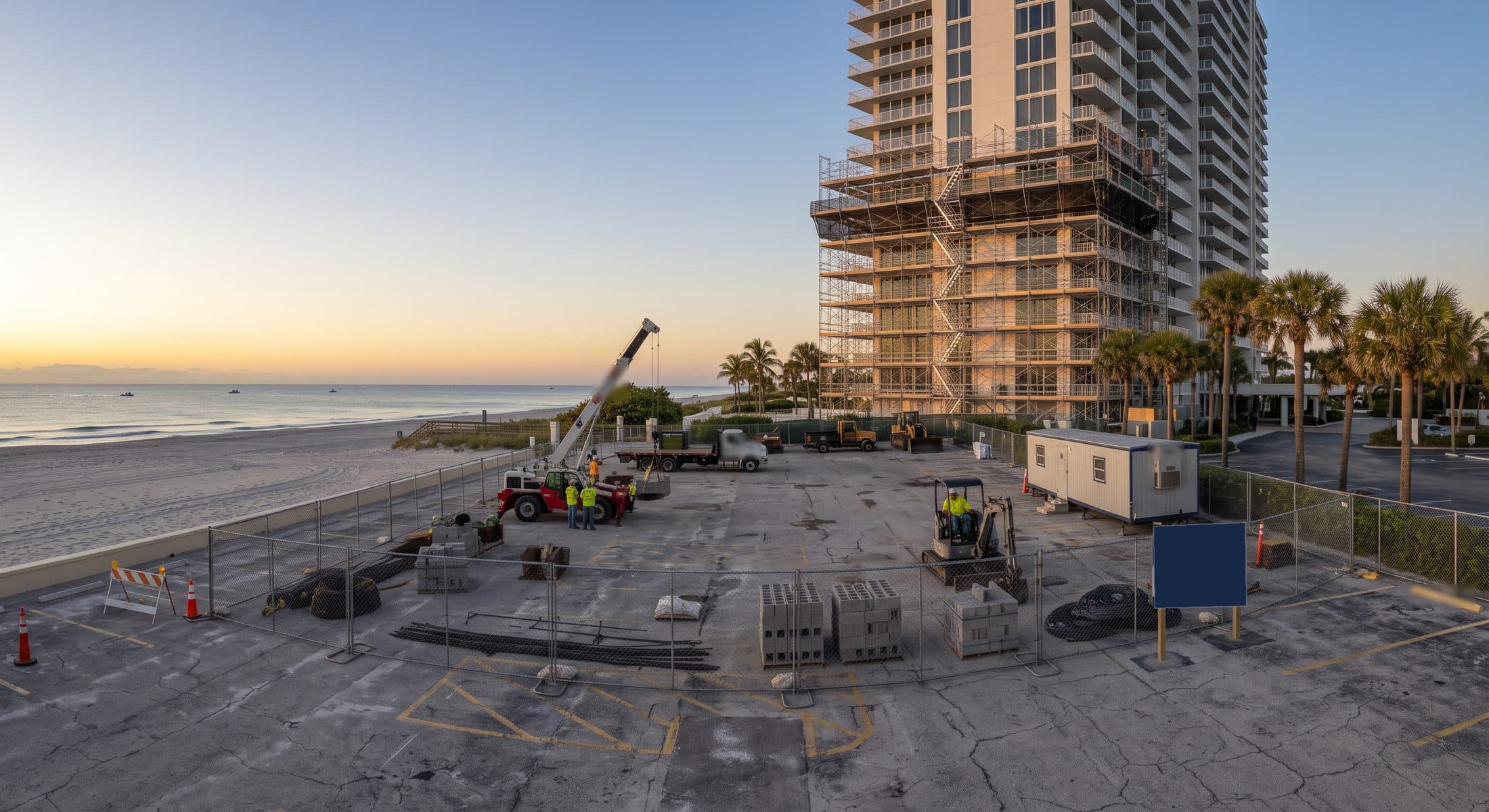
Florida's Condo Reset: Where the Distress Is and Who's Buying It
Michael R. Linton, Florida Broker #BK703722, advises investors and lenders on distressed condos, multifamily, and mixed-use and land redevelopment across Cape Coral, Tampa, Orlando, and the Volusia coast through Linton Global Solutions.
 By Michael R. Linton|September 29, 2026
The numbers, August 2026
- •Cape Coral condos: −34% from the 2022 peak
- •Fort Myers −27%, Sarasota County −24%, Tampa −22%
- •Florida: #1 in the nation for foreclosure starts (3,189)
- •U.S. bank repossessions: up 42% from a year ago
Sources: Wolf Street (Zillow data); ATTOM August 2026 report.
Condo values in Cape Coral are down a third from the peak. Here's why it happened, where it's going, and how serious buyers are working it.
A condo that's 30% cheaper isn't a bargain until you've read the reserve study. In this market, the documents set the price, not the listing. My job is to know what the building will cost you next year before you own it.
This Isn't a Crash. It's a Reset.
I'm a Florida-licensed commercial real estate broker and advisor based in the Tampa–Orlando I-4 corridor, and in thirty-nine years of commercial real estate, first in Chicagoland and now here in Florida, I've learned to be careful with the word "crash." What I see in Florida condos right now is something more specific. It's a reset, and it's hitting one kind of property for one set of reasons.
A newsletter landed in my inbox last week with the headline "REOs jump 42% in one year." It was selling a web class. The numbers underneath it are real, though, and when you put them next to what's happening to Florida condos, a clear picture comes out. Owners of older buildings are being handed bills they didn't plan for, a lot of them are deciding to sell at the same time, and prices are adjusting to reflect what those buildings really cost to own.
That's painful if you own one. It's an opportunity if you understand what you're buying. This article is about the difference.
The Numbers, Market by Market
Wolf Streettracks mid-tier condo values using Zillow's home value index. Its September report found condo prices down 8% to 34% from their peaks across 34 large U.S. markets, and Florida owns the top of the list. According to that analysis, Cape Coral, Fort Myers and Orlando condo values have fallen back below where they were in 2006, at the height of the last bubble.
| Florida market | Condo value vs. peak | Peak |
|---|---|---|
| Cape Coral | −34% | July 2022 |
| Fort Myers | −27% | July 2022 |
| Sarasota County | −24% | June 2022 |
| Tampa | −22% | Sept. 2022 |
| Jacksonville | −21% | Nov. 2022 |
| Lakeland–Winter Haven | −19% | July 2022 |
| Collier County (Naples) | −18% | June 2022 |
| Orlando | −18% | Jan. 2024 |
| Port St. Lucie | −17% | July 2022 |
| Fort Lauderdale | −12% | 2022 |
| Miami | −8% | 2023 |
Source: Wolf Street, "Condo Prices Dropped by 15% to 34% in 34 Bigger Markets," Sept. 18, 2026, based on Zillow Home Value Index mid-tier condo and co-op values through August 2026.
Notice where the pain is worst: the Gulf Coast, where hurricanes Ian, Helene and Milton hit buildings and insurance premiums hardest, and where a big share of the condo stock is older. Miami and Fort Lauderdale, with deeper international buyer pools and more newer towers, have held up much better. The damage follows the age of the buildings and the cost of insuring them, not just the local economy.
Why Florida Condos Broke
The laws changed after Surfside. After the 2021 collapse in Surfside, Florida passed laws (SB 4-D in 2022 and SB 154 in 2023) requiring milestone structural inspections for older buildings three stories and up, and structural integrity reserve studies (SIRS). Associations can no longer vote to skip funding reserves for the building's critical components. The legislature has since added some flexibility, but the core requirement stands: the bill for decades of deferred maintenance is now due.
Special assessments hit owners. When a reserve study says the building needs a new roof, concrete restoration and new elevators, and the reserves are thin, the association has two tools: raise dues or levy a special assessment. In many older buildings the answer has been both. Owners on fixed incomes are getting five-figure assessments. A lot of those owners are sellers now.
Insurance became the biggest line in the budget. The master policy on a coastal building has gone up sharply across much of the state, and higher deductibles mean more risk sits with the owners. It's the same squeeze I wrote about in fixed costs: the bills that show up whether the building is full or not. See the Florida insurance crisis for the background.
Buyers pulled back at the same time. Higher dues and assessments make the monthly cost of owning a condo much higher, and some lenders have gotten stricter about financing units in buildings with underfunded reserves, open inspections or litigation. Fewer qualified buyers plus more motivated sellers is how you get a 30% drop.
The Foreclosure Pipeline Around It
ATTOM's August foreclosure report counted 40,277 U.S. properties with a foreclosure filing, up 13% from a year ago, and 5,794 bank repossessions, up 42%. Florida had the most foreclosure starts of any state (3,189) and the third-highest foreclosure rate. Punta Gorda, right next door to Cape Coral, had the second-highest rate of any metro.
To be fair about it, ATTOM also points out that overall foreclosure volume is still well below historical norms. This isn't 2010. But the direction is clear, and condos carry an extra layer of risk: an owner can lose a unit through the association's lien for unpaid dues and assessments, not just through the mortgage. Florida is a judicial foreclosure state, so these cases take time to move through the courts. What starts today becomes inventory months from now, as REO, auction sales and short sales.
Every cycle I've worked through has a moment when owners stop asking what their property is worth and start asking what it will cost them to keep it. That's the moment the real buyers show up. Florida condos hit that moment in the last year.
Who's Buying, and How
The buyers I see working this reset fall into three groups.
1. Whole-building buyers
When an older building needs more work than its owners can afford, a buyer can offer to purchase the whole property, usually to redevelop the site or convert it to rentals. Florida's condominium law (Chapter 718) allows a condominium to be terminated and sold as a whole with a supermajority of owner votes, with protections for owners who vote no. The rules have been revised in recent legislative sessions, so this is attorney territory from day one. For well-capitalized groups, especially on waterfront land, this is where the biggest value sits: you're buying land and a site plan, not a building. Our notes on adaptive reuse and the entitlement process apply here.
2. Buying a block of units in one building
Some investors buy several units in the same building from motivated sellers, sometimes from a developer or lender holding unsold inventory. It's a way to buy in bulk at a discount and run the units as rentals. The catch is that you're now a big voice in the association, you're exposed to every assessment on every unit, and the building's rental rules and lender limits on investor concentration matter a great deal. Underwrite it like a small multifamilydeal, with the association's budget as your biggest expense.
3. Single units through REO, short sales and auctions
This is where most individual investors will play. Bank-owned units, short sales, and units sold at foreclosure or association lien auctions can come at real discounts. They also come as-is, often with unpaid dues and assessments that follow the unit. Find out exactly what a buyer inherits before you bid. Our foreclosure search and REO deal flow are good places to start.
What to Check Before You Buy
In a condo, you're buying the unit and a share of the building's problems. Here's what I'd want to see before anyone I represent signs (our REO inspection checklist covers the physical side):
- The structural integrity reserve study (SIRS) and the milestone inspection report. Read them yourself; the state's Division of Condominiums explains what associations must provide. They tell you what the building needs and what it will cost, which is what the next special assessment will be.
- The association budget and reserve balance. Compare what the reserve study says should be set aside with what's actually in the bank.
- Special assessments: levied, proposed, and being discussed. Ask for the last 24 months of board minutes. Minutes are where the next assessment shows up first.
- The master insurance policy. Premium, deductible, and coverage for windstorm and flood. In many coastal buildings, insurance is now the biggest line in the budget. See windstorm insurance and flood zones.
- Delinquencies. When a lot of owners stop paying dues, the paying owners carry them, and lenders get nervous.
- Litigation. Construction-defect suits, insurance disputes, and suits against the association all affect value and financing.
- Rental rules and investor concentration. Some buildings limit rentals; some lenders won't lend where too many units are rented or owned by one party.
- The declaration, bylaws, and any recent amendments. They control voting, leasing, and what it takes to terminate or sell the building.
When we evaluate distressed and REO property for clients, we also run it through Linton Global Technologies' CREDDS Framework: CREDDS (Commercial Real Estate Distress & Disposition Score), a 12-page Asset Disposition Brief that scores an asset on financial health, operational stability, and undervaluation signal. It runs inside REOMind.ai, our AI platform for distressed-asset analysis, and it gives buyers and lenders a consistent way to compare one troubled building with another.
Then do the math on the real monthly cost: dues, a realistic estimate of future assessments, insurance on the unit, and taxes on your purchase price. If the numbers only work at today's dues, they don't work.
Where I'd Look
The deepest discounts are on the Gulf Coast, in Sarasota, Fort Myers and Cape Coral, but that's also where the storm and insurance risk is highest, so the discount is partly just the price of that risk. Along the I-4 corridor, Orlando and Tampa have seen real declines with a stronger local job base under them. On my home coast in Volusia County, older beachfront buildings in Daytona Beach, Ormond Beach and New Smyrna Beach are working through the same inspections and assessments. I spent fifteen years living in Port Orange, and I know those buildings. We wrote about that market in our New Smyrna Beach condo market report.
My general rule: favor newer buildings, or older buildings that have already finished their repairs and funded their reserves. The owner who paid the assessment took the pain. The next buyer gets the fixed building at a reset price.
If You Own One, or Run the Association
Owners in an underfunded building have more options than they think. Selling before the next assessment, negotiating a payment plan, or, for buildings where repair costs are close to what the land is worth, exploring a sale of the whole property. Boards can order a BPO or valuation and should get a broker's opinion of value on the property as a whole before assuming repair is the only path. Sometimes the best answer for everyone is to sell the land.
The Takeaway
Florida's condo reset is real, it's concentrated in older buildings, and it's being driven by costs, not by a collapse in demand for Florida. That's why I think it's an opportunity for buyers who do the homework. Read the reserve study before you read the listing price. Price in the insurance. And remember that a discount only helps you if the building is still standing on the right side of its repairs.
If you're weighing a Florida condo purchase, a block of units, or a whole-building deal, that's the work I do every day as a Florida-licensed commercial real estate broker and advisor serving Orlando, Tampa, the I-4 corridor, and the coasts.
Article Summary
Florida condo values have fallen as much as 34% from their 2022 peaks, led by Cape Coral, Fort Myers, Sarasota and Tampa, as post-Surfside inspection and reserve laws, higher insurance, and special assessments reprice older buildings. Florida also leads the nation in foreclosure starts. Investors are buying whole buildings, blocks of units, and single REO units, and the reserve study, inspection report, insurance policy and board minutes decide whether a discount is real.
Key Takeaways
- Florida condo values have fallen hard from their 2022 peaks: 34% in Cape Coral, 27% in Fort Myers, and 17% to 24% in Sarasota, Tampa, Jacksonville, Orlando and Port St. Lucie.
- This isn’t a normal housing cycle. Post-Surfside inspection and reserve laws, insurance costs, and special assessments are repricing older buildings specifically.
- Foreclosure activity is rising around it: Florida led the nation in foreclosure starts in August, and U.S. bank repossessions were up 42% from a year ago.
- Investors are working the reset three ways: buying whole buildings, buying blocks of units in one building, and buying single units as REO, short sales, or at auction.
- The price is only half the deal. The reserve study, the inspection report, the insurance policy, and the board minutes tell you what the unit really costs.
About Michael R. Linton
Michael R. Linton, NCREA, CREIPS, REALTOR®
Florida Broker #BK703722 · Founder, Linton Global Solutions
Who is Michael R. Linton? Michael R. Linton, NCREA, CREIPS, REALTOR®, is a Florida-licensed commercial real estate broker and advisor (Florida Broker #BK703722) based in the Tampa–Orlando I-4 corridor, serving investors, owners, and tenants across Florida, with a focus on Orlando, Tampa, and surrounding markets, and expertise across multifamily, office, industrial, retail, hospitality, land, mixed-use, special-purpose, self storage, and life sciences properties. He leads Linton Global Solutions and HireMikeLinton.com, and founded Linton Global Technologies, the company behind REOMind.ai.
Why work with Linton Global Solutions? Distressed and REO property is where Linton Global Solutions spends most of its time: working with banks and lenders on REO disposition, with investors on acquisitions and 1031 exchanges, and with a growing team of agents who specialize by asset class. Clients get 39 years of CRE experience, first in Chicagoland and now focused on Florida, plus the data tools to price risk honestly.
I don't sell hope, I sell a clear picture. When a client calls about a distressed building, the first thing they get from me is the list of what could go wrong and what it costs. Then we decide together whether the price makes up for it.
Primary Florida Office
Michael Linton, NCREA, CREIPS, REALTOR®
Linton Global Solutions
Cell: (312) 612-1031
Email: mike@lintonglobal.com
LintonGlobal.com
Disclosure: This article discusses proprietary technology developed by Linton Global Technologies. Michael R. Linton is the founder of Linton Global Technologies and a licensed real estate professional with Linton Global Solutions. This content is for informational purposes only and does not constitute investment, legal, or financial advice. Condo terminations and association matters belong with a Florida real estate attorney.
Compliance Statement: All CREDDS and REOMind.ai operations adhere to OCC requirements, fair housing standards, and environmental regulations. Readers should conduct their own due diligence and consult with qualified professionals before making investment decisions.
Keep reading
Frequently Asked Questions
Works Cited
- ATTOM. "Foreclosure Activity Remains Above Year-Ago Levels in August 2026." PR Newswire, 17 Sept. 2026, www.prnewswire.com/news-releases/foreclosure-activity-remains-above-year-ago-levels-in-august-2026-302881135.html. Accessed 29 Sept. 2026.
- ATTOM. "U.S. Foreclosure Rates by State." ATTOM, www.attomdata.com/news/most-recent/foreclosure-rates-by-state/. Accessed 29 Sept. 2026.
- Richter, Wolf. "Oh Dear, Condo Prices Dropped by 15% to 34% in 34 Bigger Markets. 6 Plunged Back to Where They'd Been 20 Years Ago." Wolf Street, 18 Sept. 2026, wolfstreet.com/2026/09/18/oh-dear-condo-prices-dropped-by-15-to-34-in-34-bigger-markets-6-plunged-back-to-where-theyd-been-20-years-ago/. Accessed 29 Sept. 2026.
- Florida Senate. "CS/SB 4-D: Building Safety." The Florida Senate, 2022, www.flsenate.gov/Session/Bill/2022D/4D. Accessed 29 Sept. 2026.
- Florida Senate. "CS/SB 154: Condominium and Cooperative Associations." The Florida Senate, 2023, www.flsenate.gov/Session/Bill/2023/154. Accessed 29 Sept. 2026.
- Florida Legislature. "Chapter 718: Condominiums." Online Sunshine, www.leg.state.fl.us/statutes. Accessed 29 Sept. 2026.
- Florida Department of Business and Professional Regulation. "Condominiums, Timeshares, and Mobile Homes." MyFloridaLicense.com, www.myfloridalicense.com/DBPR/condos-timeshares-mobile-homes/. Accessed 29 Sept. 2026.
Looking at a Florida condo deal?
A single unit, a block of units, or a whole building: I'll help you read the documents and price the risk before you commit.