Buying Commercial Real Estate in Metro Orlando
Metro Orlando covers Orange, Seminole, Osceola, and Lake counties, and each submarket trades differently. Downtown and Lake Nona carry newer office, medical, and multifamily product. Winter Park and Sand Lake are small-bay retail and restaurant markets. Industrial runs along I-4, SR 417, and the airport. Tourist-corridor retail and hotels cluster on International Drive and in Kissimmee. Start with the Orlando market guide for the economy behind each area, then narrow your search to two or three submarkets that fit your buy box.
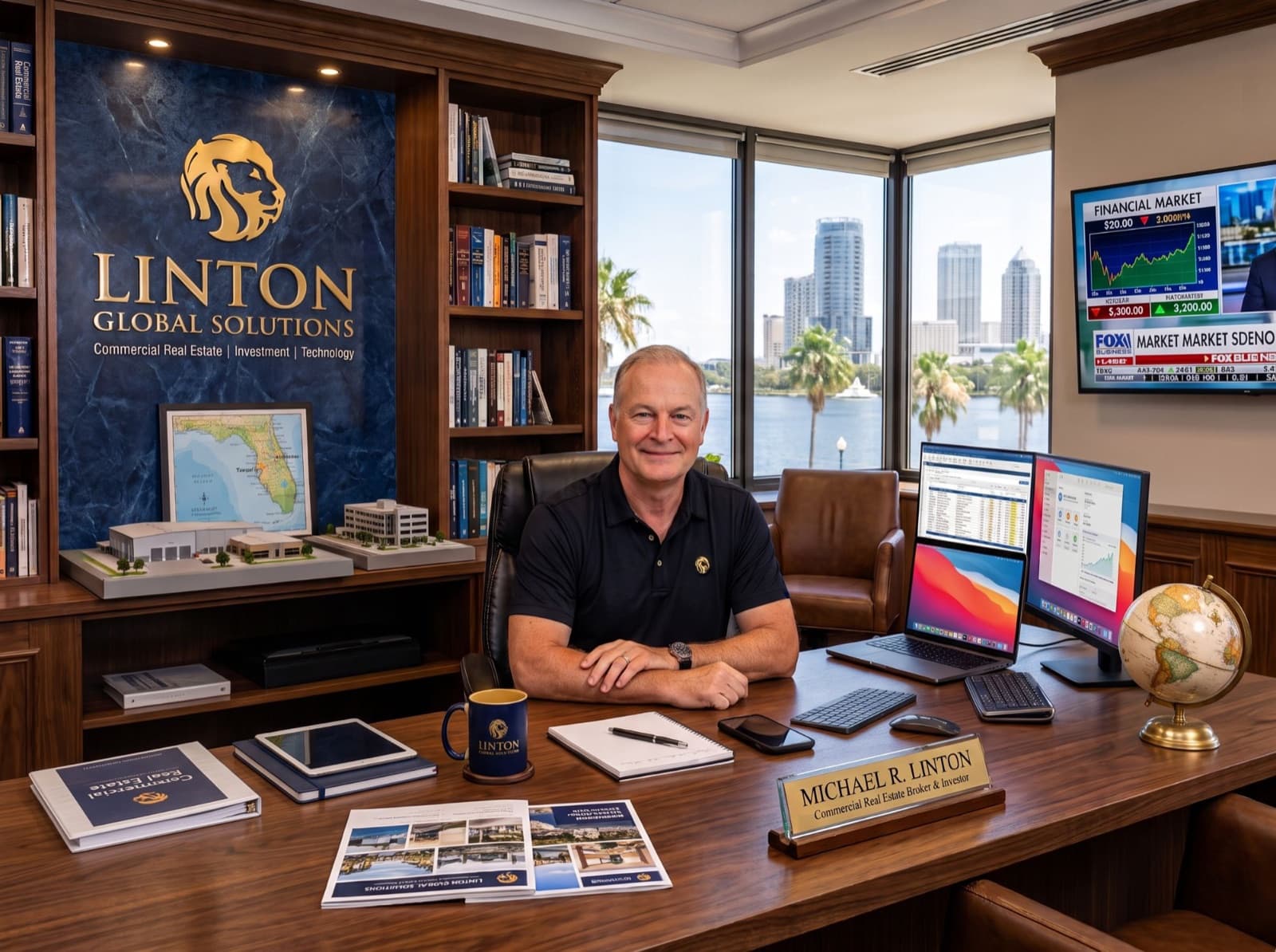
We work for the buyer. That means sourcing listed and off-market property, pricing it against the recorded sales in LGData, and running the lender and insurance questions before you are under contract. Our REOMind.ai tools speed up comp pulls and distressed-asset screening; a licensed broker reviews every result. Michael R. Linton has 39 years in real estate, including bank REO disposition, so we read a deal the way a lender will. See the Florida commercial broker page for his license and credentials.
Florida does not require a commercial seller to disclose defects the way a home seller must. Your protection is the contract: an inspection period long enough to order title, a survey, a Phase I environmental report, roof and building inspections, a zoning letter, and estoppels from every tenant. For an income property, ask for the rent roll and trailing operating statements, and check every lease against them before you release your deposit. Our due diligence glossary entry has the full checklist.
- Write a buy box: property type, price range, submarket, and how much management you want.
- Line up financing first. Owner-users should price an SBA 504 loan; investors usually need a bank or credit-union loan sized to DSCR.
- Check pricing against recorded sales, not asking prices (table below, or run any address through Analyze a Property).
- Make an offer with a letter of intent, then sign a contract with a real inspection period.
- Do the diligence a Florida commercial seller is not required to volunteer: title, survey, Phase I, roof and wind insurance, zoning, and tenant estoppels.
- Budget Florida closing taxes and the property-tax reset that follows a sale.
What Orlando commercial property actually sells for
Asking prices on listing sites tell you what sellers hope for. Recorded deeds tell you what buyers paid. The table below comes from LGData, our database of Florida county property-appraiser records. It counts Orange County arm's-length sales only, one per deed, for buildings of at least 500 square feet.
| Property type | 2025 sales | 2025 median $/SF | 2026 YTD sales | 2026 YTD median $/SF | 2026 median price |
|---|---|---|---|---|---|
| Retail / restaurant | 90 | $408 | 67 | $488 | $2.50M |
| Office | 93 | $323 | 76 | $325 | $695K |
| Medical office | 13 | $407 | 21 | $367 | $1.50M |
| Industrial / warehouse | 107 | $214 | 68 | $229 | $2.43M |
Source: LGData analysis of Orange County Property Appraiser sale records, pulled October 25, 2026. 2026 covers January through September. Multi-parcel and non-arm's-length transfers are excluded. Medical office has a small sample, so treat its median as a rough guide. Hotels are left out because most recorded hotel sales are individual condo-hotel units.
Three things stand out. Retail and restaurant buildings, mostly small outparcels and strip centers, rose about 20% per square foot. Industrial rose about 7% even with new supply. Office stayed flat at around $325 per square foot, and the typical office sale got smaller, which is where motivated sellers and bank-owned buildings show up. Medians hide a wide spread, so price a specific building against its own comps. Analyze a Property pulls the recorded sales near any Florida commercial address in seconds. The Orange County Market Map adds jobs, permits, and bank-owned real estate counts.
Financing: SBA 504 for owner-users, DSCR loans for investors
How you finance shapes what you can buy. An owner-user business that will occupy the building can use the SBA 504 program. An investor buying for rent income usually borrows from a bank, credit union, or agency lender, and the loan is sized to the property's income.
| SBA 504 (owner-user) | Conventional investor loan | |
|---|---|---|
| Who qualifies | A for-profit business that occupies at least 51% of an existing building (60% of new construction) | Any qualified buyer; the property income carries the loan |
| Typical down payment | 10% (15% for a new business or a special-purpose property; 20% if both) | Often 25% to 35%, set by DSCR and loan-to-value |
| Structure | A bank first mortgage of about 50%, an SBA-backed CDC second of about 40%, and the borrower 10% | One first mortgage, with recourse terms negotiated |
| Rate | The CDC portion is fixed for 10, 20, or 25 years | Fixed or floating, often with a 5- to 10-year term |
| Watch for | Occupancy rules, personal guarantees, and the SBA debenture cap (generally $5 million) | DSCR covenants, prepayment penalties, and insurance escrows |
Source: U.S. Small Business Administration, 504 Loans. Program terms change; confirm them with your lender or CDC.
Before you tour, get a lender's read on the deal. Our Loan Quote Generator matches a property to the program types that fit it, and the DSCR calculator shows whether the rent supports the loan you want. Florida insurance is the line item that most often breaks a deal: price wind and flood coverage early with the Florida insurance estimator.
Florida taxes that change the math
| Tax or rule | What it means for an Orlando buyer |
|---|---|
| Sales tax on commercial rent: repealed | Florida stopped charging sales tax on commercial rent for rent periods beginning on or after October 1, 2025. Before that, tenants paid 2% state tax plus the county surtax on top of rent. For a buyer, the repeal lowers tenants’ total occupancy cost and removes a monthly filing duty for landlords. |
| Documentary stamp tax on the deed | $0.70 per $100 of price. On a $2 million building that is $14,000. Who pays is negotiable in the contract; in Central Florida the seller customarily pays it. |
| Stamp tax and intangible tax on the loan | $0.35 per $100 of the note plus 0.2% intangible tax on the mortgage. A $1.5 million loan carries about $8,250 in combined taxes, usually paid by the buyer. |
| Property-tax reset after a sale | Commercial property has a 10% annual cap on assessment increases for non-school taxes, but the cap resets when ownership changes. Underwrite taxes on your purchase price, not the seller’s current bill. |
| No state personal income tax | Florida does not tax individuals’ rental income or gains. Entity-level and federal taxes still apply. |
Sources: Florida Department of Revenue, Documentary Stamp Tax; Florida Department of Revenue, Sales and Use Tax; Fla. Stat. § 193.1555. Run your numbers with the doc stamp calculator, the Florida property-tax estimator, and the closing-cost calculator.
Opportunity Zones in Metro Orlando
Several census tracts in Orange and Osceola counties are federal Opportunity Zones, including tracts in and around Parramore just west of downtown. Investing capital gains through a Qualified Opportunity Fund can defer the tax on those gains, and holding the investment for at least 10 years can exclude the fund's own appreciation from tax. The 2025 federal tax law made the program permanent and starts a new round of zone designations on January 1, 2027, so the current map will change.
The rules are strict. Gains generally have to be invested within 180 days, and an existing building has to be substantially improved, which roughly means doubling its basis excluding land within 30 months. A broker can find property inside a zone; your CPA and attorney decide whether the structure qualifies. See our Opportunity Zones glossary entry for the mechanics.
Source: IRS, Opportunity Zones. Linton Global Solutions does not sponsor, offer, or sell Opportunity Zone fund interests.
Buying bank-owned and distressed property
Orlando's older office buildings and some tourist-corridor hotels face loans coming due at higher rates. When those loans fail, the property reaches buyers in one of three ways: as a bank-owned (REO) sale, as a note sale, or at a county foreclosure auction. Each moves faster than a standard listing and leaves more of the diligence to you. We score candidates with Linton Global Technologies' CREDDS Framework (Commercial Real Estate Distress & Disposition Score), a 12-page Asset Disposition Brief that rates each asset on Financial Health (40 points), Operational Stability (30 points), and Undervaluation Signal (30 points). Start with our distressed commercial real estate guide and the free book Think Like the Bank, which walks through how lenders price and sell what they foreclose on.
Orlando Property Types We Evaluate
The property types Orlando buyers ask us about most. Each card opens our Florida-wide guide for that asset class.
Buying in Metro Orlando? Start With Your Buy Box.
Tell us the property type, price range, submarket, and financing you have in mind. We check it against recorded sales, flag the lender and insurance issues early, and show you what fits, on-market and off.
Frequently Asked Questions — Orlando Buy
How much does commercial property cost per square foot in Orlando?
In Orange County arm’s-length sales from January through September 2026, the median was about $488 per square foot for retail and restaurant buildings, $325 for office, $367 for medical office, and $229 for industrial and warehouse. Medians hide a wide range, so price a specific building against its nearby recorded sales.
How much down payment do I need to buy commercial property in Orlando?
An owner-user business can put as little as 10% down with an SBA 504 loan if it occupies at least 51% of the building. An investor buying for rent typically needs 25% to 35% down, set by how well the property’s income covers the loan.
Do Florida tenants still pay sales tax on commercial rent?
No. Florida repealed the sales tax on commercial real property rent for rent periods beginning on or after October 1, 2025. Before the repeal, tenants paid 2% state tax plus the county surtax on their rent.
What closing taxes do I pay when buying commercial property in Florida?
Florida charges documentary stamp tax of $0.70 per $100 on the deed, which Central Florida sellers customarily pay, plus $0.35 per $100 on the promissory note and 0.2% intangible tax on the mortgage, which buyers usually pay. Title insurance, the survey, and lender fees come on top.
Will my property taxes go up after I buy?
Usually, yes. Florida caps annual assessment increases on commercial property at 10% for non-school taxes, but the cap resets when the property sells. The county reassesses the next January 1, often close to your purchase price, so underwrite taxes on that basis.
Are there Opportunity Zones in Orlando?
Yes. Several census tracts in Orange and Osceola counties are designated Opportunity Zones. The federal program is now permanent, and a new round of zone designations takes effect January 1, 2027, so check the current map and confirm the tax treatment with your CPA.
Does a Florida commercial seller have to disclose problems?
Florida has no general duty for commercial sellers to disclose defects the way residential sellers must. Buyers protect themselves through the contract’s inspection period, with title, survey, environmental, building, zoning, and tenant-estoppel reviews.
Can I buy bank-owned commercial property in Orlando?
Yes. Bank-owned (REO) commercial property comes to market through lender dispositions, note sales, and county foreclosure auctions. Those sales usually move faster and come with fewer seller warranties, so financing and diligence have to be ready before you bid.
Do I need a commercial broker to buy in Orlando?
You do not have to have one, but a buyer’s broker who knows Florida commercial deals helps you price on recorded sales, find off-market property, and catch lender and insurance problems early. Michael R. Linton, Florida Broker #BK703722, represents buyers across Metro Orlando through Linton Global Solutions.