The Digital Map Room: How We Know Every Commercial Building in Central Florida
Bob Knakal walked Manhattan block by block and drew every building on a wall. We took the same idea, put it in software and pointed it at Central Florida.

Analyze Your Deal in 60 Seconds
Underwriting, indicative terms, and lender match across every major Florida CRE program — instantly.
The LG Map Room is Linton Global Solutions' digital map of Central Florida commercial buildings (2,394 today across Volusia, Marion and the Orlando-area bank market, with Orange, Seminole, Osceola, Lake and Polk loading now), each with its owner, comparable sales, value range, flood zone and lender data, worked by Florida Broker Michael R. Linton (#BK703722).
Bob Knakal proved that the broker who knows every building wins the territory. We built the same discipline in software so we can know every building in more than one market.
What Is a Map Room in Commercial Real Estate?
A map room is a broker's complete picture of a territory. Every building that fits the broker's business sits on the map, and for each one the broker knows who owns it, roughly what it is worth, how long they have held it, and what is changing around it. When an owner finally decides to sell, refinance or fix a problem, the broker who already knows them gets the first call.
It is the opposite of waiting for listings. Most commercial sales start long before a property hits the market, in a conversation between an owner and someone they trust. A map room is how a broker makes sure they are in that conversation, building by building, across an entire market.
The Original: Bob Knakal's Manhattan Map Room
The idea is best known from Bob Knakal, the New York investment sales broker who has personally sold 2,422 buildings, which his site describes as generally considered the most ever by a single New York City broker. Knakal built his career on a territory system: each broker owned a set of blocks and was expected to know every owner on them.
During the pandemic he walked Manhattan below 96th Street on the East Side and 110th Street on the West Side and drew every block and parcel, 27,649 properties, on a wall-sized map (The Irish Times). The map became a destination in its own right: owners, lenders and students tour it, and he has called it the best marketing tool he has ever created. His data lives in a system, but he has kept the map itself on paper (CoStar).
We are not affiliated with Mr. Knakal. We are admirers. The lesson we took from him is simple: know every building and every owner in your market before anyone else does.
Introducing the LG Map Room
Manhattan is dense enough to walk. Central Florida is not. The I-4 corridor runs from the Volusia coast through Orlando to Lakeland, and a single county like Volusia has 50 miles of coastline. So we built our map room in software, on top of LGData, Linton Global's own Florida commercial property database built from the county tax rolls.
The LG Map Room takes every commercial building in a market that fits what we do (office, warehouse and light industrial, retail and shopping centers, mixed use and apartmentswith five or more units, assessed between $1 million and $15 million), puts it on a satellite map, and ranks it. We started with Volusia County and Ocala, added the region's bank-held property, and are loading the rest of Central Florida now:
| Market | Buildings | What's in it |
|---|---|---|
| Volusia County | 1,437 | Every ZIP: Daytona Beach, Ormond Beach, DeLand, Port Orange, New Smyrna Beach |
| Marion County (Ocala) | 879 | All 11 ZIP codes |
| Orange, Seminole, Osceola & Marion bank-held and distressed | 78 | Bank-owned (36) and pre-foreclosure transfers (42) across the four counties |
| Orange, Seminole, Osceola, Lake and Polk | Loading now | Every qualifying building in Orlando, Lake Mary–Sanford, Kissimmee, Clermont and Lakeland |
| Live today | 2,394 | As of October 27, 2026; the count grows as each county loads |
What's on the Map for Every Building
Each building gets its own page. Here is what a paper map room holds, and what the digital one adds:
| Layer | Paper map room | LG Map Room |
|---|---|---|
| Every building | Hand-drawn parcels, block by block | Every qualifying parcel from the county tax roll, on a satellite map, ranked |
| The owner | Names written on the map | Owner of record, plus the officers and managers behind the LLC from Sunbiz, and the owner’s other Florida holdings |
| Value | The broker’s memory of recent sales | Comparable sales nearby and a value range (25th–75th percentile $/SF) |
| Risk | Local knowledge | FEMA flood zone, building age, years since last sale, and county foreclosure auctions checked every morning |
| The lender | Who you happen to know | For bank-held property, eight quarters of FDIC data on the bank’s foreclosed real estate and problem loans |
| The relationship | Index cards and a phone | A call log with next-touch dates, and owners who reply moved into our CRM, linked to their building |
The numbers already say something about the market. Of the 2,155 Map Room buildings we have checked against FEMA's flood maps so far, 205 (about one in ten) sit in a high-risk flood zone, which matters for insurance cost and for what a lender will lend. Every building also gets a 0–100 distress reading built from public signals (court actions, inactive owning companies, out-of-state owners, long holds, older buildings, flood risk, value below nearby sales), in the spirit of our CREDDS Framework. Most buildings score low. That is the point: the few that score high get a call first.
The map does the remembering. My job is to pick up the phone and be useful to the owner on the other end.
How We Work the Map
- Rank. Every building is scored on how likely the owner is to want a conversation now: years held, ownership changes, building age, distress signals and value.
- Check. Before any letter goes out, a verification step holds back anything that shouldn't be mailed: trusts and estates, public owners, missing mailing addresses, inactive companies. A person reviews every hold.
- Write. Owners get a short personal letter from a broker, addressed to the officer named on the company's state filing, with an offer of a free, confidential property valuation.
- Listen. Each letter carries its own code, so when an owner replies we know which building they are asking about.
- Serve. When an owner responds, the building's page already holds the comps, value range, flood zone and the buyers whose buy boxes fit it, so the first conversation is useful.
Banks get the same treatment. For bank-held property, the Map Room shows eight quarters of the bank's own FDIC call-report data on foreclosed real estate and problem loans, so we approach a special-assets officer already knowing their book. See bank services and REO disposition.
A Title Check Before the First Call
Before we call an owner, we want to know what is recorded against the building. The Map Room can run a preliminary later date search on any property: it finds the owner's vesting deed in the county Official Records, then lists every instrument recorded against the owner since, including mortgages and who holds them now, construction liens, judgments, lis pendens, easements and satisfactions. Each lien is matched to the satisfaction that released it, so what is still open stands out.
On a recent Daytona-area shopping center, that search turned up the original acquisition loan and its later assignment, three state tax liens that had all been satisfied, an outparcel sold to a national restaurant chain, and one open city lien. That is a very different first conversation from a cold call. It is a prospecting tool, not a title commitment; every deal still gets title insurance before closing.
What We Don't Do
A map room is a listening tool, not a spam cannon. We use public records only, never people-search or data-broker sites. We don't guess email addresses. Owners who don't reply are not added to our CRM or any list; they stay a dot on our map. Only an owner who asks for a valuation or talks with us becomes a relationship, linked to their building.
Nobody goes into our CRM because a computer found them. An owner becomes a relationship when they choose to talk to us.
If You Own a Commercial Building in Central Florida
You may get a letter from us. If you do, here is what it means: your building is the kind we know well, in a market we cover closely, and we would like to tell you what it is worth today, what a lender would lend against it, and how holding, refinancing and selling compare. No obligation, and no listing pressure.
You don't have to wait for the letter. Request a free commercial property valuation, look up your county on the Linton Global Market Map, read our Florida market updates, or see the markets we cover. Bank or servicer? See commercial BPOs and our free Central Florida distress brief.
Key Takeaways
- ✓A map room is a broker’s complete, ranked picture of a territory: every target building, its owner, its value and what is changing around it.
- ✓Bob Knakal’s Manhattan map room (27,649 properties) made the idea famous; the discipline behind it is knowing every owner before they decide to sell.
- ✓The LG Map Room puts that discipline in software for Central Florida: 2,394 commercial properties today, with the rest of the region loading now, each with owners, comps, flood zones, bank data and a preliminary title check.
- ✓Software does the remembering and the checking. A licensed Florida broker still makes the call, writes the letter and picks up the phone.
- ✓Owners are contacted by letter with a free valuation offer, and only owners who reply become CRM relationships.
Summary:The map room is one of commercial real estate's oldest disciplines: know every building and owner in your territory. The LG Map Room puts that discipline in software for Central Florida, starting with 2,394 buildings and growing county by county across the region, so a licensed broker can spend the time on what software can't do: being useful to the owner.
About Michael R. Linton
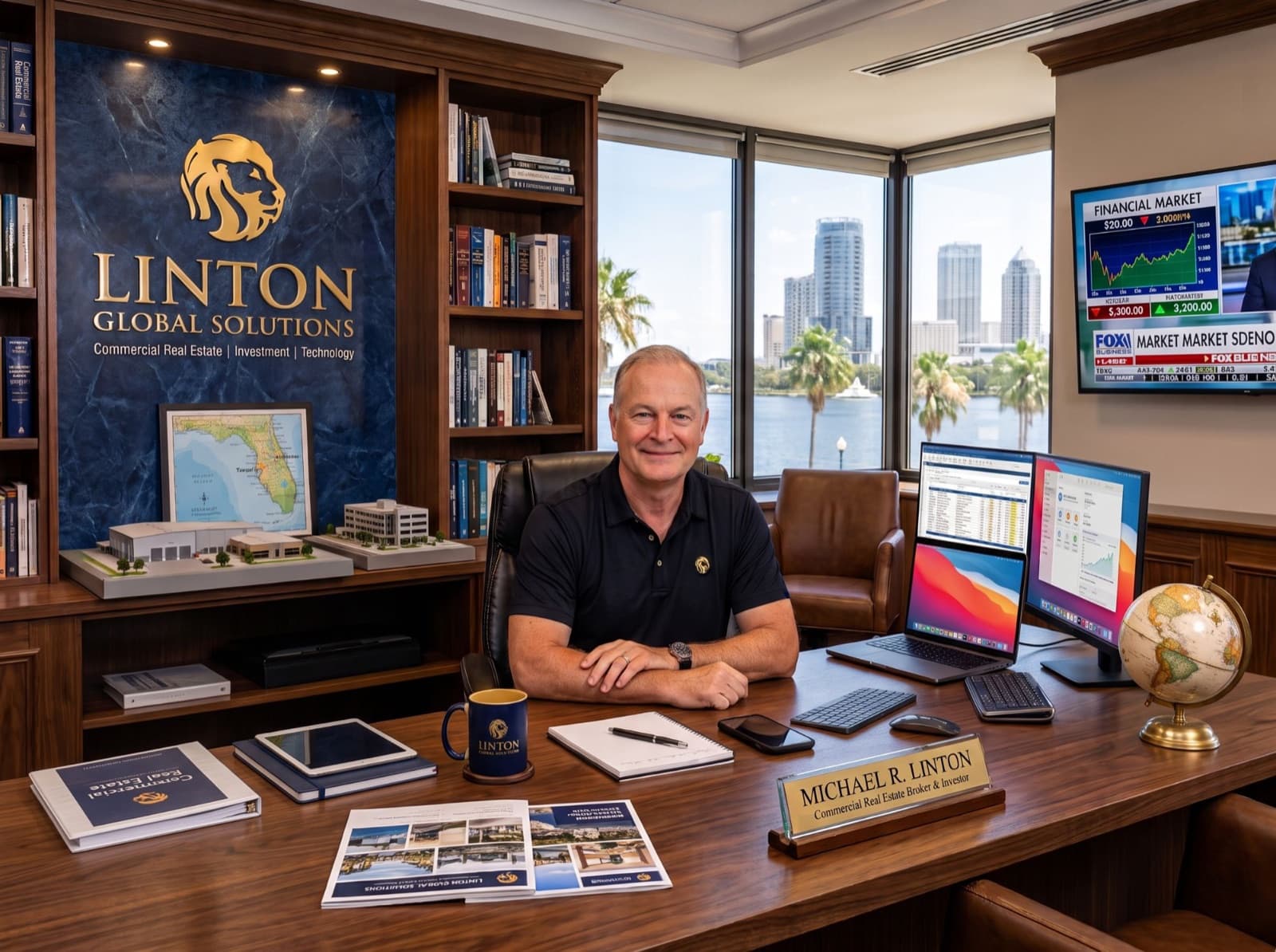
Who is Michael R. Linton? Michael R. Linton, NCREA, CREIPS, REALTOR®, is a Florida-licensed commercial real estate broker and advisor (Florida Broker #BK703722) based in the Tampa–Orlando I-4 corridor, with 39 years in commercial real estate, much of it in distressed property and bank-owned assets. He leads Linton Global Solutions and founded Linton Global Technologies, the company behind REOMind.ai and LGData. See the Florida commercial broker profile.
Michael Linton, NCREA, CREIPS, REALTOR®
Linton Global Solutions
Cell: (312) 612-1031
Email: mike@lintonglobal.com
LintonGlobal.com
Frequently Asked Questions
What is a commercial real estate map room?+
A map room is a broker’s complete picture of a territory: every target building on a map, with who owns it, what it is worth, how long they have held it and what is changing around it. The idea is best known from New York investment sales broker Bob Knakal, whose hand-drawn map covers 27,649 Manhattan properties. The LG Map Room is Linton Global Solutions’ digital version for Central Florida commercial property.
What is the LG Map Room?+
The LG Map Room is Linton Global Solutions’ digital map of Central Florida commercial buildings. It ranks every office, warehouse, light industrial, retail, shopping center, mixed-use and apartment (5+ units) property assessed between $1 million and $15 million in each market, with the owner of record, the officers behind owning companies, comparable sales, a value range, the FEMA flood zone and bank data on the lender. It covers 2,394 properties today and is expanding across Central Florida.
Which Central Florida counties does the LG Map Room cover?+
Today: Volusia County (1,437 properties, including Daytona Beach, Ormond Beach, DeLand, Port Orange and New Smyrna Beach), Marion County and Ocala (879), and 78 bank-held and pre-foreclosure commercial properties in Orange, Seminole, Osceola and Marion. Orange, Seminole, Osceola, Lake and Polk counties are loading now, covering Orlando, Lake Mary, Sanford, Kissimmee, Clermont and Lakeland.
Where does the Map Room data come from?+
Public records: county property appraiser tax rolls through the Florida Department of Revenue, Florida Division of Corporations (Sunbiz) filings for the people behind owning companies, FEMA National Flood Hazard Layer flood zones, FDIC call reports for the banks, and county clerk foreclosure auction calendars. Every figure keeps its source.
What is a later date search?+
A later date search checks the county Official Records from the owner’s vesting deed forward for anything recorded since: mortgages, assignments, liens, judgments, lis pendens, easements and satisfactions. The LG Map Room runs a preliminary version from the public index; it is a prospecting aid, not a title commitment or title insurance.
I received a letter from Linton Global Solutions about my building. Why?+
Your property is in the LG Map Room because it fits the type and size of commercial building we track in your market, and the letter offers a free, confidential valuation. There is no obligation, and owners who do not respond are not added to any sales list or CRM. To ask for a valuation or to be left alone, use the code on your letter at lintonglobalsolutions.com/property-valuation or call (312) 612-1031.
How is a digital map room different from CoStar or Reonomy?+
Data platforms sell the same database to everyone. A map room is a broker’s working territory: a smaller, ranked list in one market, checked by hand, with notes from every call, a property page for each building and a licensed broker who knows the area. The LG Map Room is built on LGData, Linton Global’s own Florida commercial property database.
Does Linton Global Solutions buy commercial properties?+
Linton Global Solutions is a licensed Florida real estate brokerage. It values properties, lists and sells them, and connects owners with qualified buyers whose buy boxes fit the building, including buyers ready to close quickly when a property is not listed with another broker.
Find out what your building is worth today
Free and confidential: nearby comparable sales, what a lender would lend, a realistic price range, and hold vs. refinance vs. sell on one page.
Works Cited
- Knakal, Bob. BobKnakal.com, bobknakal.com. Accessed 28 Oct. 2026.
- “Here's How New York Dealmaker Bob Knakal Looks to Map Out Success at His New Shop.” CoStar News, www.costar.com. Accessed 28 Oct. 2026.
- “The Real Estate Agent Mapping Out New York's Biggest Commercial Property Deals.” The Irish Times, 28 Feb. 2024, www.irishtimes.com. Accessed 28 Oct. 2026.
- Federal Emergency Management Agency. “National Flood Hazard Layer.” FEMA, www.fema.gov/flood-maps/national-flood-hazard-layer. Accessed 28 Oct. 2026.
- Federal Deposit Insurance Corporation. “BankFind Suite.” FDIC, banks.data.fdic.gov. Accessed 28 Oct. 2026.
- Florida Department of State. “Division of Corporations (Sunbiz).” dos.fl.gov/sunbiz. Accessed 28 Oct. 2026.
- Florida Department of Revenue. “Property Tax Data Portal.” floridarevenue.com/property. Accessed 28 Oct. 2026.
Disclosure: Linton Global Solutions and Linton Global Technologies are not affiliated with Bob Knakal or BKREA; references to his map room are based on published reporting. Property counts are as of October 27, 2026 and change as the county tax rolls update. This content is for informational purposes only and does not constitute investment, legal or financial advice.
Compliance Statement: Linton Global Solutions is a Florida-licensed real estate brokerage, not a lender, broker-dealer or investment adviser. Valuations described here are broker opinions, not appraisals.