
Michael R. Linton, Florida Broker #BK703722 and author of Think Like a Banker, values office, warehouse, retail and apartment buildings for owners in Ocala and Marion County through Linton Global Solutions, using the same methods a lender and an institutional buyer use.
Owners in Ocala ask me what the county says their building is worth. The better question is what a buyer's bank will lend on it, because that is the most that most buyers can pay.
The Short Answer
Your Ocala commercial building is worth what a buyer will pay for its income, and a buyer can only pay what its lender will finance. Start with net operating income from the real rent roll and the last 12 months of expenses. Divide it by a market cap rate for buildings like yours, check that against comparable Marion County sales, then test it against what a bank will lend. A 40,000-square-foot Ocala warehouse earning $300,000 a year is worth about $4.0 million at a 7.5% cap rate, and every half-point of cap rate moves that by roughly $250,000 to $300,000.
The Marion County Property Appraiser's just value is not part of that math. It is a tax number.
Why the County's Number Isn't the Price
The property appraiser's “just value” is a mass appraisal for property tax, set once a year from broad models across thousands of parcels.[1] It doesn't read your leases, your tenants' credit, your roof or the last six months of sales. On a leased commercial building it can be well above or well below what a buyer would pay. Treat it as the start of a conversation, never as a price.
The other reason it matters: Florida reassesses a commercial property at a sale. Your buyer won't underwrite your tax bill; it will underwrite taxes on its own purchase price, which can lower the NOI it pays you for.[2] Estimate the buyer's bill with the Florida property tax calculator.
Step 1: What It Earns (NOI Is Your EBITDA)
Before an investment banker markets a company, they clean up its earnings so a buyer can trust them. Do the same for your building. Net operating income is rent and other income, less vacancy and operating expenses, before debt service, depreciation and income tax. A buyer will rebuild it from:
- The rent roll: every tenant, square feet, rent, lease dates, options, and who pays what (NNN, gross or modified gross).
- Market vacancy, even if you are full today. Buyers rarely underwrite 100% occupancy.
- A trailing-12 statement of taxes, insurance, repairs, management and utilities.
- Reserves for the roof, HVAC, paving and dock equipment.
The four mistakes we see most often in Ocala owner statements: no management fee (a buyer will charge one), personal or one-time costs mixed into expenses, below-market rent to a related company, and last year's insurance premium instead of this year's quote.
Step 2: Three Lenses of Value
Bankers value companies three ways: comparable companies, precedent transactions and discounted cash flow. Commercial real estate uses the same three lenses, and a good broker opinion of value shows all of them.[3]
| Lens | How it works | When it leads |
|---|---|---|
| Income | NOI ÷ a market cap rate, or a discounted cash flow over a hold | Leased, income-producing buildings |
| Sales comparison | What similar Marion County buildings sold for, per square foot and per dollar of income | Owner-user and smaller buildings |
| Cost | Cost to build today, less depreciation, plus land | Newer and special-purpose buildings |
The result should be a range: what a well-run sale should bring, what a fast sale would bring, and what it would take to reach the top.
The Cap Rate Is a Multiple
A cap rate is NOI divided by price. Flip it and it is the price-to-earnings multiple a banker uses to value a company. A 7.5% cap rate is a 13.3× multiple of NOI.
| Cap rate | Multiple of NOI | Value of $300,000 NOI |
|---|---|---|
| 6.5% | 15.4× | $4,615,000 |
| 7.0% | 14.3× | $4,286,000 |
| 7.5% | 13.3× | $4,000,000 |
| 8.0% | 12.5× | $3,750,000 |
| 8.5% | 11.8× | $3,529,000 |
Buyers pay a lower cap rate (a higher price) for income that is more certain: long leases, strong tenants, a newer building, a deep pool of buyers. They demand a higher cap rate when the income is short, depends on one tenant, or needs a big capital project. That gives you two levers: raise the NOI, or lower the risk a buyer prices in.
Step 3: What a Bank Will Lend on Your Building
A commercial lender runs three tests and lends the lowest. Whether you refinance or sell, this is your ceiling, because your buyer's lender runs the same math.[4]
| Test | Typical requirement | Max loan on $300,000 NOI, $4.0M value |
|---|---|---|
| Debt service coverage | NOI at least 1.25× debt service | About $2.83M at 7.0%, 25-year amortization |
| Loan-to-value | 65% to 75% of appraised value | $2.6M at 65% |
| Debt yield | NOI at least 9% to 10% of the loan | $3.0M at 10% |
Here the 65% loan-to-value test binds, so the loan is about $2.6 million. At 7.0% on 25-year amortization, the loan constant is about 8.5%: every dollar borrowed costs about 8.5 cents a year. When a building's cap rate is below that, borrowing more lowers the owner's cash return, which is why so many refinances that worked in 2021 don't work today. See what a good DSCR and cap rate are in Florida for the full formula.
If you know what a lender will lend on your building, you know what most buyers can pay for it.
Worked Example: One Ocala Warehouse, Three Paths
A hypothetical 40,000-square-foot warehouse in Ocala, built in 1985, leased to two tenants at $8.50 per square foot NNN. The owner has a $900,000 loan balance.
| Gross rent | $340,000 |
| Less 5% vacancy and credit loss | ($17,000) |
| Less unrecovered costs and reserves | ($23,000) |
| Net operating income | $300,000 |
| Value at a 7.5% cap rate | $4,000,000 ($100/SF) |
| Hold | Refinance | Sell | |
|---|---|---|---|
| Cash at closing | $0 | About $1.6M: a $2.6M loan less the $900K payoff and about $100K of costs | About $2.87M before income tax: $4.0M less $200K of costs, $28K of doc stamps and the $900K payoff |
| Income after | NOI less current debt service | NOI less about $220K a year of debt service | Reinvested, or rolled into a 1031 exchange |
| Still exposed to | Lease rollover, the roof, interest rates | The same, with about three times the debt | Nothing on this building |
None of these is right for every owner. The point is to see all three on one page, with real numbers, before choosing. Florida's documentary stamp tax on a deed is 70 cents per $100 of price, which is the $28,000 above; check yours with the doc stamp calculator.[5] If you sell, a 1031 exchange can defer the gain.
The Marion County Market Behind the Numbers
As of September 2026, the Linton Global Market Map shows Marion County with about 71 million square feet of commercial buildings across 8,976 parcels, a median year built of 1986, and 418 arm's-length commercial sales on the 2026 tax roll at a median of $126 per square foot.[6] Private employment grew 2.0% in the latest year, and commercial distress runs about 2.1 events per 1,000 commercial parcels.
Two things follow for an Ocala owner. First, the county median mixes every kind of commercial building; your number comes from comparable sales of your type, size and age, and from your income. Second, a market with this much older stock and steady job growth rewards owners who can show a buyer clean income and a documented building. See the Marion County Market Map and our Ocala market update.
Three Ways to Raise the Price Before You Sell
| NOI | 7.0% cap | 7.5% cap | 8.0% cap | 8.5% cap |
|---|---|---|---|---|
| $280,000 | $4.00M | $3.73M | $3.50M | $3.29M |
| $300,000 | $4.29M | $4.00M | $3.75M | $3.53M |
| $320,000 | $4.57M | $4.27M | $4.00M | $3.76M |
- Extend a lease. Moving a tenant from one year left to five can lower the cap rate a buyer applies more than a rent increase would raise NOI.
- Document the roof and HVAC. A buyer who can't see the condition prices in the worst case.
- Fix expense leaks. Every $10,000 of NOI is worth about $133,000 of price at a 7.5% cap rate.
A half-point move in the cap rate usually moves the price more than a year of rent growth does.
From the book
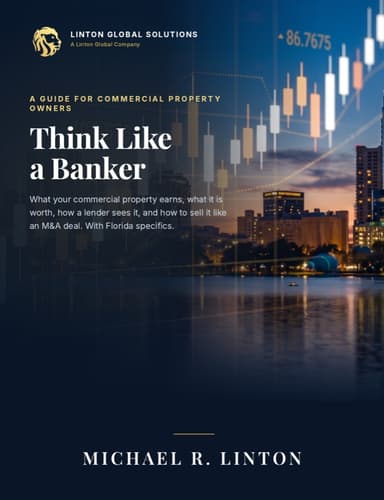
Think Like a Banker: A Guide for Commercial Property Owners
The full Ocala warehouse example, the 24-unit Ocala apartment example, how to run a sale like an M&A process, the data room every buyer asks for, Florida taxes on the way out, and a tear-out owner's checklist.
Get it on AmazonSummary and Key Takeaways
- The Marion County just value is a tax number. Your building is worth what a buyer will pay for its income.
- Start from NOI built the way a buyer will rebuild it: real rent roll, market vacancy, a management fee, reserves and this year's insurance quote.
- A cap rate is a multiple: 7.5% is 13.3× NOI. A half-point is roughly $250,000 to $300,000 on $300,000 of NOI.
- Lenders lend the lowest of DSCR, LTV and debt yield. That ceiling is also what most buyers can pay.
- Put hold, refinance and sell on one page with real numbers before choosing.
Study mode · 34 flash cards
Ocala Building Value Flash Cards
34 cards on the county’s number, NOI, the three lenses, loan sizing, the Ocala warehouse example and raising the price. Study full screen and mark what you know.
0 got it · 0 learning
All 34 flash cards as text
The county’s number
- What is the Marion County Property Appraiser’s just value?
- A mass appraisal for property tax, set once a year from broad models. It is not a sale price.
- What does the just value fail to read?
- Your leases, your tenants’ credit, your roof and recent sales.
- How should an owner use the county’s number?
- As the start of a conversation, never as a price.
- Why won’t a buyer underwrite your current tax bill?
- Florida reassesses commercial property at a sale, so the buyer underwrites taxes on its own purchase price.
What it earns
- What is NOI the real estate version of?
- A company’s EBITDA: earnings before debt service, depreciation and income tax.
- What four things will a buyer rebuild your NOI from?
- The rent roll, market vacancy, a trailing-12 expense statement, and reserves.
- You manage the building yourself and show no management fee. What will a buyer do?
- Add one. Put it in your NOI before you price the building.
- You lease space to your own company below market. How will a buyer value it?
- On the lease that exists, not the rent you could charge.
- Your statement uses last year’s insurance premium. What should it use?
- This year’s renewal quote. In Florida the difference can be large.
- You’re 100% leased. What vacancy will a buyer underwrite?
- Market vacancy. Buyers rarely underwrite 100% occupancy.
Lenses and multiples
- What are the three lenses of commercial value?
- Income, sales comparison and cost.
- Which lens leads for a leased, income-producing building?
- Income: NOI divided by a market cap rate, or a discounted cash flow.
- When does the cost approach matter most?
- For newer and special-purpose buildings.
- What should a good broker opinion of value give you?
- A range: a well-run sale, a fast sale, and what it would take to reach the top.
- What multiple of NOI is a 7.5% cap rate?
- 13.3×.
- What is $300,000 of NOI worth at 6.5% and at 8.5%?
- About $4,615,000 at 6.5% and $3,529,000 at 8.5%.
- About how much is a half-point of cap rate worth on $300,000 of NOI?
- Roughly $250,000 to $300,000 of price.
- What kind of income earns a lower cap rate?
- More certain income: long leases, strong tenants, a newer building and a deep pool of buyers.
What a bank will lend
- What three tests does a commercial lender run?
- Debt service coverage, loan-to-value and debt yield. It lends the lowest result.
- Why does the bank’s number matter even if you plan to sell?
- Your buyer’s lender runs the same math, so it sets what most buyers can pay.
- On $300,000 NOI and a $4.0M value, what do the three tests allow?
- About $2.83M on coverage (1.25× at 7%, 25 years), $2.6M at 65% LTV, and $3.0M at a 10% debt yield. The bank lends about $2.6M.
- What is the loan constant at 7.0% on 25-year amortization?
- About 8.5%: every dollar borrowed costs about 8.5 cents a year.
- A building’s cap rate is below the loan constant. What happens if the owner borrows more?
- The owner’s cash return falls. That is why many 2021 refinances don’t work today.
Hold, refinance or sell
- Describe the Ocala warehouse in the example.
- 40,000 SF, built 1985, two tenants at $8.50/SF NNN, with a $900,000 loan balance.
- What are its NOI and value?
- $300,000 of NOI; about $4.0 million ($100/SF) at a 7.5% cap.
- How much cash does refinancing free, and at what cost?
- About $1.6 million, with about $220,000 a year of debt service and roughly three times the debt.
- What does selling net before income tax?
- About $2.87 million: $4.0M less $200K of costs, $28K of doc stamps and the $900K payoff.
- How is Florida’s deed doc stamp tax figured on a $4.0M sale?
- 70 cents per $100 of price: $28,000.
- How can a seller defer the gain on the sale?
- With a 1031 exchange into a replacement property.
- What is the point of laying out hold, refinance and sell together?
- To compare all three with real numbers before choosing. None is right for every owner.
Raising the price
- Why can extending a lease beat a rent increase?
- Moving a tenant from one year left to five can lower the cap rate a buyer applies more than the rent raises NOI.
- Why document the roof and HVAC before selling?
- A buyer who can’t see the condition prices in the worst case.
- What is $10,000 of extra NOI worth at a 7.5% cap?
- About $133,000 of price.
- What usually moves price more: a half-point of cap rate, or a year of rent growth?
- A half-point of cap rate.
About Michael R. Linton
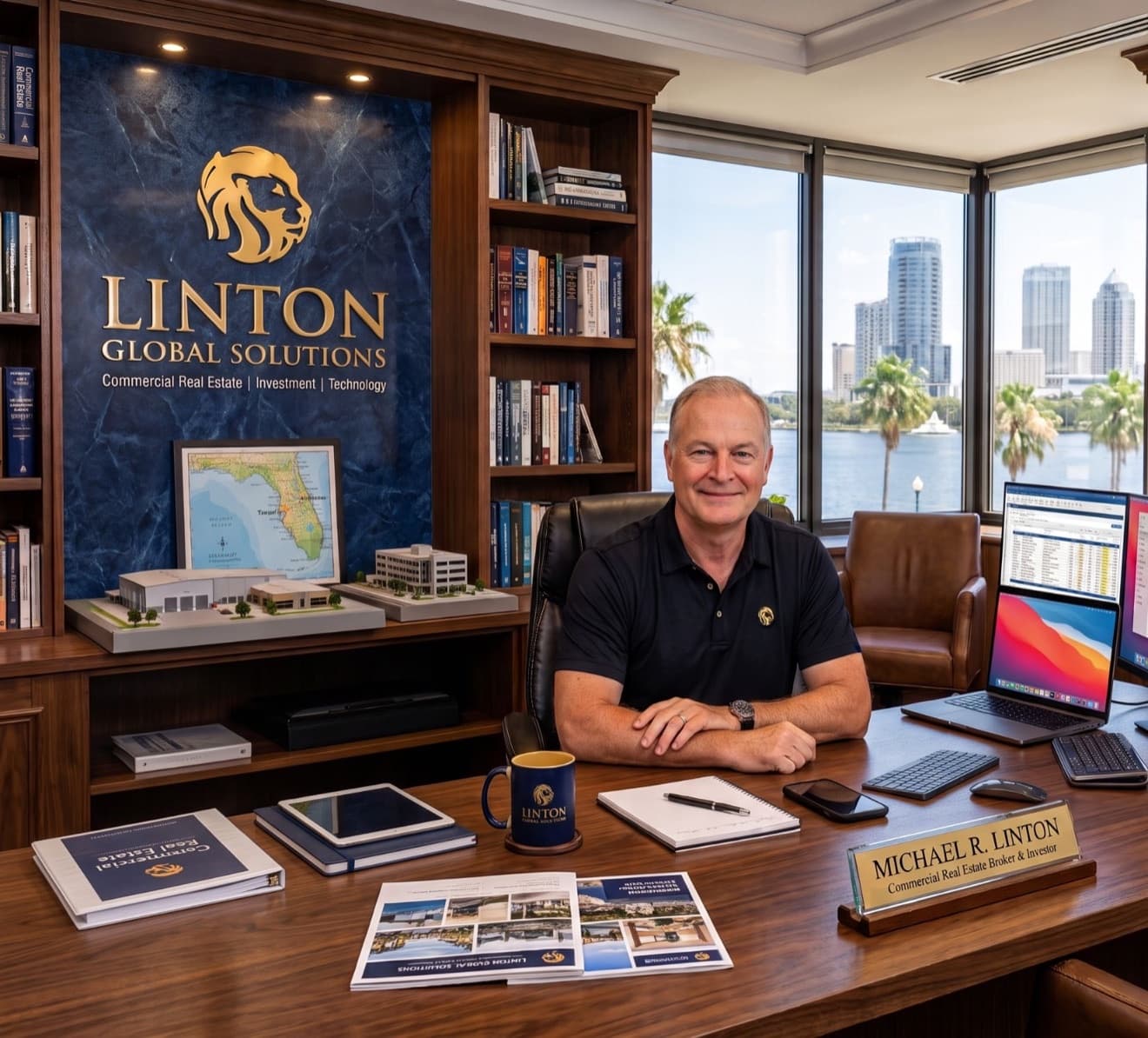
Who is Michael R. Linton? Michael R. Linton is a Florida-licensed commercial real estate broker and advisor based in the Tampa–Orlando I-4 corridor, serving owners, investors and tenants across Florida, including Ocala and Marion County. He is the author of Think Like a Banker, leads Linton Global Solutions and HireMikeLinton.com, and founded Linton Global Technologies, which builds the REOMind.ai platform.
Why choose Linton Global Solutions? Because the building is underwritten before it is marketed. Every valuation starts with lender-grade NOI and a loan-sizing test, so owners price to what buyers can actually finance. That discipline, along with 39 years of closings, is why owners call Mike first. Read more about his Florida brokerage practice.