Michael R. Linton, Florida Broker #BK703722, advises multifamily, industrial, retail and office investors on cap rates, DSCR loan sizing and refinances in Orlando, Tampa and the I-4 corridor via Linton Global Solutions.
Most Florida deals don't die on price. They die when the buyer finds out the loan is smaller than they assumed. Check the DSCR before you write the offer, with real Florida insurance and taxes in the NOI, and you'll know what the deal is worth to a lender, not just to the seller.
The Short Answer
A good DSCR for a Florida commercial loan is 1.25x or higher. Most banks and CMBS lenders treat 1.25x as the floor, agency multifamily lenders go to about 1.20x, and riskier property types such as hotels and office need 1.35x to 1.50x or more.[2][3] A good cap rate depends on the asset class: stabilized Florida multifamily and industrial trade roughly in the 5% to 6.75% range, retail in the 6% to 7% range, and suburban office and hotels above 7.5%.[1]
The more useful test is how the two numbers relate. If a property's cap rate is lower than your loan constant (the annual payment as a percentage of the loan), the deal will not reach 1.25x DSCR without a large down payment. Cap rate tells you what you're paying for the income. DSCR tells you how much of that price a lender will finance.
What Is a Good DSCR?
Debt service coverage ratio (DSCR) is net operating income divided by annual debt service. A 1.25x DSCR means the property earns $1.25 for every $1.00 of mortgage payments, leaving a 25% cushion for vacancy, repairs or a bad insurance renewal. Lenders size the loan to that cushion, so DSCR, more than price, decides how much you can borrow.
- Below 1.00x: the property doesn't cover its own mortgage. Only bridge or hard-money lenders will consider it, and only with a credible plan to raise NOI.
- 1.00x to 1.19x: thin. Usually needs a lower loan amount, a guarantor with outside income, or a bridge loan.
- 1.20x to 1.34x: the bankable range for most stabilized multifamily, industrial and retail.
- 1.35x and up: strong. Expect better pricing and terms, and it's often required for office, hotels and self storage.
Lenders calculate DSCR on their NOI, not the broker's. They add a vacancy factor, a management fee and replacement reserves even when the seller's statement shows none, and in Florida they re-underwrite insurance and property taxes at the new owner's cost. The OCC Comptroller's Handbook on commercial real estate lending describes this approach to repayment capacity, and the Fannie Mae Multifamily Selling and Servicing Guide sets the coverage tests for agency multifamily loans.
What Is a Good Cap Rate?
Capitalization rate is NOI divided by price. A $5 million building with $325,000 of NOI trades at a 6.5% cap. A lower cap rate means a higher price for each dollar of income, usually because buyers see less risk or more growth. A higher cap rate means a cheaper price, usually because of shorter leases, older buildings, weaker locations or less available financing.
A “good” cap rate is one that fits your plan. A stabilized Orlando apartment building at a 5.25% cap can be a good buy for a long-term holder with low leverage. The same cap rate is a poor buy for an investor who needs 70% financing, because the income won't support that loan. National surveys such as the CBRE Cap Rate Survey track the ranges by market; CBRE's late-2025 survey put stabilized infill Orlando multifamily at roughly 4.75% to 5.75%.[1]
How DSCR and Cap Rate Connect
One formula ties the two together:
The coverage formula
DSCR = Cap Rate ÷ (LTV × Loan Constant)
The loan constant is the annual payment divided by the loan amount. At a 6.75% rate on 30-year amortization it is about 7.78%; on 25-year amortization it is about 8.29%. Rearranged, the formula tells you the most a lender can lend: maximum LTV = cap rate ÷ (required DSCR × loan constant).
That is what the chart above shows. At today's rates, a 6.0% cap deal supports only about 62% loan-to-value at 1.25x DSCR, even if the lender's policy allows 75%. The income, not the policy, limits the loan. Buying at a cap rate below the loan constant is called negative leverage: each borrowed dollar costs more than the property earns on it, so borrowing more lowers your cash-on-cash return instead of raising it.
Florida Benchmarks by Asset Class
The table shows the ranges we see when underwriting stabilized Florida deals in Orlando, Tampa and along the I-4 corridor. They move with interest rates and vary by submarket, building age and tenant quality, so check current sales comparables and a lender quote before relying on them.
| Asset class | Typical cap rate | Typical min DSCR | What moves it |
|---|---|---|---|
| Multifamily (stabilized) | 5.0% – 6.0% | 1.20x – 1.25x | Agency and bank debt; insurance and taxes drive most misses |
| Industrial / flex | 5.5% – 6.75% | 1.25x | Short lease terms on small-bay push lenders toward the higher DSCR |
| Neighborhood retail | 6.25% – 7.25% | 1.25x – 1.30x | Grocery anchor and lease rollover set the rate |
| Medical office | 6.0% – 7.0% | 1.25x – 1.35x | Health-system tenants price closer to industrial |
| Suburban office | 7.5% – 9.5%+ | 1.35x – 1.50x | Many lenders also require a 10%+ debt yield |
| Hospitality | 7.5% – 9.5% | 1.40x – 1.60x | Underwritten on trailing 12-month NOI, not pro forma |
| Self storage | 5.75% – 6.75% | 1.30x – 1.40x | Lease-up and rate-management history matter |
| Land | No cap rate | No DSCR | No income to cover debt; sized on value and equity |
Ranges are Linton Global Solutions underwriting observations for stabilized Florida assets, informed by national cap rate surveys and lender term sheets. Mixed-use and special-purpose properties are underwritten by their dominant income stream; life sciences space trades closest to industrial and medical office.
Worked Florida Example: A 40-Unit Orlando Apartment Deal
A buyer is offered a 40-unit apartment building in Orlando for $6,000,000. The seller's NOI is $360,000, a 6.0% cap rate. The buyer wants a 65% loan ($3,900,000) at 6.75% on 30-year amortization.
- Debt service: $3,900,000 × 7.78% = about $303,500 a year.
- DSCR on the seller's NOI: $360,000 ÷ $303,500 = 1.19x. Below a 1.25x requirement.
- Maximum loan at 1.25x: $360,000 ÷ 1.25 = $288,000 of allowable debt service, or about $3,700,000 of loan (62% LTV). The buyer needs about $200,000 more equity.
- Florida insurance check: the lender re-quotes wind coverage and adds $40,000 a year. NOI drops to $320,000, DSCR to 1.05x, and the maximum loan to about $3,290,000 (55% LTV). The equity gap is now about $610,000.
Outcome: at the seller's price, the deal needs either about $610,000 more cash or a price near $5,330,000, which is a 6.0% cap on the lender's $320,000 NOI. The buyer used the insurance quote to renegotiate. Run this test before the letter of intent, not after the appraisal.
In Florida, the insurance quote is part of the price. One wind-coverage quote can cut six figures off what a lender will lend. Get a real quote during the first week of due diligence and put it in the NOI before you agree to anything.
Florida Factors That Move DSCR and Cap Rates
Property insurance
Windstorm and flood premiums are the biggest swing in Florida NOI. Coastal Tampa Bay and Volusia properties carry far higher premiums than inland Polk or Lake County deals. The Florida Office of Insurance Regulation publishes market data on commercial insurers; use a current quote, never the seller's old policy.[4]
Property tax reassessment
Florida reassesses commercial property toward the sale price after a purchase. A building bought for well above its assessed value will see a higher tax bill the next year, so lenders underwrite taxes on the purchase price.[7] The Florida property tax calculator estimates the new bill.
Loan program
SBA 504 loans for owner-occupied buildings work with lower coverage ratios than most investor loans (see the SBA's 504 program page).[5] Bridge loans may lend at 1.00x or less on today's income if the business plan shows a path to a permanent loan. The program changes the target, so match the deal to the right lender before you price it.
Debt yield
Many CMBS and bank lenders now test debt yield (NOI ÷ loan amount) alongside DSCR, often requiring 8% to 10%.[6] Debt yield ignores interest rate and amortization, so it limits loans on low-cap-rate deals even when the rate is attractive. Check it with the debt yield calculator.
Five-Step Checklist Before You Make an Offer
- Rebuild NOI the way a lender will: market vacancy, a management fee, reserves, a current insurance quote and taxes reassessed on your price.
- Calculate the cap rate on that NOI, not the seller's.
- Find your loan constant from a real rate quote and amortization.
- Solve for maximum LTV at the lender's DSCR and debt yield, and compare it with the loan you planned.
- Close the gap with price, equity or a different loan program before you sign the letter of intent.
The Linton Global Deal Analyzer runs these steps in one screen, and Linton LenderMatch matches the deal with lenders whose coverage requirements fit it. For the full owner's view of how lenders underwrite, read Think Like a Banker: A Guide for Commercial Property Owners.
Summary and Key Takeaways
- A good DSCR for most Florida commercial loans is 1.25x or higher; agency multifamily allows about 1.20x, and hotels and office need 1.35x to 1.50x.
- Good cap rates vary by asset class: about 5% to 6.75% for stabilized multifamily and industrial, 6% to 7% for retail, and 7.5% or more for office and hotels.
- DSCR = cap rate ÷ (LTV × loan constant). When the cap rate is below the loan constant, leverage hurts returns and the loan shrinks.
- Florida insurance and tax reassessment are the most common reasons a deal's DSCR falls short, so stress them before the offer.
Study mode · 39 flash cards
DSCR and Cap Rate Flash Cards
39 cards on DSCR, cap rates, the loan constant, Florida benchmarks and the Orlando example. Study full screen and mark what you know.
0 got it · 0 learning
About Michael R. Linton
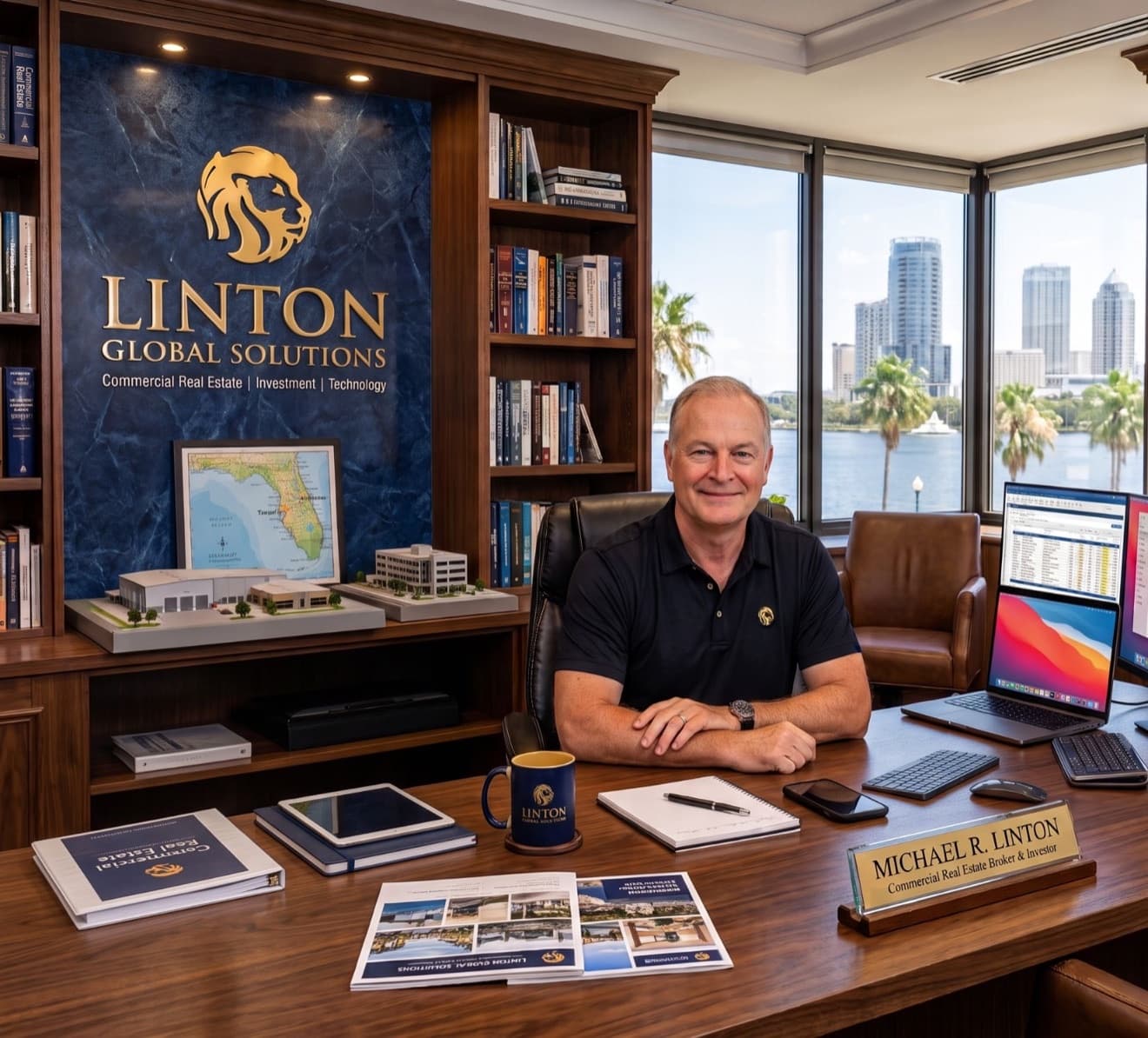
Who is Michael R. Linton? Michael R. Linton is a Florida-licensed commercial real estate broker and advisor based in the Tampa–Orlando I-4 corridor, serving investors, owners and tenants across Florida, with expertise across multifamily, office, industrial, retail, hospitality, land, mixed-use, special-purpose, self storage and life sciences. He leads Linton Global Solutions and HireMikeLinton.com, works with a team of agents who specialize by asset class, and founded Linton Global Technologies, which builds the REOMind.ai platform.
Why choose Linton Global Solutions? Because the deal is underwritten before it is marketed. Every listing and acquisition starts with lender-grade NOI, a DSCR test and a financing plan, so buyers know the loan before they commit and sellers price to what the market can finance. That service-first discipline, along with 39 years of closings, is why owners and investors call Mike first. Read more about his Florida brokerage practice.
Cap rate is the market's opinion. DSCR is the lender's. A good Florida deal has to satisfy both, and my job is to show you where they meet before you spend a dollar on due diligence.